The .300 H&H: King before the magnums
It’s hardly surprising that the various .300 Magnums are some of the most popular hunting cartridges on the market today. Although the ballistics of the individual .300 Magnum cartridges may differ slightly, they all shoot the heavier .308 bullets. This implies bullets weighing 180gr or more at velocities that allow a hunter to connect with quarry at extended distances with enough energy left over to ensure adequate penetration. In short, then, the .300 Magnums are hard-hitting and versatile cartridges suited for a wide variety of game animals.
To the best of my knowledge, the first ‘hot’ .308 cartridge, implying a .308 cartridge that could better the muzzle velocity of the .30-06 Springfield at the time, was the now-doomed .30 Newton. The .30 Newton was introduced in 1913 and bettered the .30-06’s muzzle velocity by 150fps. Although factory ammunition in .30 Newton was available for a few years, the cartridge was a thing of the past by the late 1920s.
In 1925, however, a new contender stepped into the ring: the Holland & Holland .30 Super, or, as it subsequently became known, the .300 Holland & Holland Magnum (.300 H&H for short). As the name suggests, the new .300 was introduced by the British firm of Holland & Holland, based in London, and it featured impressive ballistics for the time. It was a development from that firm’s existing .375 Holland & Holland Magnum cartridge, today one of the most popular cartridges of all time. Like the .375 H&H, the .300 H&H has a belted case designed for use in bolt-action rifles based around the excellent M98 Mauser action.
Holland & Holland was (and is) a boutique gun and rifle maker, and the result was that rifles in .300 H&H were initially expensive, one-off custom rifles for individual clients. In the US, however, makers such as Griffin & Howe in New York City and the Hoffman Arms Co from Cleveland, Ohio, started chambering rifles for the .300 H&H almost from the get-go. The Western Cartridge Co helped matters further along when they started offering factory ammunition for the .300 H&H almost right from the start as well.
Notwithstanding the .300 H&H’s early foothold in the US, 1935 was the year in which the cartridge really took off in that country. The prestigious (marksmanship) Wimbledon Cup Match of 1935 was won by Ben Comfort, shooting a rifle in .300 H&H custom-made for him by Griffin & Howe on a 1917 Enfield action. The American shooting public took note, and just two years later, Winchester chambered their Model 70 in .300 and .375 H&H. The .300 H&H was finally on a secure footing with affordable factory rifles and ammunition available.
In London, meanwhile, Holland & Holland wasn’t standing by idly while others were cashing in on one of their inventions. A rimmed version of the .300 H&H called the Super .30 Magnum Flanged was introduced. The rimmed .300, introduced a year after the belted rimless version, was intended for use in single-shot and double rifles. Also to keep chamber pressure down to ensure reliable extraction from double rifles, with muzzle velocity reduced by a 100fps compared to the rimless .300 H&H.
I’ve seen a handful of original Holland & Holland Royal double rifles in .300 H&H Flanged, and they were superb. One stands out in particular. It was ordered by an Indian Maharaj in the 1930s. It came inside in an oak-and-leather case and was fitted with a vintage Zeiss scope. The stock was of stunning French walnut and featured characteristic Holland & Holland-style bold scroll engraving with the Maharajah’s crest in gold on the sideplates of the action. The rifle is one that many can only dream of owning.
The .300 H&H remained popular for many years after World War Two, and makers such as FN, Remington, and others made rifles in .300 H&H. In 1944, the more powerful .300 Weatherby Magnum joined the stable as well, and it remains a popular cartridge in the Weatherby line-up to this day. By the 1960s, however, first cold winds started blowing for the .300 H&H. In 1960, Norma introduced their .308 Norma Magnum. The new hot .300’s case was shorter than the .300 H&H’s long, sloping case but had increased case capacity and hence slightly improved ballistics. In addition, it could be housed in an action with a shorter bolt-throw. Strike One.
Strikes Two and Three occurred in 1963. In this year, Winchester not only changed the design of their excellent Model 70 action to an easier-to-produce push-feed design, but also introduced the .300 Winchester Magnum. Despite criticism of its relatively short neck, the .300 Winchester Magnum became the most popular .300 Magnum cartridge of them all, and it has remained on that perch ever since. Like the .308 Norma Magnum, the .300 Winchester can be housed in an action with a shorter bolt-throw than what is needed for the .300 H&H. Because it is such a popular cartridge, it has benefitted from up-to-date ballistic developments in terms of propellants and bullets. The .300 H&H, on the other hand, was put on life support by rifle and ammunition manufacturers, liked and adored only by those who owned and used one.
Despite newer cartridges and factory ammunition getting ever scarcer and more limited in bullet choice, the .300 H&H stayed alive. Holland & Holland received a modest but steady stream of orders for rifles in .300 H&H over the years and a quick look at the company’s website shows several of their rifles in .300 H&H being offered for sale. Custom rifle builders also made rifles in .300 H&H for customers who wanted a rifle chambered for the Holland round. Meanwhile, second-hand factory rifles in .300 H&H, notably those made by Winchester before 1964, became sought-after by collectors and hunters alike, a trend that is still in full swing.
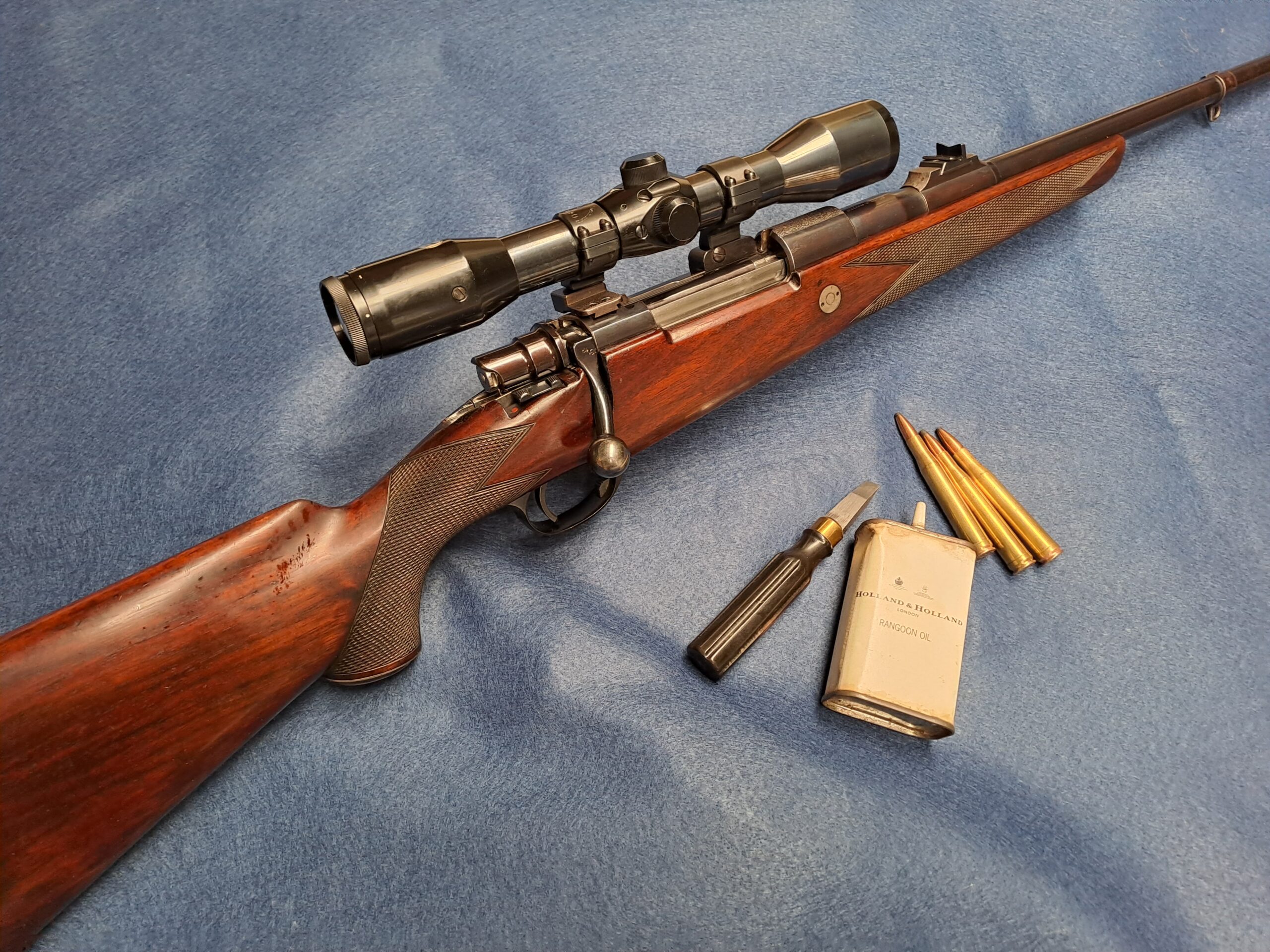
Just recently, a good friend acquired a rifle in .300 H&H that is not only a fine example of gunmaking but proof positive that the .300 H&H’s appeal is lasting with many. To put the history of this particular rifle in perspective, it is necessary to wind the clock back for a few years.

The British gunmaking firm of J Roberts & Co was established in 1953 by Joseph Roberts, with premises in London. J Roberts & Co started out as a gunshop but eventually gravitated towards gunsmithing and the manufacture of complete guns. In 1959, Joseph’s son Paul joined the business and the firm’s name changed to J Roberts & Son. Throughout the 1960s and 70s, Joseph and Paul Roberts bought up a great many fine guns and rifles in India and retailed them in the UK and elsewhere.
In addition to dealing in fine guns and rifles, Paul Roberts became a respected gunsmith himself and was also a keen hunter. He hunted in Africa regularly and enjoyed fine British rifles for his big-game hunting. When he was approached by a friend in the late 1970s on guidance for a plains game rifle for an upcoming African safari, Paul’s advice was to the point. He accompanied his friend to the Holland & Holland premises where he ordered a rifle from them in .300 H&H calibre. Paul joined his friend on the African hunt and, along with a heavy-calibre Rigby double rifle, the new .300 H&H was used on many of the African species.
Fast-forward a few decades, and with the .300 H&H’s owner ageing, and not using the rifle regularly, his rifle was sold through none other than an older Paul Roberts in 2023, and my friend here in Australia therefore became the owner of a lovely used .300 H&H.
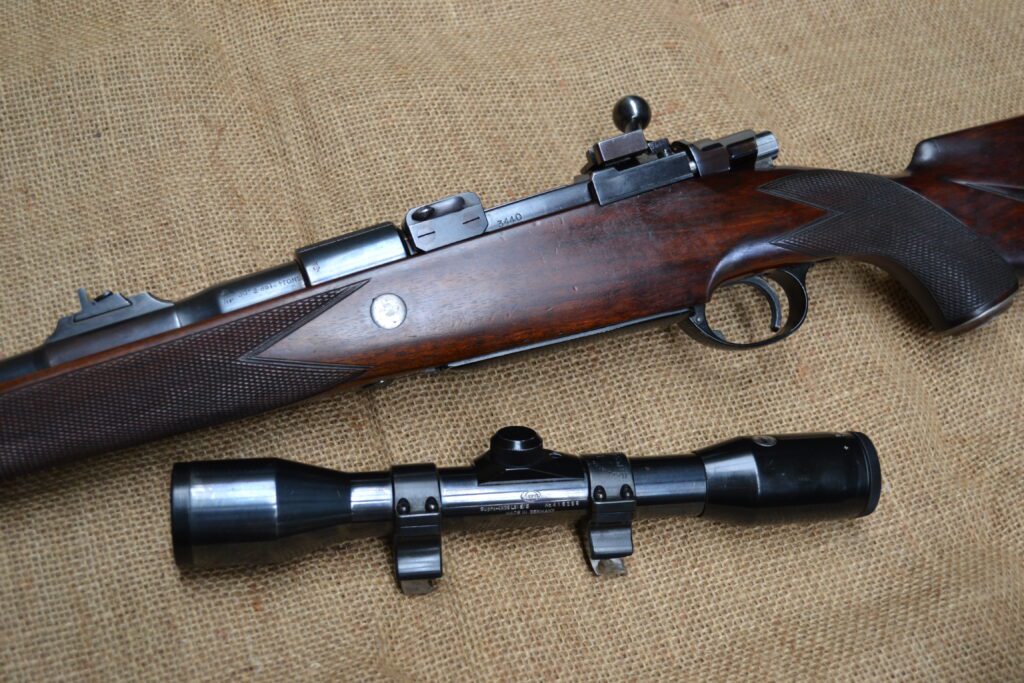
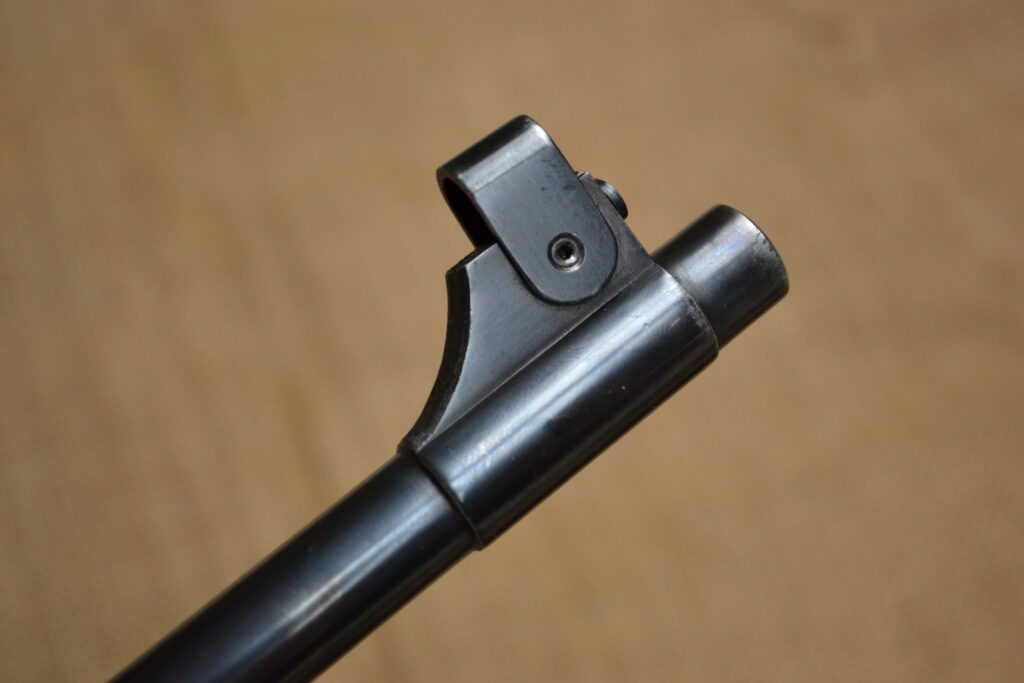
If we look at the rifle itself, it’s made on a commercial FN Supreme M98 action. The barrel is 24″ in length and features open sights in the classic Holland & Holland pattern consisting of the folding-leaf, wide-V backsight and the front sight mounted on a barrel band with folding sight protector. The rifle was clearly made for hunting as it is noticeably light for a .300 Magnum at just over 3kg without the scope. The barrel profile is as slim as I’ve seen on a .300 Magnum and the barrel has a circumference of a mere 15mm at the muzzle – a full 4mm less that my lightweight Sako AV .30-06.
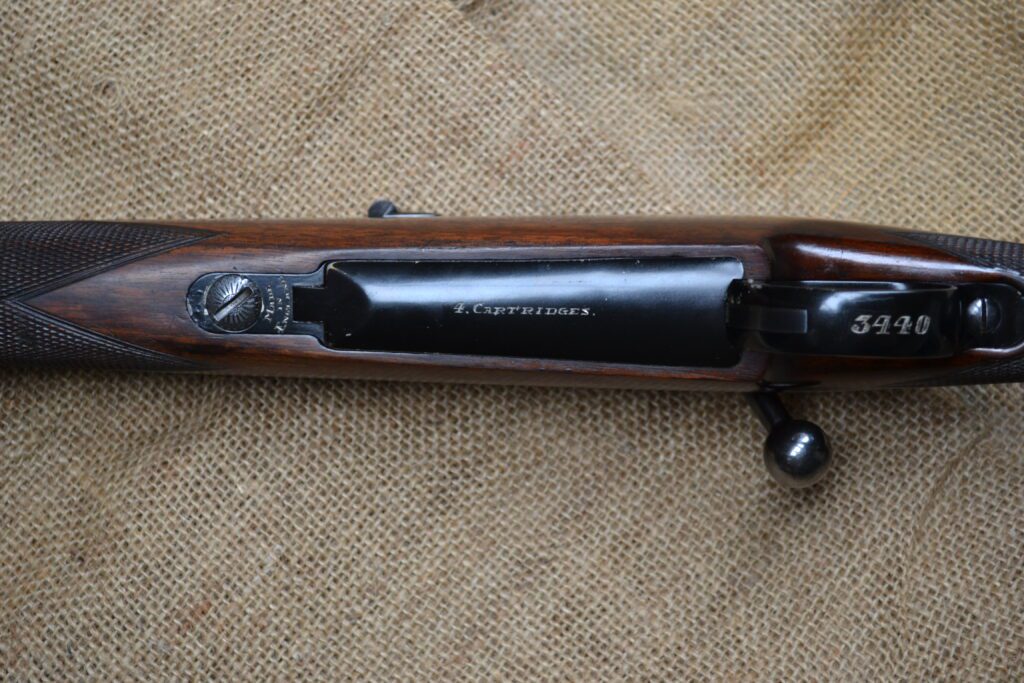
During the 1960s and 70s, Holland & Holland used trigger guard/magazine box assemblies made from aluminium on many of their bolt-action rifles. The aluminium was painted black and, in some instances, even engraved. Why they went this route I have no idea, but this era wasn’t the best time for the British gun trade. It could have been a cost-cutting measure (machining a similar trigger guard/magazine box assemble from solid steel is expensive) or a case of having to make do with what was available. It’s the one aspect about this rifle that grates me somewhat, but considering the rifle’s excellent overall condition, it’s a small trade-off.
In another throwback to 1970s rifle fashion, the stock features a somewhat subdued Monte Carlo cheekpiece in place of the traditional Holland & Holland-style shadowline cheekpiece, coupled with a classic straight stock. The Monte Carlo comb was carved with a healthy dose of British understatement, however, and in addition to fitting me very well, it looks elegant, so no complaints from me.
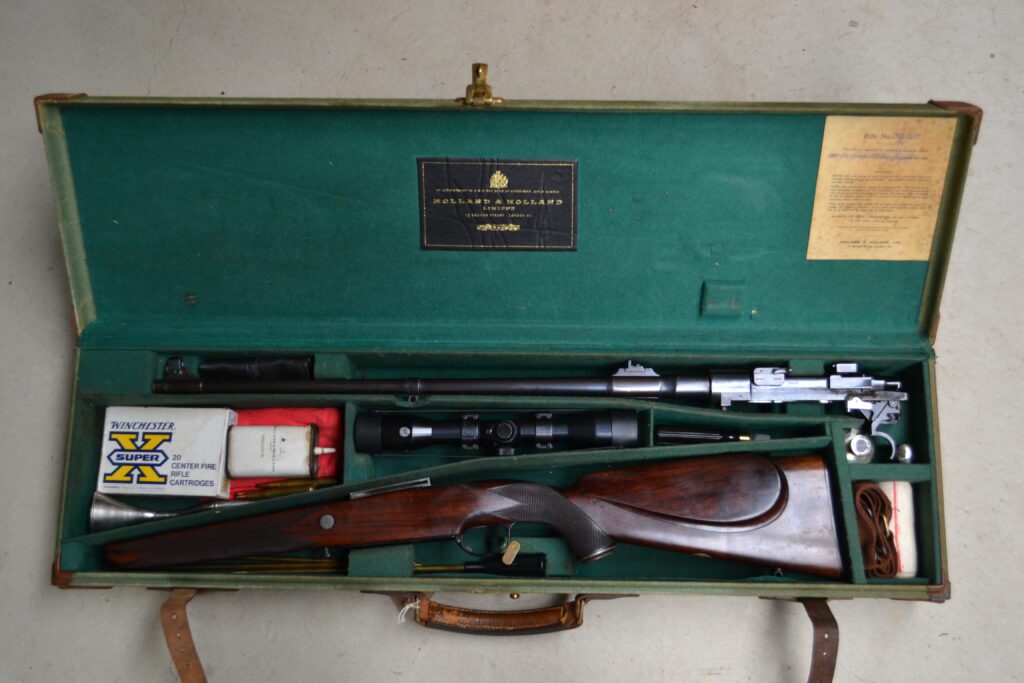
Another appealing feature of the Holland & Holland is the fact that the rifle is a take-down model. With the Holland & Holland take-down system, the barrelled action is removed from the stock altogether, simply using a tuppenny coin (supplied in the case), loosening the front guard screw and unhooking the barrelled action from a notch milled into the tang of the action. Compared to other take-down systems used by British gunmakers over the years, whereby the barrel is unscrewed from the action, this system is preferable. When disassembled, the rifle and all the other bits such as the cleaning rod, water funnel, turnscrew (not a ‘screwdriver’ in British gunmaking terminology), and everything else that was supplied along with the rifle when it was ordered, fits neatly into a canvas case.
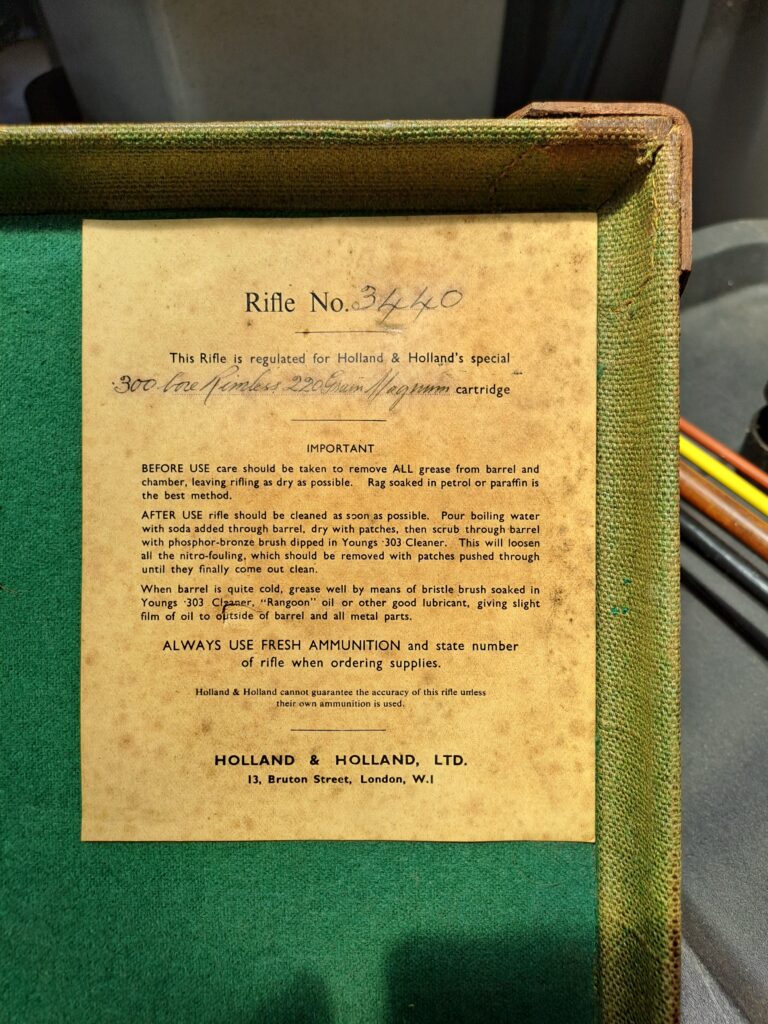
A label on the inside of the lid of the case notes that the rifle’s open sights were regulated for ammunition loaded with 220gr bullets. In a nice touch, the rifle was supplied with another front sight in the trapdoor grip cap regulated for the 180gr load and numbered to the rifle. As the rifle is fitted with a 4×36 Nickel Supra scope, it’s doubtful if the open iron sights have ever been used, but they are there if needed. The rifle uses Holland & Holland’s traditional quick-detachable scope mounts. It is one of the best take-down systems out there and is certainly a practical and stylish (if expensive) addition to any rifle.
The figure of the wood used is not overly ostentatious but the characteristic red tint of the stock is evidence of the alkanet root-infused boiled linseed oil that was used during the finishing process. Alkanet root (Alkanna tinctoria) is a plant native to the Mediterranean region. The roots are dried, ground up, and added to boiled linseed oil which is then applied to gunstocks during the finishing process. The alkanet root infuses the oil with a deep red colour, and this infused oil was a standard ingredient in the English gun trade for many years for adding colour to gunstocks during the finishing process.
The rifle’s overall condition is exceptionally good, and it has clearly not seen a lot of use over the years. The styling, especially the stock, may be slightly unusual for a rifle by a British maker, but it reflects the era during which the rifle was crafted and is a part of riflemaking history. I sent a few pictures of the .300 H&H rifle to a friend in South Africa who is also a keen collector. His reaction was that the rifle was a very functional and good-looking piece of 1970s “kitsch” that he wouldn’t mind owning! Knowing the rifle’s current owner, it will certainly see use in the game fields of Africa again sooner rather than later. Not bad for 1970s kitsch!
Share this article

Related
Articles

Related
Recipes
Sorry, no related items found.