

How animals see camouflage
I have been obsessed with camo since I was a youngster. To the point that, for a high school art project I made a camo t-shirt. Initially I dyed the shirt brown using onion skins as a base colour. Then I tie-dyed it with a light khaki derived from green vegetables before I embossed the shirt with brown prints from a bracken fern.
The sense of accomplishment I had from making it myself, then busting bunnies while wearing it, gave me a real incentive to strive for more.
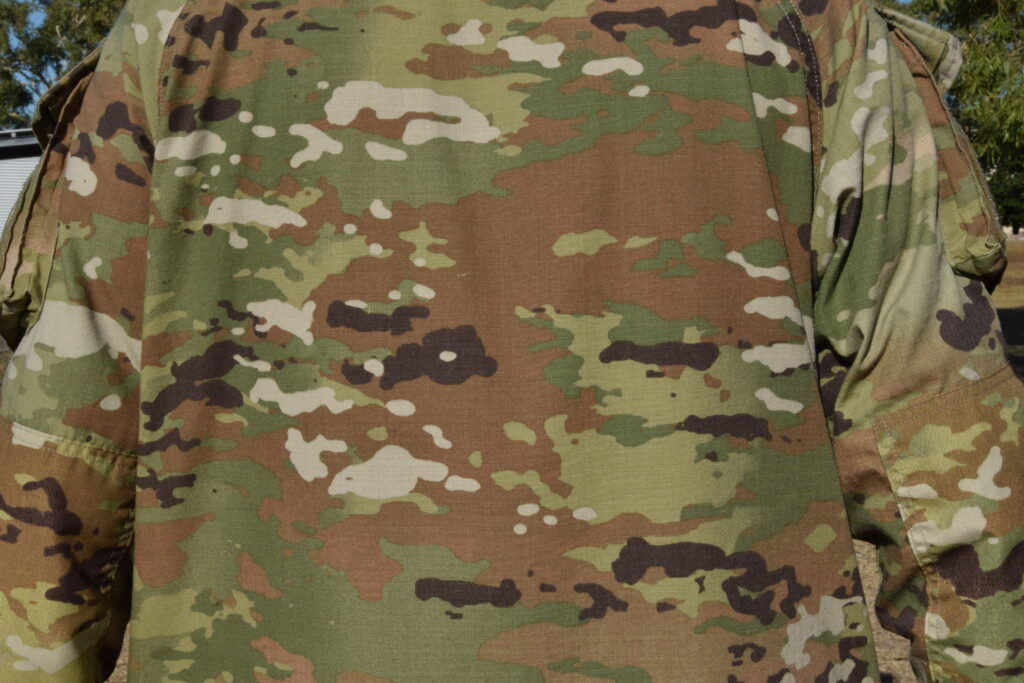
Now, as a 28-year Army veteran, I’m still playing around with different camo patterns and colours for hunting. While my old Army issued cams may work well during warfare, they don’t function as effectively as you would think for hunting.
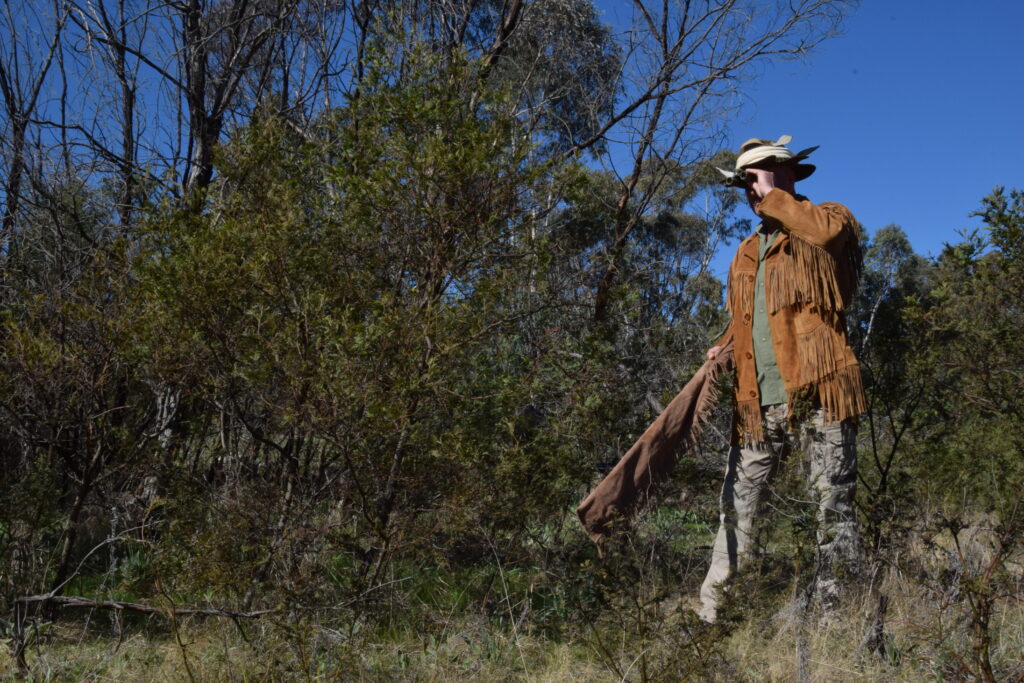
And it doesn’t take long in the field to know there’s a problem. Many times, I’ve been on Army patrols wearing Auscam trying to be a quiet as possible – only to have birds call out with their predator alarm. A few incidents like this and a curious mind starts wondering…
I’m a scientist, so I know that birds are tetrachromats – they see four colours. These are ultraviolet (UV), blue, green and red. By contrast, humans are trichromats and can only see three colours: blue, green and red. Interestingly, humans see different wavelengths of blue, green and red than do our feathered friends. And the capacity to see UV is something that humans simply don’t have.
Oxford Dictionary definition
Camouflage: n. 1 a the disguising of military vehicles, aircraft, ships, artillery, and installations by painting them or covering them to make them blend with their surroundings. b such a disguise. 2 the natural colouring of an animal which enables it to blend in with its surroundings. 3 a misleading or evasive precaution or expedient. v.t.r hide or disguise by means of camouflage [F f. camoufler disguise f.It. camuffare disguise, deceive]
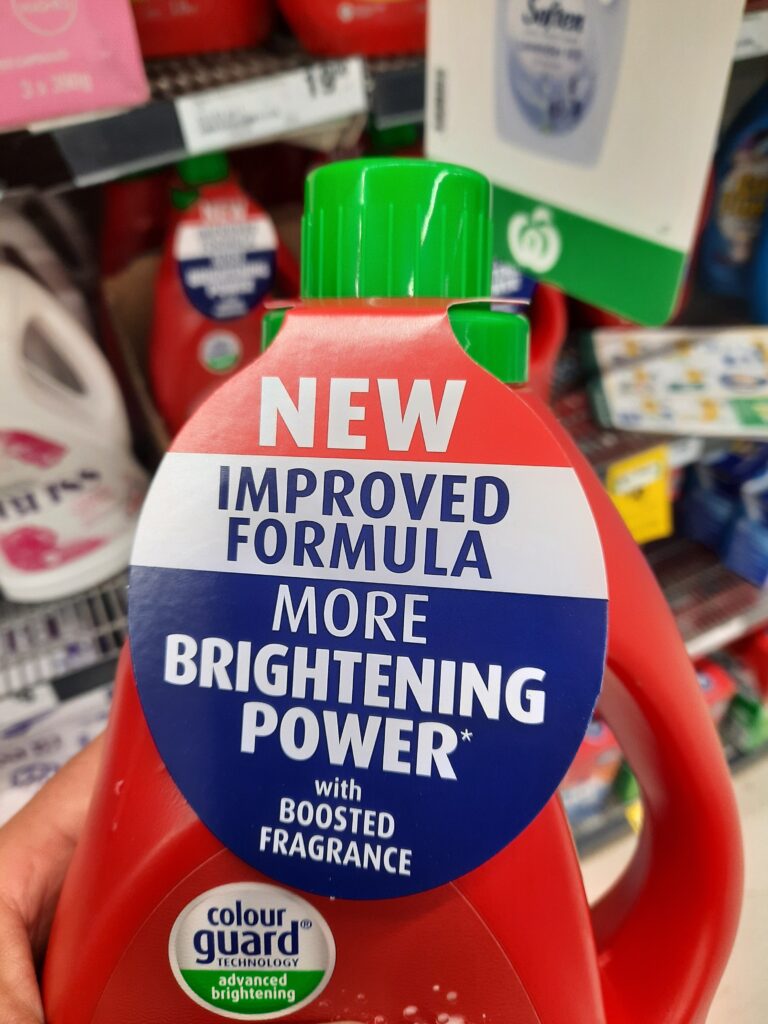
Knowing this, I started to speculate about what makes humans so obvious to birds. I considered whether it was the additives in my laundry detergent. Did the products that touted ‘whiter than white’ results have UV brighteners in their chemistry that the birds were responding to? It didn’t seem to be the case with my Disruptive Pattern Camouflage Uniform (DPCU).
I would change laundry detergents numerous times, and wash in cold water, but it didn’t seem to make a blind bit of difference. The birds still sang out. So, if it wasn’t the detergent that was to blame with my DPCU, then maybe it was the chemicals in the dye or the fabric of my clothes that were making me obvious…
I clearly looked scary enough that they were happy to alert all their buddies and any other animal within earshot. Then again, perhaps the problem was more basic. After all, I’ve been 6ft 3″ (190.5cm) since I was a teen and I’m a biped with two forward facing eyes. So, I fit all the indicators of a predator. It was time to do some further research.
Glow in the dark
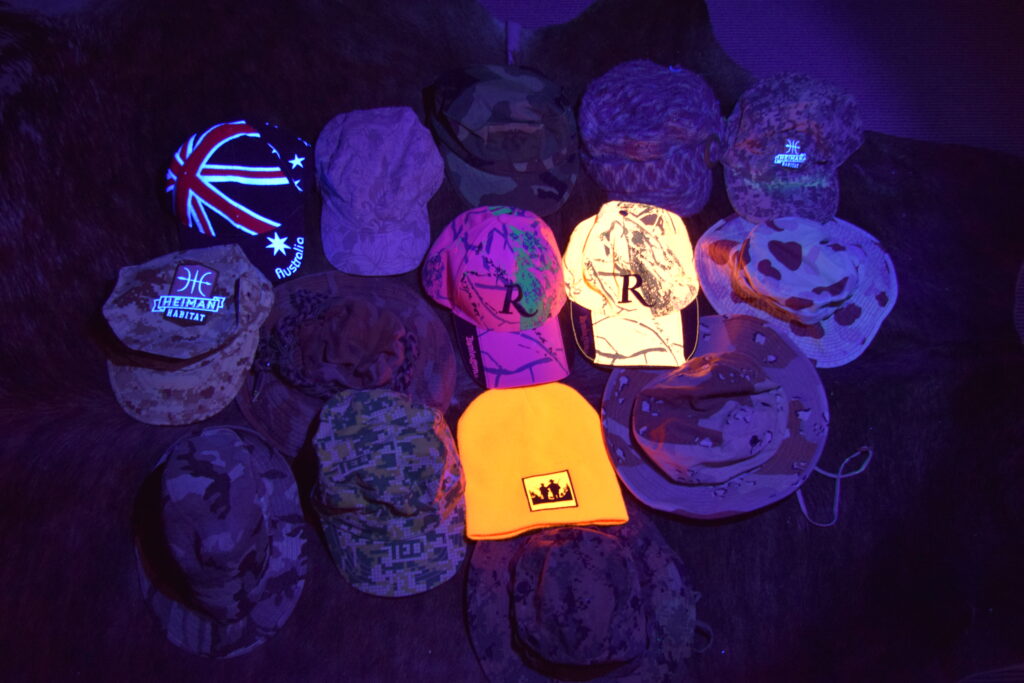
So, let’s look at the issue of ultraviolet. A 2014 paper published in Proceedings of the Royal Society B recorded the results of a study conducted into 38 different mammals; the purpose being to determine if they could see UV light and its reflections.
The paper’s conclusions indicated that it’s not just birds that can see UV light. Indeed, most mammals can – including dogs, cats and deer. Unlike humans, these mammals have lenses that allow UV light to pass though. While they don’t have a specialised UV-sensitive photoreceptor cone in their retina, the other three kinds of colour receptors combine to make up for it. This finding came as a surprise to some contemporary vision specialists.
Interesting too are recent results from European studies in Sweden and Hungary that suggest dogs have an infrared sensor in the tip of their nose. These sensors enable them to detect minute changes in temperature, such as when other animals are nearby. So, it’s not only snakes, bats, frogs and blood-sucking insects that have infrared perception. Some mammals have this ability too.
If our quarry can see UV (or near UV), and some also have an infrared sensory capability, what does this tell us about what we need to be wearing when we hunt? What we need for hunting and sun protection is loosely woven material that is thick and made from natural, not synthetic, fabrics. Items made from vinyl, plastic or metal can alert animals because they reflect light. Think of the shine from a blued gun barrel or a bow limb. It’s not the colour of the barrel/limb that alerts the game, but rather the geometric symmetry of its silhouette and the UV and IR light it reflects. Head out in vegetable-dyed hemp and you start increasing your odds of a successful hunt.
Colour blind
When thinking about how to conceal ourselves from game, it pays to consider what colours they can actually see. When we hunt animals like deer, many of us know to wear blaze orange to make ourselves obvious to other humans, while not alerting the game to our position.
It all comes down to rods and cones, and we’re not talking about fishing or ice creams! Photoreceptors within the eye are classified into two groups: rods which have a high sensitivity to light and detect motion; and cones which have a low sensitivity to light and are responsible for colour vision/perception.

Deer are crepuscular animals which are primarily active during twilight (ie, dusk and dawn). Rats, rabbits, pigs, cats, dogs and some farm animals are also more comfortable in low light. These kinds of animals all have more rods and less cones than we do. In fact, they have so few cones that they have dichromatic colour perception, meaning they can only discern two of the three primary colours.
What animals like these lack in cones, they compensate for with more rods in order to see better in lowlight. The presence in their eyes of cones that are sensitive to two types of wavelengths within the blue and darker green frequencies leads us to believe that such animals have a certain capacity for colour perception. But they experience a type of red-green colour blindness termed deuteranopia and as such they may not ‘see’ colours as we do.
For example, studies of the anatomy of a deer’s eye indicate that light green, orange and red appear to them as shades of grey. So, wearing camo in the red-through-brown-through-light-green continuum is essentially a waste of time, unless your clothing has clear lines of contrast to enhance different grey tones. If not, you need to focus on breaking up your outline and applying other tenets of field craft. But remember, deer sense colours towards the violet end of the light spectrum. So, this means they can see middle green wavelengths through to short blue wavelengths and they also perceive UV light.
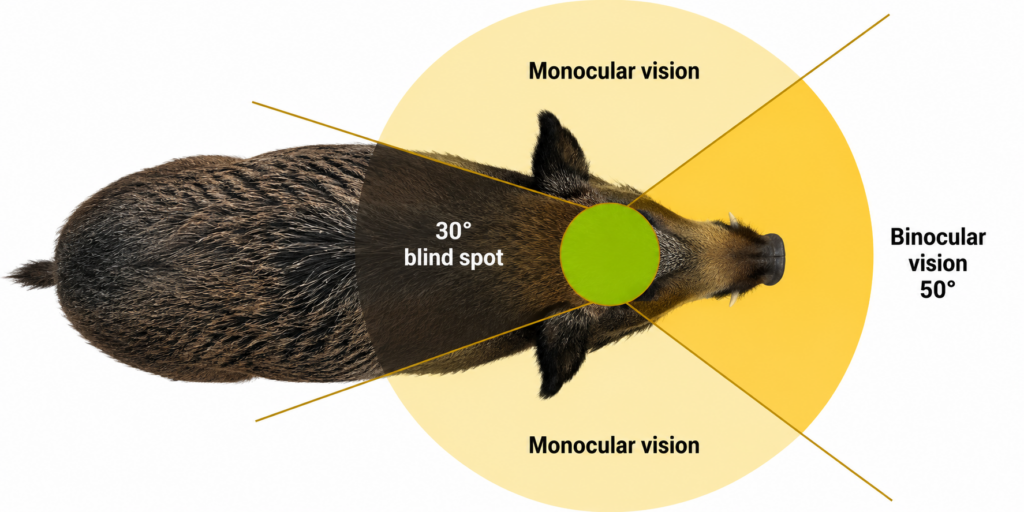
It’s important to understand what colours our quarry see. It’s also helpful to know ‘how’ they perceive colours. For example, a human eye can perceive contrasts between colours because of the inhibiting effects of stimulated receptors in the retina on their neighbouring nerve cells. By contrast, in a pig’s eye this inhibitory effect is much weaker so that boundaries between light and dark areas blur into each other.
The same phenomenon affects colour sensitivity. Where humans see sharp boundaries between two contrasting colour fields, pigs perceive the whole spectrum of hues leading from one field into the other. This is what we call spectral vision. The result is that pigs tend to see solid objects merely as flat planes of single colours if the hues are too closely related. Unless colour fields form a sharp contrasting borderline of two distinctive colours, the pig cannot perceive a difference. For example, the soft blurring and gradation of the colours in a rainbow makes it invisible for the pig’s vision.
On the other hand, goats can perceive light in the blue/violet spectrum as well as the green to yellow/orange spectrum. Out of all the colours that goats can see, they are able to distinguish the colour orange best while they are the worst at distinguishing the colour blue. So tan, green and brown camo, matched to the local fauna, will work best when stalking goats in temperate zones. Here, blaze orange sticks out like a sore thumb. By contrast, orange blends in well out West with the red sand and ochre bluffs.
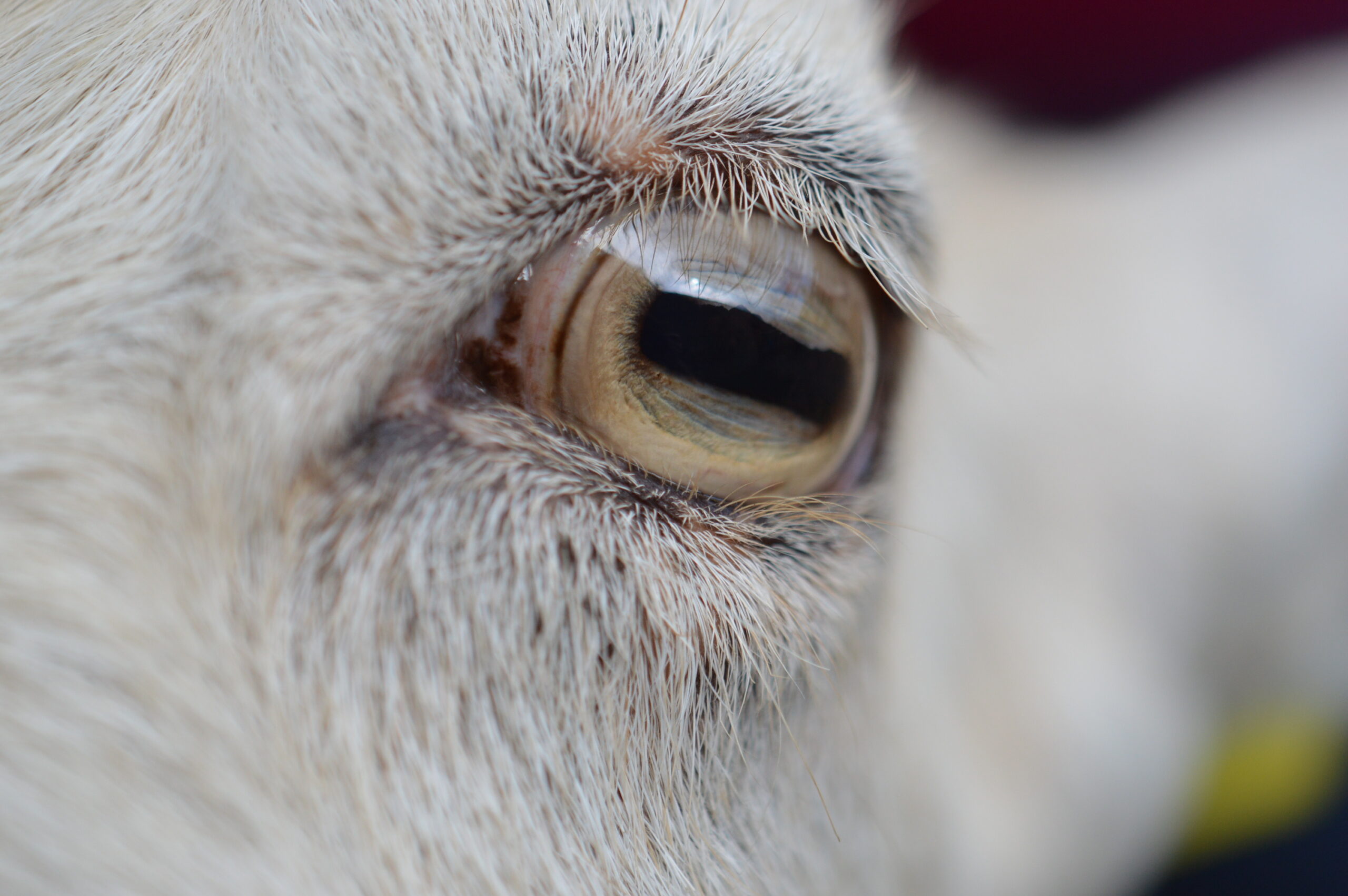
While goats can’t see in the UV spectrum, they’re still able to see in the twilight better than humans, thanks to the design of their eye pupils. We have round pupils whereas the pupils in a goat’s eyes are horizontal and shaped like a rectangle. Much as our pupils dilate to allow more light in, the same applies to goats – but more effectively.
Conversely, in the day, the pupils shrink, creating a slit, much like a polarising lens. This helps goats to avoid being blinded by the sun during the brightest part of the day. The takeaway message for this is that it’s best to hunt goats around mid-morning and mid-afternoon so they don’t have the visual advantage.
Humans and many other animals do not look at a scene in a state of fixed steadiness. Instead, our eyes move around, unconsciously, locating interesting parts of the scene and building up a mental, three-dimensional ‘map’ corresponding to the scene.
This so-called saccade eye movement helps us to acquire, fix and track visual stimuli. In particular, by moving the eye so that small parts of a scene can be sensed with greater resolution, the brain calculates the distance to multiple objects. Combine our game’s acute peripheral vision and field of vison with its saccadic eye movements and I’m sure you’ll appreciate why it can be difficult to close the distance between hunter and prey.
Camo conclusion
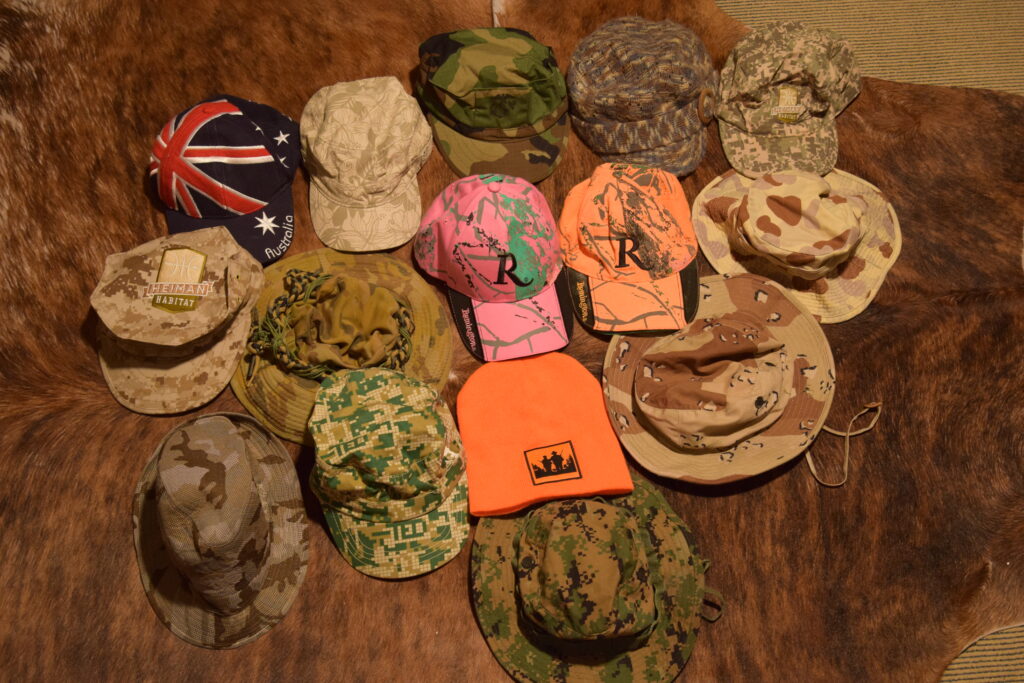
During the past couple of decades, there’s been a tremendous increase in the number and variety of camo patterns and materials available to hunters. This has occurred despite the paucity of scientific knowledge about what game animals ‘actually’ see.
So, is the camo we buy useful? After all, most camo is designed and advertised in glossy photos on how well it blends into the surrounds. But all this really tells us is that the clothing is designed to fool HUMANS.
When we’re hunting, there’s no question that scent and movement are far more determinative of success than the colour of our clothing. And any camouflage pattern or combination of clothing and equipment that has bold, contrasting colours (like tan vs. green hues) and breaks up your outline will help conceal your location.
However, paying heed to the other relevant elements of true camouflage will never go astray. That is: ‘know your enemy’ and adapt your clothing and equipment to suit the season, weather and terrain. Importantly, acknowledge the differences between prey species and why things are seen.
Share this article

 Website
 Facebook
Related
Articles



It’s a dog-eat-pig world: Hunting wild dogs over a pig carcass
Related
Recipes
Sorry, no related items found.