

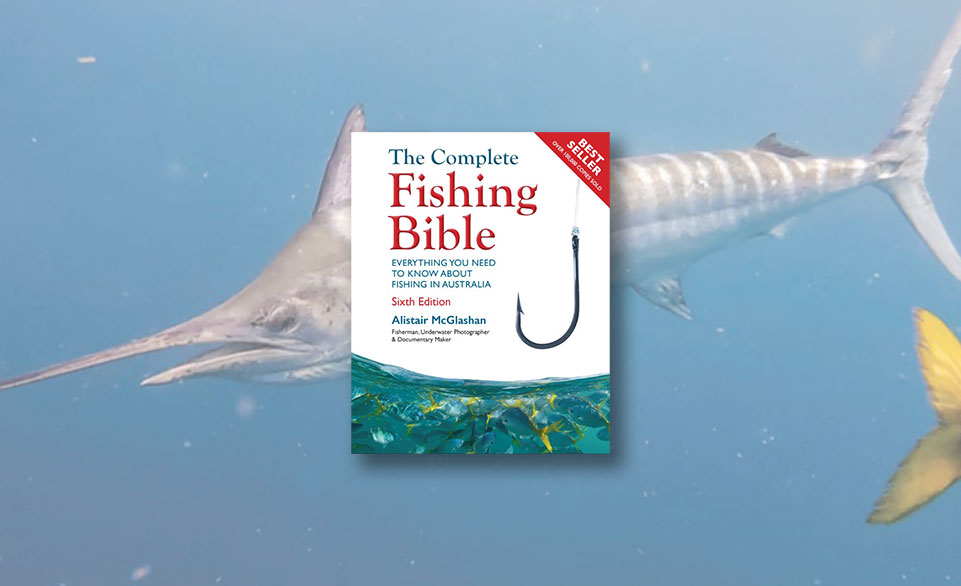
The Complete Fishing Bible – Sixth Edition
Calling a book The Complete Fishing Bible sets a fairly high bar. Add the subtitle Everything You Need to Know About Fishing in Australia and there is really nowhere to hide.
Fortunately, Alistair McGlashan has given himself 528 pages to make his case.
Now in its sixth edition, this substantial hardback is an extraordinarily broad journey through Australian fishing. Tackle, rigs, knots, species, techniques, boats, electronics, destinations, fish care and cooking are all covered, but even that list barely scratches the surface.

First published in 2007, The Complete Fishing Bible has endured because fishing itself never stands still. Tackle and technology improve, techniques are refined, new opportunities emerge and even experienced anglers continue to learn. McGlashan has described this latest edition as a complete revamp, bringing the book up to date with current equipment, methods, fishing locations and knowledge, along with hundreds of new photographs.
And photographs are one of its great strengths.
There are hundreds upon hundreds of glossy images throughout, ranging from beautifully captured fish and fishing locations to action on the water and underwater photography. They make it an impressive book simply to browse, while diagrams, illustrations and photographs are used wherever they can explain something more clearly than words alone.


That approach becomes obvious almost immediately in the ‘Tackle’ section. Readers are taken through rods, reels and terminal tackle before progressing into rigs and knots. Numerous arrangements are illustrated for estuary, saltwater, beach and rock, game and freshwater fishing, with concise explanations of how they work and the situations or species they suit.
The progression ranges from simple unweighted and free-running rigs to paternosters, float rigs, live-bait arrangements, trolling set-ups and specialist applications such as shark fishing. Knot tying receives similar treatment, with clear diagrams covering a selection of useful knots and practical advice on tying and maintaining them.


It is a good example of McGlashan’s broader approach. Start with useful fundamentals, understand why something works and then adapt and refine it as your experience grows.
The ‘Fish Species’ section is similarly practical. Rather than merely identifying fish, entries combine photography with information on where particular species occur, when they are best targeted, suitable fishing techniques and eating qualities. Coverage ranges through estuary and coastal fish, inshore and deepwater species, baitfish, tropical fish, pelagics, sharks and rays and freshwater species.

Naturally, no 528-page book can catalogue every fish found in Australian waters. Instead, McGlashan has selected an angler-focused cross-section ranging from highly sought-after sportfish and familiar table species to some lesser-known inhabitants.
From there, the scope expands considerably.
‘Saltwater Techniques’ takes in estuary fishing, tides, boat and bank fishing, live baiting, stalking the flats, lure fishing, rock and beach fishing, bottom bouncing, soft plastics, trolling, targeting surface-feeding pelagics, using sounders and more.

‘Fly Fishing’ has its own section, as does ‘Sport Fishing’, where subjects include offshore trolling, tuna, jigging, bluewater live baiting, cubing and daytime swordfishing. ‘Freshwater Techniques’ moves through streamcraft, lure fishing in lakes and impoundments and even paddle-powered and back-country canoe fishing.
Then comes ‘Boating and Fishing Techniques’ and the practical business surrounding the fishing itself.
Sounders, downrigging, night fishing, fighting fish, family fishing, choosing and setting up a boat, towing, handling heavy weather and crossing bars are among the subjects covered. There is also information on catching a feed, looking after the catch and cleaning it properly.
Advice on bleeding and icing fish is accompanied by photographs demonstrating how to fillet a catch efficiently and minimise wasted meat. ‘Al and Audi’s Family Recipes’ then takes the process to its logical conclusion, providing ideas for putting some of that catch to good use at home.
Australia’s extraordinary variety of fishing helps explain why the book can range so widely.
At one extreme an angler might chase powerful bluefin tuna in the Southern Ocean, while at the other they could stalk trout with a fly in a high-country stream. Fishing might mean a beach, rock ledge, wharf, creek, river, impoundment, estuary, billabong or a run far offshore.
A dedicated ‘Australia’s Hot Spots’ section reflects that diversity, taking readers from Sydney Harbour and South West Rocks to Lake Glenbawn, Lake Eucumbene, Port Phillip Bay, Western Port Bay, Tasmania’s Central Highlands, Broome, Corroboree Billabong and Cairns and the Great Barrier Reef.


Given the book’s breadth, the detailed contents and index make it easy to find a particular subject when needed, while a glossary provides a useful guide to fishing terminology.
That ability to work on several levels is one of the book’s biggest strengths.
McGlashan writes in his introduction that fishing is something you can never completely master and can always improve at. That philosophy suits the book perfectly. A newcomer can build knowledge from the ground up, someone with a few years behind them can fine-tune techniques or tackle unfamiliar subjects, while a seasoned angler can use it as a reference or explore another branch of fishing.
And McGlashan brings considerable credibility to the task.

Better known simply as Al, he has spent more than three decades fishing, filming and photographing Australia’s waterways. His work has appeared across magazines, newspapers and international fishing publications, while his television career has included ‘Big Fish Small Boats’ and ‘Fish’n With Mates’. He is also known for the documentary ‘Life On The Line: The Story of the Southern Bluefin Tuna’.
His underwater photography has become a particularly recognisable part of his work, so it is fitting that imagery plays such an important role in this book.


McGlashan describes The Complete Fishing Bible as the biggest undertaking of all the books he has written. His acknowledgements also make clear that his wife Audi played a pivotal role in producing this edition, including through her imagery and involvement in capturing their fishing life on camera.
Fishing legend Rex Hunt provides the foreword, and his endorsement goes beyond McGlashan’s ability to catch fish. Hunt highlights his knack for communicating fishing clearly, particularly to newcomers, while still providing plenty for seasoned anglers. He also points to McGlashan’s respect for the environment and his belief that the future of Australian angling is in good hands.
For McGlashan, fishing is not solely about putting a fish in the boat. Family, time outdoors, learning, respecting the environment and passing knowledge to another generation all matter.
That should resonate particularly well with Australian Hunter readers.
There has always been plenty of crossover between hunting and fishing. Both reward understanding the environment, choosing suitable equipment, developing practical skills and continually refining technique. Both can take us into spectacular Australian country, and for many people both ultimately include the satisfaction of responsibly sourcing food for the family table.


That makes The Complete Fishing Bible appealing well beyond someone who identifies first and foremost as a keen angler. Australian hunters, campers, travellers and outdoors-minded men and women will find plenty within its pages that feels familiar, along with an enormous amount that may encourage them to pick up a rod and explore another side of the outdoors.
The subtitle promises Everything You Need to Know About Fishing in Australia. Taken absolutely literally, no single publication could ever contain every piece of knowledge associated with a pastime this broad and constantly evolving.
McGlashan has nevertheless had a remarkably serious crack at it.
From rigs and knots to sharks, freshwater streams to bluewater sport fishing, choosing a boat to cleaning a catch, and beginner fundamentals through to specialist techniques, the depth and variety are impressive.

Add the hundreds of photographs, instructional diagrams, Australian destinations and the accumulated knowledge of a lifetime spent fishing, and this becomes far more than another how-to book.
It is a guide, reference point, learning curve, fine-tuning tool and photographic celebration of Australian fishing all rolled into one – and the sort of book you can return to for years.
The Complete Fishing Bible – Sixth Edition
Everything You Need to Know About Fishing in Australia
Alistair McGlashan
New Holland Publishers
528 pages
Hardback
RRP $59.99
Available from all good bookstores or online through New Holland Publishers.
Share this article
 Website
 Instagram
 Facebook
Related
Articles


A Top End trifecta: Buffalo, barra and boars

Related
Recipes