

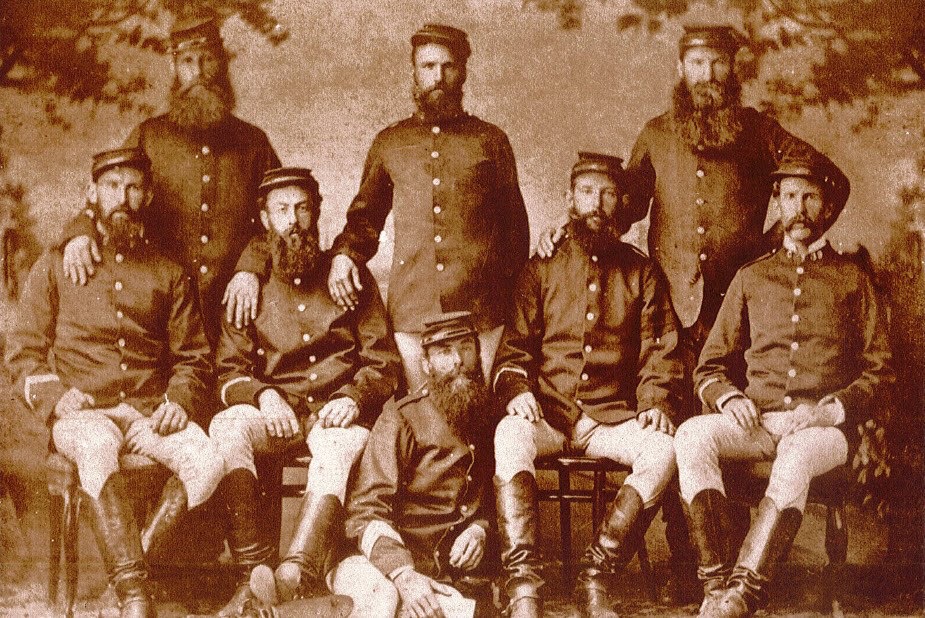
Police firearms of the bushranger era
It was a hard life for colonial policemen in the goldrush and bushranger era. They faced their lawless adversaries armed only with a single-shot pistol. Bushrangers were often armed with a six-shot revolver and more than one firearm.
The classic example of a gun battle with protagonists armed with these firearms took place at Fogg’s shanty near Bigga in New South Wales on July 16, 1861. William Fogg was harbouring notorious bushranger Frank Gardiner, when two troopers rode up. Sergeant John Middleton entered the building first, with his single-shot Tower percussion pistol. He noticed a man duck into a back room and as he followed, a shot was fired at him.
Middleton then re-entered the room and both men fired. The sergeant’s shot missed but Gardiner’s shot caught Middleton in the mouth, causing a ghastly wound. Middleton attempted to reload but Gardiner fired again, wounding the policeman’s hand and leg. Middleton staggered out into the yard as Constable William Hosie came up and entered the building. Again, both men fired. Hosie’s shot wounded Gardiner near the mouth, while the bushranger’s shot struck Hosie in the head, knocking him to the ground.
Gardiner now came at Middleton when on the ground, ready to club the policeman with his revolver. Middleton prepared to defend himself with a hammer-headed riding crop, just as Trooper Hosie re-entered the fray. Middleton hammered Gardiner with the riding crop while Hosie wrestled the revolver from his hand. Fogg called to the troopers to cease the violence and Gardiner was subdued and handcuffed.
It was discovered that Gardiner had one shot left in his revolver, which was probably a six-shot 1851 model Colt Navy percussion revolver of .36 calibre. The policemen were armed with the regulation English Tower single-shot percussion muzzle-loading pistol, either the 1853 .65 calibre model or the 1843 .577 calibre model. These resembled the classic ‘pirate pistol’.
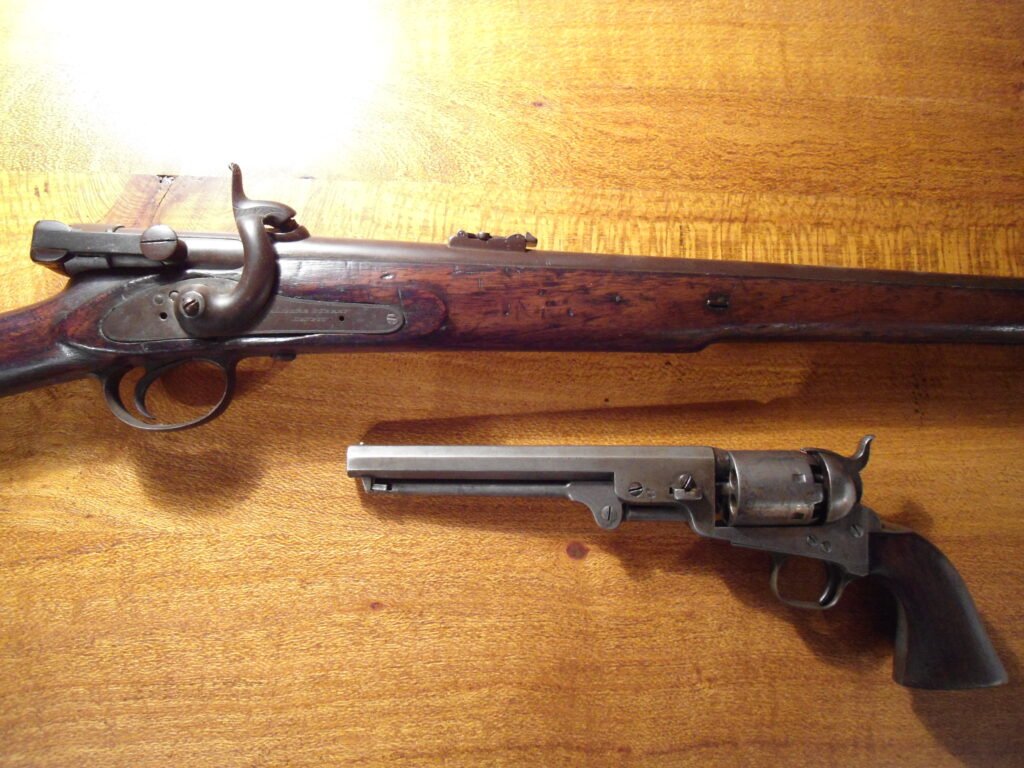
The police force had not long to wait before they were also better armed. On March 1, 1862 the NSW Government passed the Police Regulation Act which set the structure of the police force as it exists today. Other colonies followed soon after. The force was now better organised, uniformed, mounted and armed. Police were issued with the 1851 Colt Navy .36 calibre single-action six-shot percussion revolver.
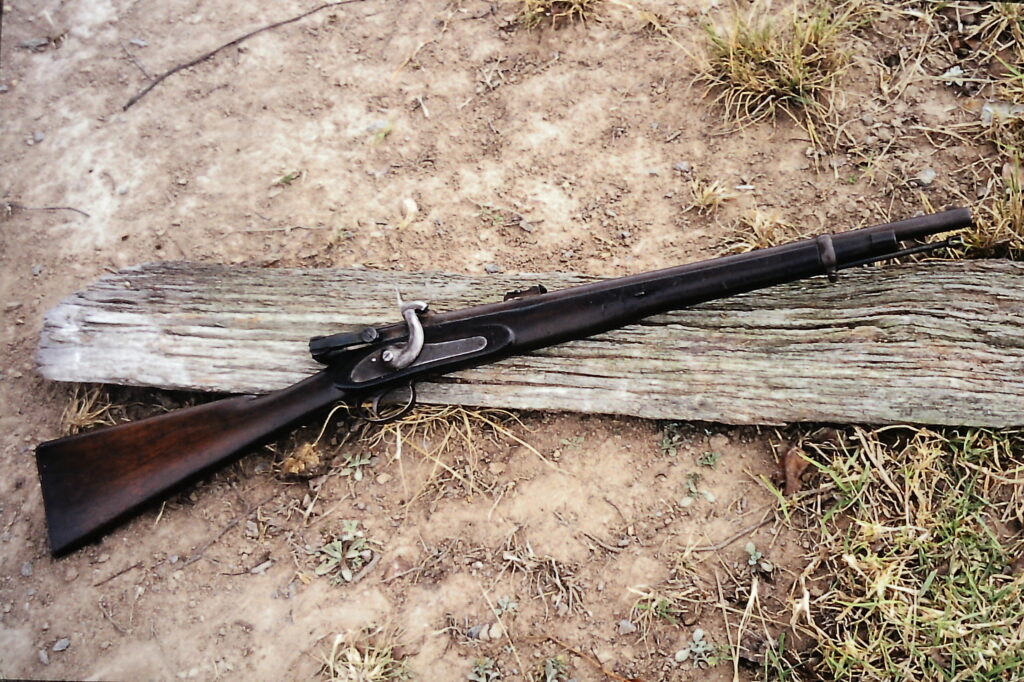
As for long-arms, the old muzzle-loading, single-shot Enfield carbine was replaced by the English Calisher and Terry .53 calibre single-shot breech-loading percussion carbine. These far superior firearms were usually carried on the saddle. A paper cartridge was available for the Colt and the Terry.
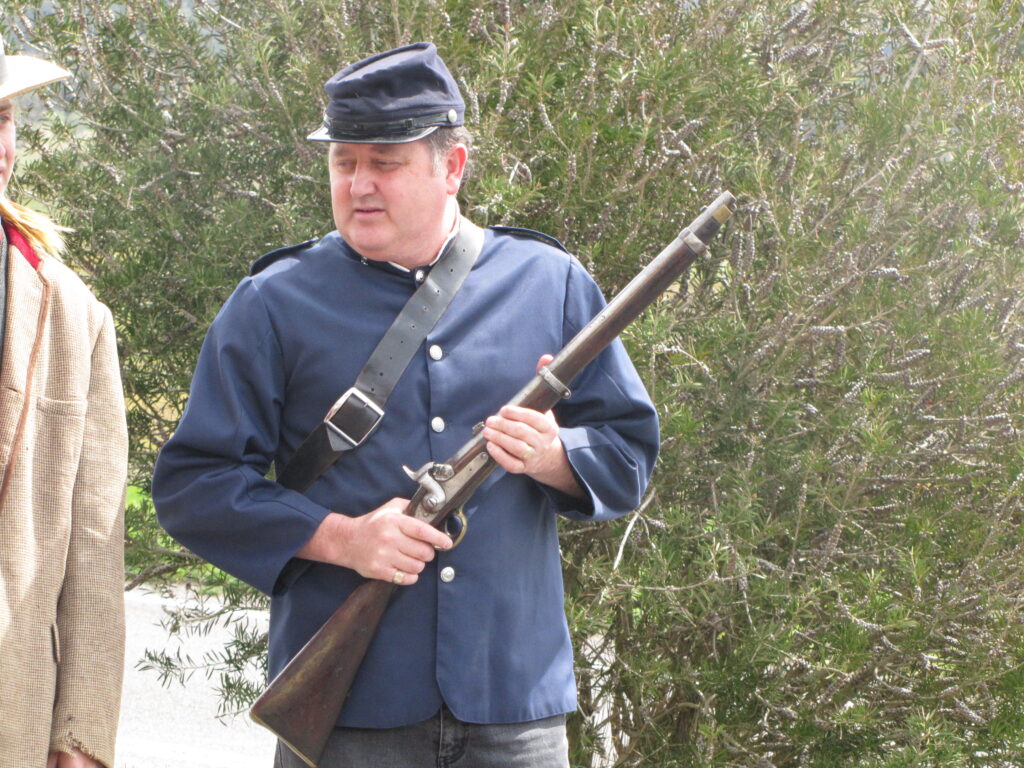
Following the fight at Fogg’s shanty, Frank Gardiner escaped from police custody and masterminded the successful attack on the Forbes Gold Escort at Eugowra Rocks on June 15, 1862. The aftermath of this violent incident caused the first fatality in the reformed NSW Police. The overturned escort coach was eventually righted and continued to Orange with the wounded troopers and others on board. Trooper Moran, one of the wounded policemen, placed his Colt Navy revolver in its holster under the seat of the coach. As the coach turned a corner in Orange, the Colt pistol slipped from its holster and the hammer received enough force to fire a shot upwards. Constable William Haviland was hit in the throat and died instantly.
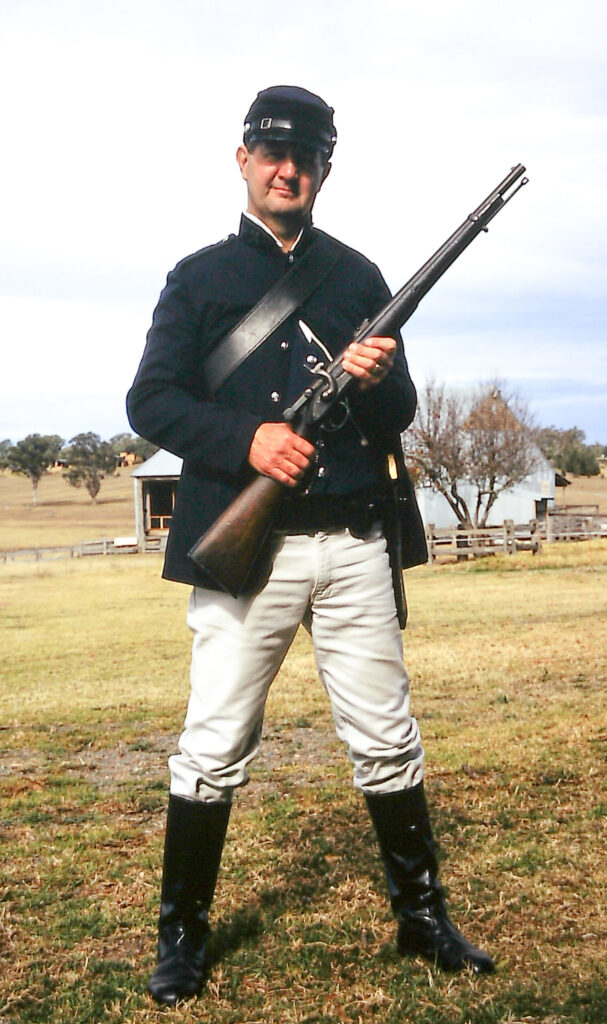
Haviland had survived the vicious attack on the escort coach at Eugowra, only to die once reaching safety in Orange. A plaque honours his memory at Orange Police Station. As well as the government issue firearms, foot police were supplied with a baton, bayonet and sheath, and the mounted police received a sword. The revised Police Rules of October 16, 1864 stated that all items of arms, ammunition and accoutrements had to be signed for and returned when leaving the force.
Each constable was supplied with 20 rounds of ammunition, which had to be accounted for. A fine of six pence was imposed for every missing cartridge. When applying for more cartridges, a written explanation had to give reasons as to how the previous issue became expended. No constable could load or discharge his firearms unless ordered to by his superior, or in case of an emergency. Firearms practice with live ammunition was out of the question. This conservation of ammunition is reflected in the incident of May 20, 1864 when Ben Hall, John Gilbert and James Gordon raided the Bang Bang Hotel in Koorawatha, south of Cowra in NSW. They were seeking fine racehorses stabled there but did not figure on the presence of Constables McNamara and Scott. After a running gun battle in the back paddock, the three bushrangers were forced to retire after firing an estimated 25-30 rounds. The police, who were mindful of reserving their ammunition, accounted for nine shots.
Although bayonets and swords were on issue, there are few reports of these ever being used. The most well-known incident where a bayonet was brandished was at Collector in NSW, on Australia Day 1865. The only policeman in Collector was Constable Samuel Nelson, a foot policeman and lock-up keeper. The two better-armed mounted troopers were out searching for bushrangers, who were at that time plundering the inn in town. Constable Nelson was informed of the raid on the inn and marched into town. He armed himself with his 1855 model Constabulary carbine. This was a single-shot muzzle-loader of .65 calibre. At the end of the barrel, he fixed his bayonet.
While Ben Hall and John Gilbert ransacked the inn, young John Dunn guarded the captives out the front. Dunn was given a single-barrel percussion shotgun that Ben Hall had found inside. As Nelson approached the inn with the single-shot carbine and bayonet, Dunn called out and then fired the shotgun, which did terrible damage to the constable’s chest. As Nelson staggered, Dunn fired his Colt Navy pistol and the bullet entered Nelson’s face. Constable Nelson was the father of eight, with another on the way. Two of his sons witnessed his death. A monument now stands outside the Bushranger Inn at Collector and Nelson’s grave can be visited around the corner in the cemetery.

One incident where a sword was wielded occurred in Victoria in September 1853. Two murderers named Henry Bradley and Patrick O’Connor, after committing crimes in Van Diemen’s Land, forced the crew of a schooner to take them across Bass Strait, where they landed near Cape Schanck at a place now known as Bushrangers Bay. The two criminals kept up their life of robbery and shooting and moved northward through Brighton and Gisborne. The pursuing police caught up with them near Kilmore. The police charged, with Sergeant Nolan wielding his sword, and after a brief struggle Bradley and O’Connor were taken into custody. Their crimes ended on the Melbourne gallows on October 24, 1853.
As with the case of Constable Nelson, police bravery was often not enough to overcome adversity and to enforce the law. But modern police firearms in the hands of a determined trooper could sometimes make all the difference. Since the devastating attack on the gold escort at Eugowra Rocks by Frank Gardiner’s gang, in June 1862, the authorities had devised improved rules for gold and prisoner escorts. This included escort troopers no longer being cooped up inside the coach. Mounted troopers were to ride ahead of and in rear of the coach, with the senior officer at the rear. Also, the gold box was to be firmly attached to the coach.
These rules were strictly obeyed on March 13, 1865 as the gold escort from the Araluen goldfields near Braidwood in NSW made slow progress up Araluen Mountain from the valley to the plateau above. The four-wheeled gold cart, or wagonette, was driven by gold buyer John Blatchford, with the iron gold safe enclosed in a wooden box attached to the floor. Constables Daniel Byrne and John Kelly rode in advance of the cart, while Constable McElligott and Senior Constable Stapylton rode well behind.
Near the top of the precipitous mountain road, Ben Hall, John Gilbert, John Dunn and an unidentified man waited in ambush. The bushrangers fired without warning, hitting Kelly in the chest. He fell by the roadside where he continued the fight with his Calisher and Terry carbine. Blatchford, who was also wounded, ran back down the road for help. The two rear troopers headed up into the bush to outflank the attackers. Meanwhile, Constable Byrne had steadied the two runaway horses and positioned himself behind the rear wheel of the cart. He placed his cartridges on the ground and prepared to defend the vehicle with his Calisher and Terry carbine. The bushrangers’ constant firing failed to dislodge the determined trooper and they were eventually forced to retreat while firing on the two rear troopers, who were now flanking them.
Government strategy, modern firearms and determined law officers combined to defeat the most notorious criminals in the Empire. Not always did police officers confront bushrangers with standard issue firearms. In some cases, higher ranking officers used Adams or Tranter revolvers, often purchased privately. Others were available for police to use, especially on special or covert duties.
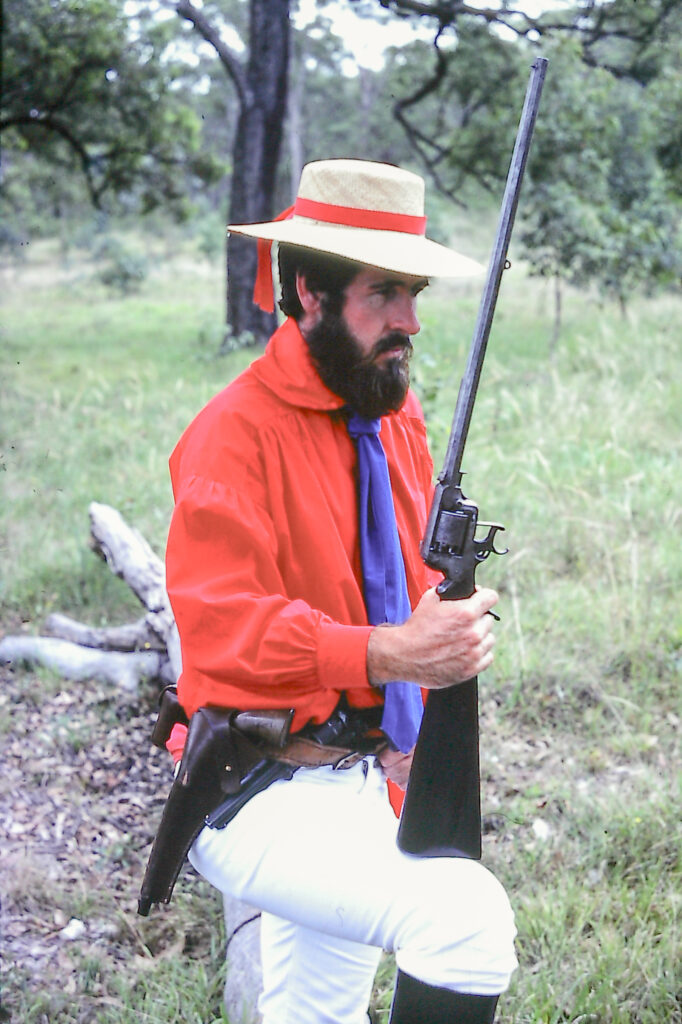
Colt and Tranter pistols were popular with police and bushrangers alike. Quite often, successful bushrangers were armed courtesy of the NSW Police. Both Colt and Tranter also made long-arm versions of their popular pistols. The Colt Revolving Rifle 1856 model carbine .56 calibre 5-shot and the Tranter Revolving Rifle 1856 model .45 calibre five-shot were highly prized. The action was the same as that used in the revolving pistols. The Tranter was considered the ultimate firearm of its day.
In January 1867, four Special Constables set out from Braidwood in NSW to track down the Clarke Gang of bushrangers. At different times, the government would employ dedicated and skilled men to act as Specials for covert operations. The four men were issued with five Tranter pistols and two Tranter revolving rifles. The Specials were ambushed by unknown assassins near remote Jinden. Most were seemingly executed after surrendering. Two unfired pistols remained at the scene but the bushrangers added two revolving rifles and three pistols to their arsenal.
On April 27, 1867 bushrangers Thomas and John Clarke were surrounded by police in an isolated hut near Jinden. After an extensive gun battle in which there were wounds on both sides, the bushrangers surrendered. The police searched the hut and found two revolving rifles and two revolvers. One rifle was a Colt and the other a Tranter. The Tranter was identified as one taken from the party of Special Constables who were murdered in January. The Colt was also government issue. The two Colt revolvers were marked NSWG and NSW.
As time moved on, so too did technology. Police firearms became more sophisticated. Metal cartridges replaced paper. The Webley became the standard police revolver. The four Victorian troopers ambushed by the Kelly Gang at Stringybark Creek in 1878 were armed with these. They also had a seven-shot lever action .50 calibre Spencer repeating carbine which was borrowed for this patrol from the local gold escort party. After the ambush in which three policemen died, the bushrangers acquired the firearms, although Ned Kelly avoided the superior Spencer as he found it confusing.
Some other police-issue firearms that saw service as time progressed were the Alexander Henry carbine (first and second versions), Martini Henry carbine and Snider carbine.
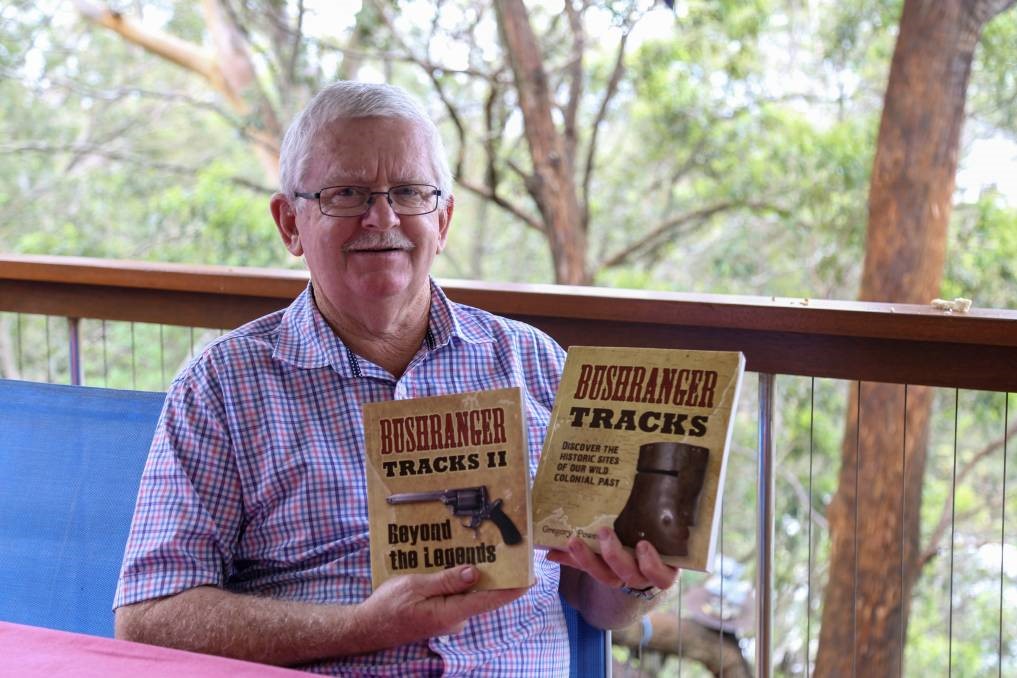
*Gregory Powell is the author of Bushranger Tracks and Bushranger Tracks: Beyond the Legends.
Share this article
Related
Articles



Related
Recipes
Sorry, no related items found.