

Can recreational hunting actually reduce deer numbers?
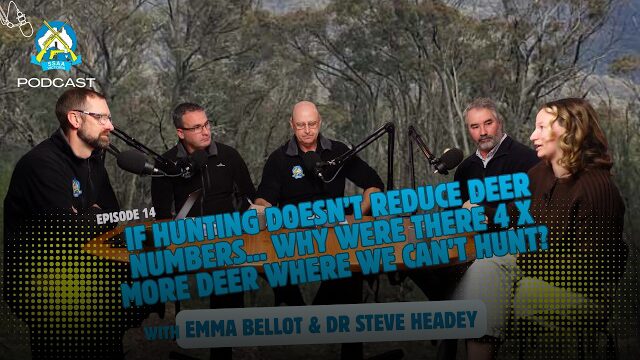
SSAA Victoria takes a close look at one of the most debated questions in Australian deer management: can recreational hunting actually reduce deer numbers?
The discussion (commencing at the 14-minute mark) features Emma Bellot and Dr Stephen Headey from RMIT University, focusing on Bellot’s honours research into deer density, vegetation impact and public attitudes toward deer hunting in Victoria’s Lake Eildon National Park.
The key finding is hard to ignore. The study compared adjacent hunting and non-hunting areas and estimated deer density at 2.31 deer per square kilometre where hunting was allowed, compared with 8.61 deer per square kilometre where hunting was prohibited. That means deer density was almost four times higher in the non-hunting area.
The research used camera-trap distance sampling across 24 cameras over about 75 days, producing almost 7000 deer images. Around 77 per cent of deer detections came from the non-hunting area, despite equal survey effort.
The discussion also covers public attitudes. Bellot’s survey found broad support for recreational hunting as a deer management tool, including support for expanding hunting access in some Victorian parks and reserves. Recreational hunting with rifles ranked as the most preferred deer management method among respondents, ahead of bowhunting, contracted ground shooting and aerial culling.

For hunters, the video is useful because it puts evidence behind a point many have made for years: regulated recreational hunting can contribute to deer control, particularly where governments are willing to provide access and use hunters as part of a broader management strategy.
The vegetation results were more nuanced. The study did not find significant differences in most vegetation measures between the hunting and non-hunting areas. That suggests deer impacts can be site-specific and influenced by more than deer density alone.
The takeaway is that access matters, science-based evidence matters and recreational hunting deserves a serious place in the deer-management conversation.
Read more on the broader topic in the bumper conservation issue of Australian Hunter.
Share this article

 Website
 Instagram
 Facebook
Related
Articles


Related
Recipes