


Hunting with the .240 Page Souper Pooper
I was keen to try out my Winchester Model 70 short-action on feral game after having the barrel reprofiled and the chamber recut to give a shorter throat. I was using a new load in my .240 Page Souper Pooper that I had been testing at the SSAA range, consisting of the 90gr Sierra Tipped GameKing (TGK) and 51 grains of AR2213SC at 3240fps. Previously I was using the 90gr Swift Scirocco at 3350fps.
The .240 Page Souper Pooper was the second of Warren Page’s 6mm creations back in the 1950s. It uses a necked-down 7×57 case blown out to remove much of the body taper and is given a 28-degree shoulder for good feeding and to reduce case stretching. You can also use 6mm Remington brass to form the cases. The 90gr TGK is not new to me, I have been using this projectile since it became available but in a differently chambered rifle at 3120fps.
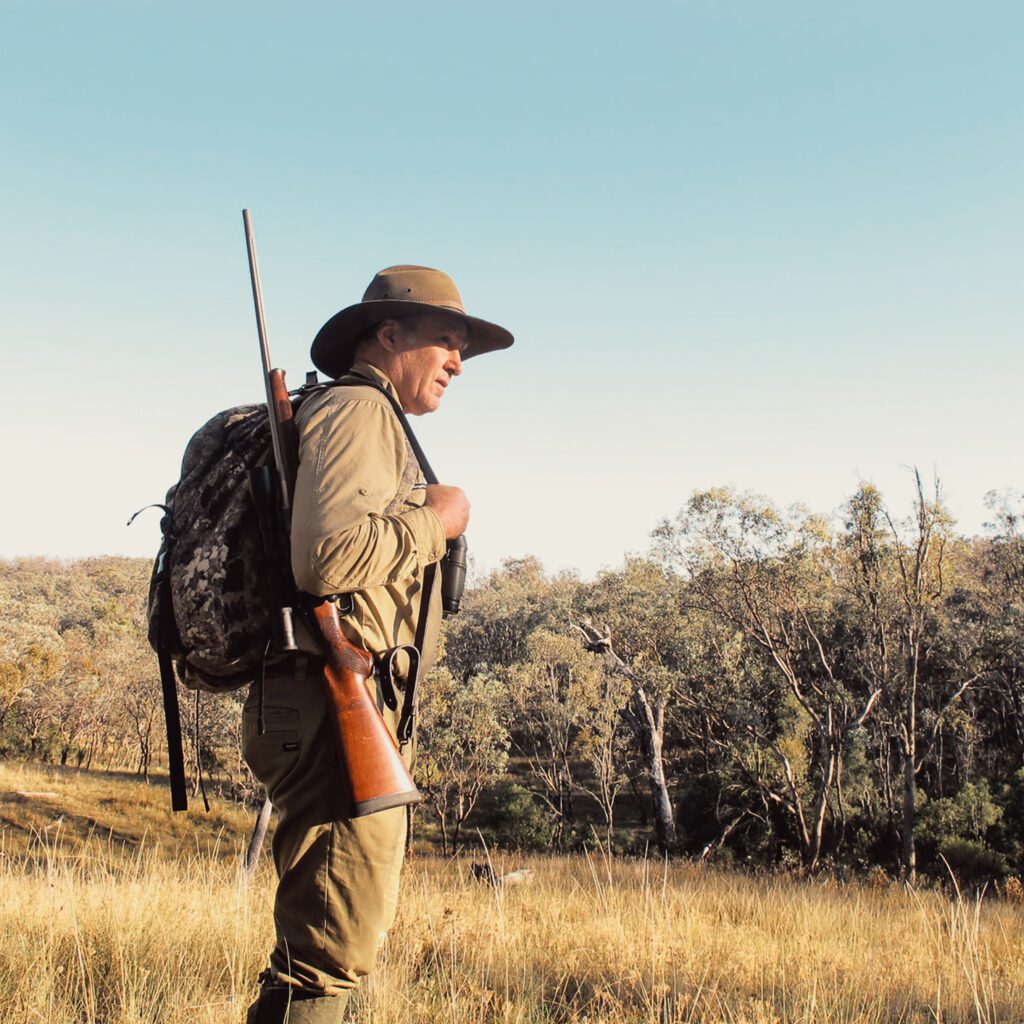
Arriving at the property on a February afternoon, I decided to visit an area that, in the past, had been productive for rabbits and foxes, with the occasional feral cat. I sat and waited in the shade of a gum tree out of the direct summer sun, hoping the purply-red meat ants wouldn’t crawl up the inside of my trousers and sting my legs.
The sun doesn’t set too well after 8pm at this time of year and it was just too early and hot for anything but a goanna to be out. As the shadows grew longer, I decided to go for a walk down near the blackberries, which were ready to be eaten. All I saw was one buck rabbit at about 30yds, so I chambered a round and the rabbit stopped long enough to aim for his head. That 90gr TGK cleanly removed most of his head. Ideal for a good rabbit stew, I cleaned him and put him in my tucker bag. I had a feed of the blackberries, being careful as I was picking them to look out for snakes.
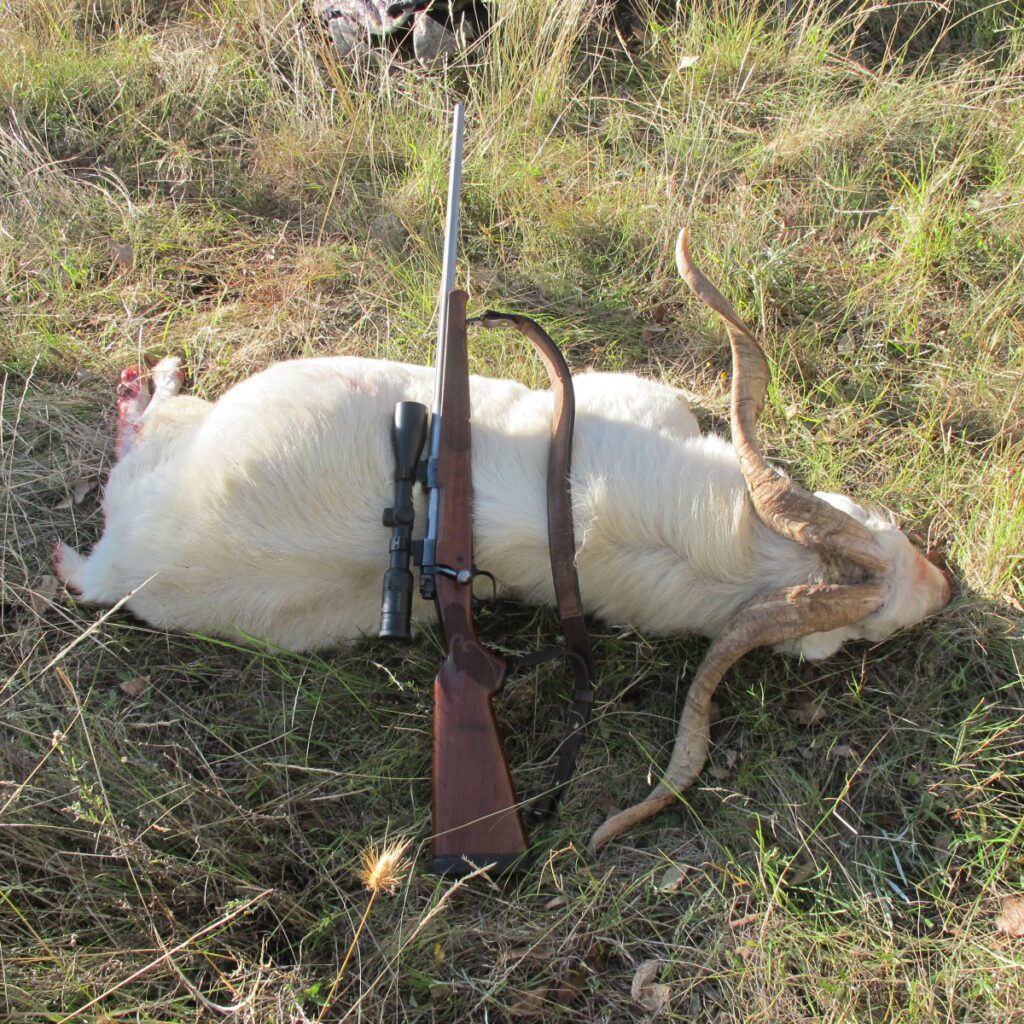
I crossed into less-open bushland, thinking that I might just find a pig before dark. Instead of a pig, I came across a billy goat feeding on a sapling. I had exhausted my supply of chevon the week before my trip and knowing that even an old billy still tastes okay if made into a curry, I decided to take him offhand at about 70yds. The horns of the billy had a 36″ spread… way short of the magical 50″ but still pleasant to look at.
The next morning, I decided to go to where I saw a fallow deer on my previous trip. I hit the barely visible track at 5am, with just enough moonlight to not need a head-torch. The big male kangaroos were grunting, but not the fallow stags. I walked and walked. Eventually I came to an open area with quite a bit of pig rooting.
And there, to my left about 120 paces away, was a big sow with her medium-sized piglet and a boar. I loaded a round into the chamber as quietly as possible. I then stalked, trying to keep a sapling between them and myself, until I reached the sapling about 100 paces from them.
They were close to each other, moving around and rooting up the ground. I had to keep checking through my Swarovski 8×30 binoculars to make sure which was the boar, as I wanted to shoot him first. I fired at the boar, but he took off at full speed.
The sow and her half-grown piglet disappeared in a different direction. I quickly chambered a second round and shot the boar with a high shoulder hit at which he crashed to a stop – dead.
The following day I decided to climb up a large hill to hopefully take a long shot at a goat. The main reason that I had the barrel reprofiled on the Model 70 was to reduce the weight of the rifle, which would be of most benefit in the hills. Yet I didn’t want the rifle to be too light. I still needed to be able to precisely place a bullet in the vital area of a small deer or a wild dog at perhaps 350yds if need be. However, it is mainly at ranges less than 300yds that I have shot this rifle. For example, I used this rifle and cartridge successfully on overseas hunts for a Coues deer at 253yds, a Columbian blacktail at 225yds and a running coyote at 206yds. The flat medium-range trajectory, coupled with the relatively light recoil of the 90gr projectile from the .240 PSP, allows well-placed shots on small targets.
At 3.58kg with a 3-10 Swarovski scope, I have the combination just right for its intended purpose. The Sierra TGK has a good ballistic coefficient (BC), at least when its velocity remains above 2700fps, which corresponds to a maximum of 268yds at an initial muzzle velocity of 3240fps. This high BC for a 90gr bullet ensures less wind-drift, drop and reduction in velocity due to air resistance on the long shots.

But it’s not just past 300yds that the higher BC works to your advantage. From the moment the projectile leaves the barrel, the higher BC bullet starts to work better than a lower BC bullet – it’s just that the advantage is greater the further the distance the bullet travels.
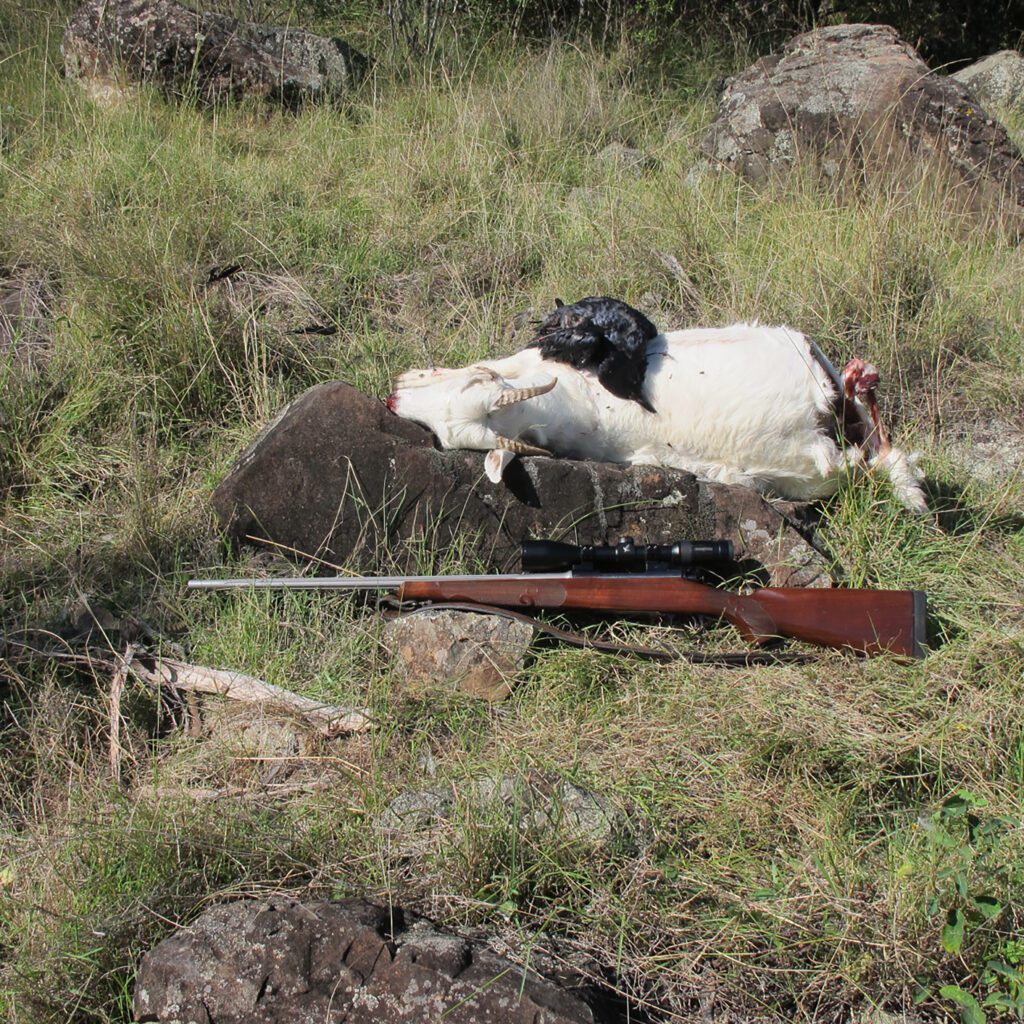
Climbing up the side of the hill, I kept looking across with my binoculars to the adjacent steep wooded side, hoping that I might see goats for a long cross-gully shot. But this was not to be. I was close to the summit, and I could hear and then see goats coming down the hill at an angle, not far above me. I decided to go for a tender one this time, delicious in a rogan josh curry. I shot a female through the shoulder at about 25 paces, and it dropped right there. The projectile exited the far shoulder after expanding.
The bullet destroyed the meat on both shoulders, so I had to be content with just the meat from both hind legs and rump. It’s probably better to shoot a goat through the ribs if you want to salvage all the available meat. However, I do tend to favour a shoulder shot on most game. The temperature was predicted to reach 37C on this day, so I decided to head back, which would make it about five hours of walking that morning – certainly enough in summer.
On my final day I opted to follow a creek bed to its source and see what I might find. I came across a mob of pigs and targeted a young porker to roast whole. I shot one at about 50 paces while the others ducked off into the thick bush. The high-speed bullet ripped the young pig open – something that my high velocity 6mm has previously done. So, it was not suitable to take back with me.
Rather than backtrack and follow the creek all the way to where I originally started, I headed up to the top of the hill to come around the back and see what was on the top there. This was unfamiliar territory, so I found a landmark and took out my compass and found the direction I needed to travel was west-northwest.
Once I started to come down from the hill in the thicker bush, I would have to rely on my compass and this direction. I was on a hill adjacent to the summit where I had shot the goat on the previous day.
Having located a rock ledge, which gave me a good view of the side of the adjacent hill in the hope that I might spot a fallow stag, I sat down and started glassing. I saw a crow fly across and wondered if it would land on the remains of the goat I had shot the day before. Yes, it did!
Now I certainly like to see when the wedge-tailed eagles clean up my goat carcasses… but crows? Especially when they peck the eyes out of sheep. Where I was sitting was not suitable for a prone shot. I didn’t have a rangefinder with me but estimated the distance to be 175-200yds across the gully. I was sitting down and rested my elbows on my thighs. I wound the scope up from 3.3 magnification (lowest setting) to 6-power. A higher magnification would be too much clear movement from the less-than-perfect rest.
I squeezed the trigger, aiming at the crow that was feeding on the goat carcass. At the shot, I didn’t see the crow fly off. I thoroughly checked the carcass and its surroundings with binoculars but couldn’t see a dead crow.
Curiosity got the better of me, so I climbed down to the bottom of the gully and then up the other side to where the goat was. There was a dead crow on the far side of the goat, and that’s the reason I couldn’t see it with the binoculars. Now that is why I like my Winchester Model 70 chambered in .240 Page Souper Pooper.
Share this article

Related
Articles



Related
Recipes
Sorry, no related items found.