


Packing light with the Leatherman Skeletool
The Leatherman Skeletool was announced at the 2007 SHOT Show (Shooting, Hunting and Outdoor Trades) in Orlando, Florida and released to the general public in the early months of the following year.
Since then, it has gone on to spawn a myriad of styles, colours and blade configurations specifically tailored to end-user requirements. I see tools and knives as equally crucial as a rifle and ammunition. Let us examine the Skeletool, what it does, plus what it is good for.
This particular tool is aimed squarely at those of us who gravitate towards the minimalist side of things. There is a definite current trend towards non-essential, lightweight and small-scale carry-ability for the outdoors, when waltzing around the mountains, plains or swamps. ‘Ultralight’ would appear to be the catchcry of the day for so many of us. As my years in the Army taught me – pack light, travel far.
So, what does this tool offer? Well, pliers (as most Leathermans do), wire cutters, hard wire cutters, knife blade, interchangeable bit driver, pocket clip, carabiner, bottle opener and lanyard ring. Not much, you say? I would agree with that. But how much do you think you need to carry on you for a few days in the wilderness, floating down a river in a kayak or a long weekend hunting red deer or water buffaloes?
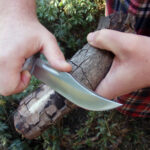
The knife blade is 6.6cm in length or 2.6″. It is available in either straight edge, semi-serrated or fully-serrated depending upon the model. The knife fits into place via a liner locking mechanism for added safety. The blade also features a cut-out hole for easy one-handed thumb actuated deployment and this can be accessed without the need to open the tool out.

The bit driver also features a locking mechanism, this time of the push button style and you’ll need the tool open to reach it. Each Skeletool comes with two interchangeable bits, both of which are fully supported by the aftermarket kit set and ratchet, increasing versatility immensely. The bits are a set of double flathead and double Phillips head screwdrivers. The second bit is held within the tool by friction in a small cut-out inside the handle and can be pushed out to install by means of thumb pressure. And no, I’ve never had that spare bit come loose or be lost. It is held in place well. Given the ergonomic curve of the Skeletool handles, it is easier to deploy the tool with both handles extended before attempting to drive screws.
The pliers aren’t exactly what I would define as needle nose, but they are close. They feature serrations within the jaws for grip and can also turn small nuts and bolts. Regular wire cutters and a hard wire cutting notch round out the plier head features.
Unlike larger Leatherman models, the Skeletool does not include interchangeable wire cutters, such as those on the Surge and Charge. The non-knife blade and driver handle has a carabiner built into it which also incorporates a bottle opening capability. There is a large circular cut-out behind the carabiner, which (although the bit driver extends into it) can be used as a lanyard ring, or you could simply affix a small split ring onto this cut-out as a means of attaching a lanyard, if desired. A slender and unobtrusive deep carry-style pocket clip rounds out this Leatherman tool.

There are multiple holes milled into the various body parts as well as the blade. Given that the Skeletool has a folded closed length of only 10cm and a weight of a mere 142g, you could argue that all of these little holes save a great deal of weight. However, their visual appeal is through the roof.
What do you need it for? It isn’t big, considering other Leatherman offerings and it doesn’t have a great deal of stuff. But it is light and provides a lot of the things you need without a lot of the things you don’t. It is markedly different from the tool proliferating rival models. It has been optimised for the few tools which it does feature.

This is where the Skeletool shines. Small repairs or tightening scope mounts and screws. Accessing the sideplate on your baitcaster, holding a hook so you can make running repairs to a fishing fly or lure before the bass or trout go off the bite. Cutting lines, gutting fish and small game. It is grand for this, because the spring-loaded carabiner and pocket clip both positively encourage carry-ability. So, it’s a great lightweight tool for hunters and anglers or backpackers who follow the ‘every ounce counts’ philosophy.
The popularity of the Skeletool has spawned various incarnations and refinements over the years. The first offering (2008) was stainless only with straight edge blade from 420HC steel. From 2009 onwards, stainless Skeletools were available with a partially serrated blade and remain so. Various other versions have appeared in different colours and black oxide finishes, while more recent CX models have expanded the range with additional colours and protective Cerakote coatings.
The next version of the Skeletool is the CX. This model was released at the same time as the regular, but it offers an improved blade of 154CM steel. As a reversal, CX models were originally tendered with the semi-serrated blade for their first year of production, then replaced with straight edge from 2009.
The serrations are deeper than those found on the regular stainless model. I’m fortunate to own both first year production models – CX and regular. Both display ‘patent pending’ stamps and are highly collectable. Early CX models featured a diamond-like black tungsten coating on most external surfaces, along with a carbon-fibre insert as the spacer bar sandwiched into the carabiner handle. The carbon-fibre insert has since been replaced with aluminium.
The next version of note is the RX model. This was released in 2016 and is touted as a rescue and first responder version. This model was initially orange but was switched to red around 2018. Its blade is serrated for roughly 3/4 of its length and is slightly different from the serrations of the 2008 CX and regular tool. The RX keeps the upgraded 154CM steel, but the end of the flat bit driver incorporates a tungsten carbide glass breaker. Apart from a few limited runs, the Skeletool does not come with a sheath, more than likely due to the carry options built into it, but small aftermarket sheaths are available online.

The Skeletool family also includes the pared-back KB and KBx folding knives, which dispense with the pliers in favour of an even lighter design.
The ergonomics of the Skeletool handle are probably the best of any multi-tool, Leatherman or otherwise, that I’ve ever handled. Their comfort is sublime and the way they sculpt into your palm is a thing of beauty. This is one elegant tool. The actual construction or build quality is durable, functional and pleasing.
However, I will state that a tool of this size, comprising a small blade of this length, should be used as a supplement to a good quality knife, not as a complete replacement for it. There are limits to what such a short blade can accomplish. Overall, the Skeletool is impressive.
I’ve regularly carried one either on my belt or in my pocket for many hunting and fishing adventures throughout Queensland and the Northern Territory since it was introduced. I often had one on my person during the final years of Army service. It is an efficient, practical and highly useful tool for any hunter, angler, soldier, kayaker, backpacker or outdoors enthusiast.
At a glance
Model: Leatherman Skeletool
Closed length: 10cm or 4″
Open length: 15cm or 6″
Weight: 142g or 5oz
Production: 2008-present
Material: 420HC and 154CM blade steels, carbon-fibre inserts on early CX models
Sheath: No
Approx. retail: $195.95 (standard Skeletool), $244.95 (CX), $257.95 (RX)
Share this article
Related
Articles


What to carry hunting: Essential gear for safety and success


Related
Recipes
Sorry, no related items found.