


Hunting goats with a Haenel Jaeger 9
Some of our European counterparts hunt the elusive goat-antelope creature, the chamois, in the Austrian Alps with a kipplauf. This is a tilt-barrel single-shot rifle which is often chambered in a European rimmed cartridge such as 6.5x57R.
I was hunting Boer goats in the Nandewar Range in northern NSW, with a Haenel Jaeger 9 kipplauf chambered in .308 Win. The Boer goats, like the chamois, don’t have the large horns our usual feral goats have, but they make up for that with the delicious flavour of their meat.
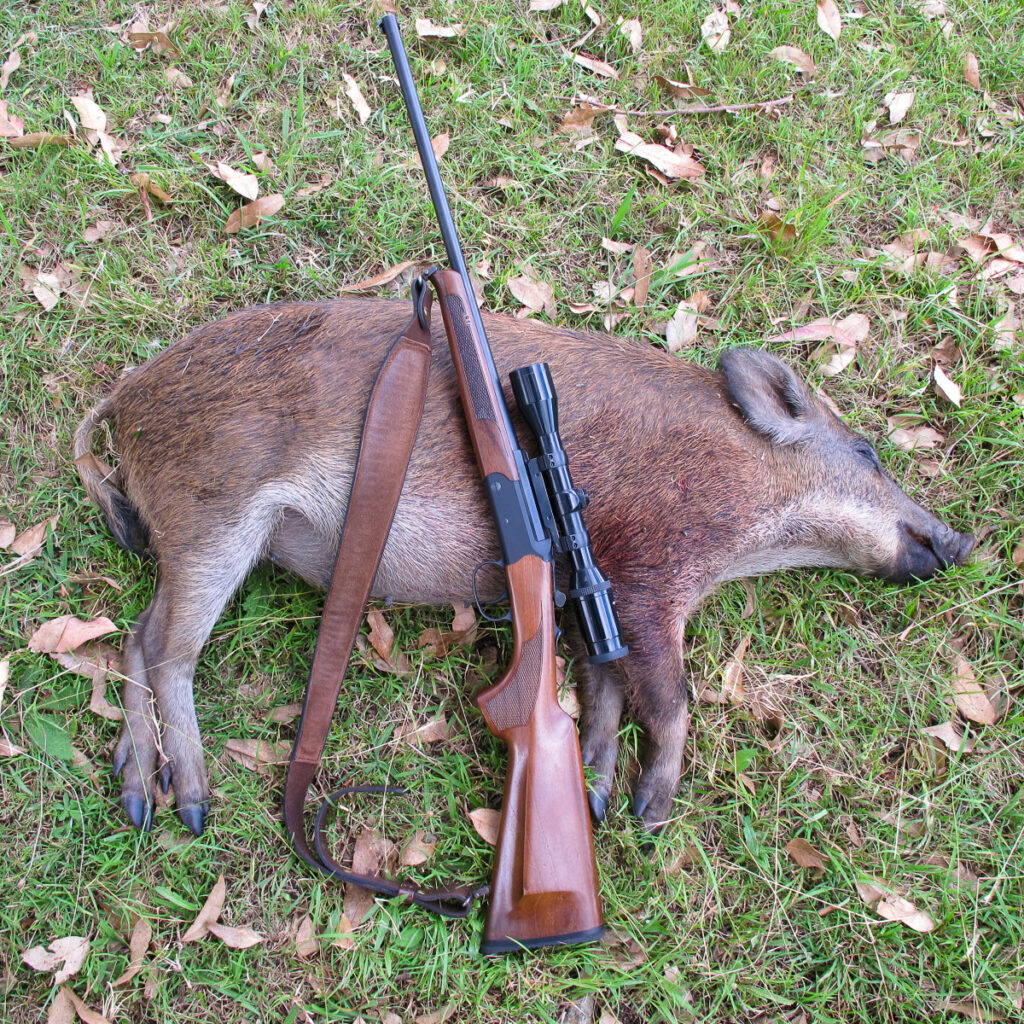
It was February and the blackberries were out. The previous afternoon I had taken the kipplauf with me when having a feed of the blackberries to see if there were any rabbits or even a fox hanging around. There was no sign of recent rabbits but there were three pigs there. I shot the first pig and instead of the others running off, they pretty much stayed still, allowing me to replace the spent .308 with a new round and shoot the second pig. I shot the third pig as he was exiting the scene. The rimless cases were easy to extract.
At about 7pm that evening I was enjoying a cold drink, when I thought to set up the tripod with the Leica 12x50mm binoculars and search the hills for goats. Finding goats using this equipment saves a lot of fruitless climbing. A white speck seven-eighths up a heavily wooded hill caught my attention. Was this just a distant cockatoo sitting on a branch high up in the hills? The Leica 12 power binoculars soon revealed that it was a goat.
There looked to be two goats bedding down for the evening in thick bush. It was too late to stalk up there as I had run out of light. Hopefully, they would be in that same location in the morning. A stalk was planned to take me higher than the goats so that I would come down from above if they were still there the next day.
Goats are more of a challenge to hunt in the hills and in the warmer months. Climbing up the hills is good exercise and preparation for the upcoming deer season in the cooler months. I mainly hunt them for meat but always keep an eye out for a billy with a wide set of horns. Chevon makes great slow-cooked curry.
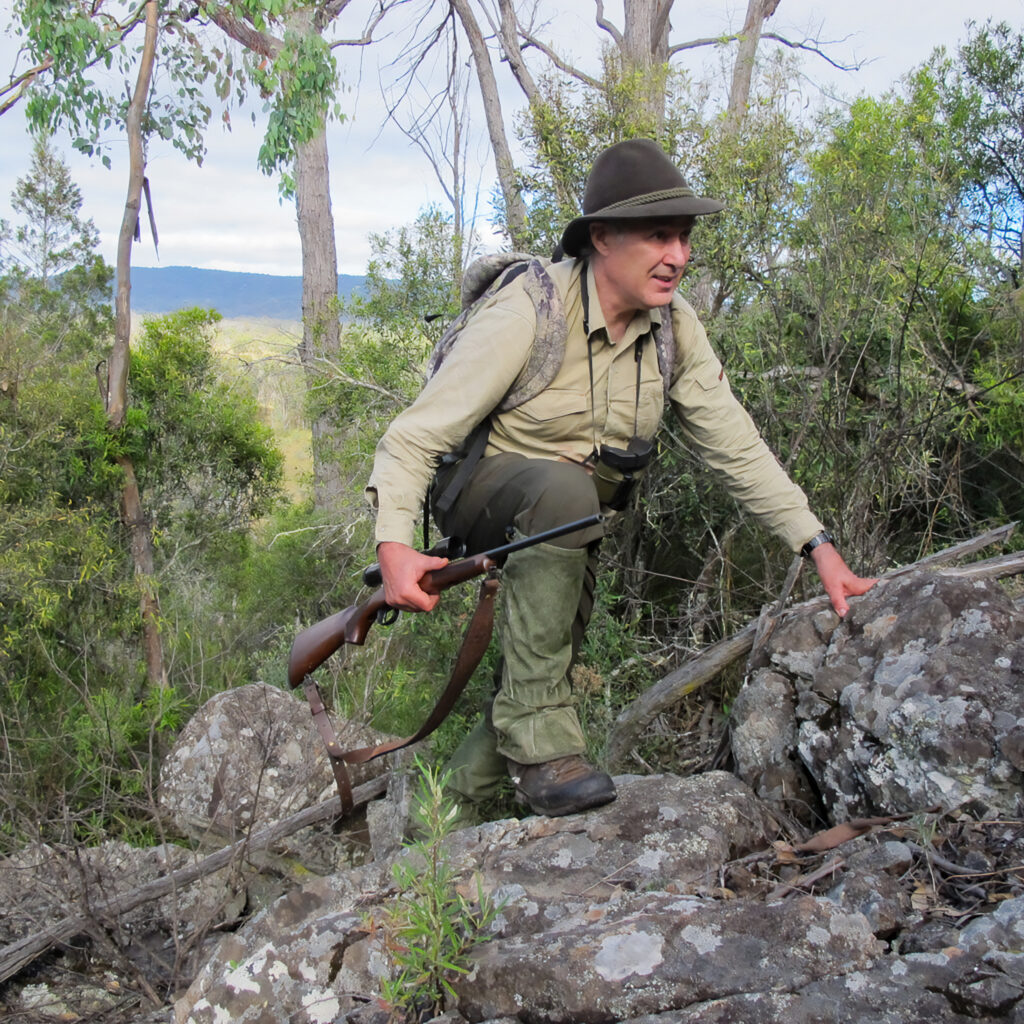
I set off before sunrise early that next morning. A kipplauf has several advantages over a conventional bolt-action rifle. While it is true that you don’t have fast follow-up shots if needed, due to being able to relatively safely have a round chambered when hunting, you can have a faster first shot.
This is because the rifle has a cocking switch instead of a safety, so the kipplauf is in an uncocked mode until you press that switch forward, as opposed to being cocked and locked with a conventional safety. As conventional safeties can fail, resulting in an accidental discharge, the safe way to carry a conventional rifle is with an empty chamber. This requires you to load a round from the magazine, which is much slower and noisier than pressing the cocking switch forward. The Blaser R8 also has a cocking switch instead of a conventional safety. This is the feature that to me is more important than the quicker follow-up shots of a bolt-action rifle on many occasions.
Climbing up the hills through the thick bush, the shorter kipplauf was better than even a handy short-action bolt-action rifle with a 22″ or 23″ barrel. Whether in my hands or on my shoulder, it doesn’t catch as much on the tea tree branches and other low bushes. The barrel of my Haenel has been shortened to 22″, which is ideal for a .308. My kipplauf is about 3″ shorter than a bolt-action rifle of the same barrel length.
Other modifications I have done include removing the soldered iron sights, shortening the length of pull to 137/8” from 14¼” and removing the 230g weight in the buttstock (to balance the lighter front end). The weight of the rifle, Swarovski 3-9 scope and EAW mounts is an ultra-light 2.72kg and it balances perfectly. This is achieved with a wood stock and without having a pencil-thin barrel. Mine is .593″ at the muzzle. I appreciated the very light weight when climbing that morning.
In the thick bush, it is inevitable for the stock to scratch a little. The German-made Haenel Jaeger 9 (Merkel owns Haenel) has quite a reasonable grain wood stock, not as high grade as on the Merkel which was about 2¾ times the price when I bought mine, nor as attractive as on the Blaser K95 which was around four times the price. But I don’t have to nurse it as much for fear of dinging it or scratching it when going through the thick bush or on slippery slopes. I do admire a beautiful wood stock though.
But I really wanted a goat. So, I reached a rock platform which was a little higher than where I had spied the goats the previous evening with the binoculars on the tripod. It was too early and dark to check if they were still in that vicinity before I headed out early in the morning.
Through the bushes, I could just make out that the goats were where I last saw them the night before. I was close, within 30 paces, but needed to get closer because of the vegetation in the way so that I could have a clear shot. The wind was right and they weren’t aware of my presence. There were about four of them rather than the two I had previously seen.

The Speer 150-grain flat-base Spitzers are plenty big enough for goats, deer and pigs but that doesn’t stop them from deflection or blowing up on tree branches. They were Boer goats, which was pleasing. A black and white one approached. It was about 20 paces away and would soon see me. I raised the kipplauf to my shoulder, edging forward the cocking switch at the same time. I fired at its chest. I was using 44.5gr AR2206H in ADI cases. This gives 2830fps in my rifle out of the 22″ barrel.
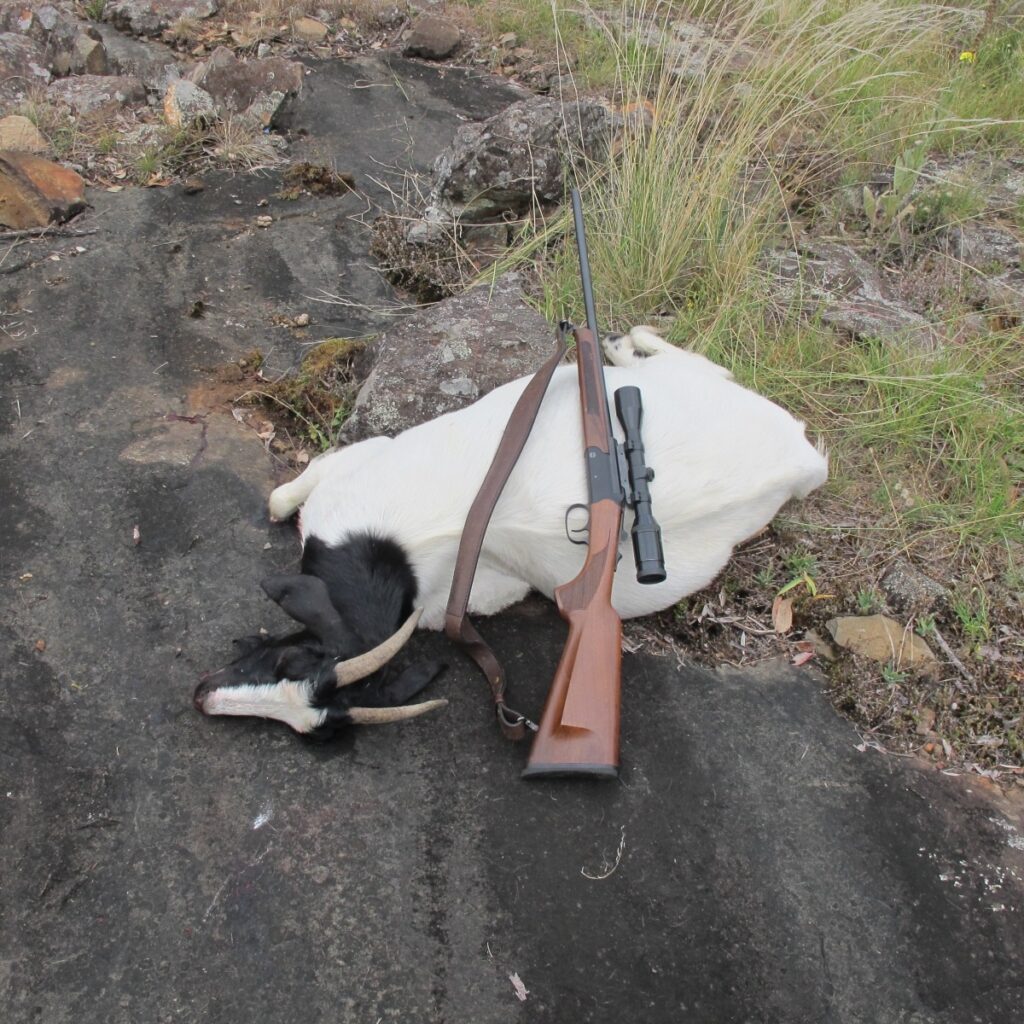
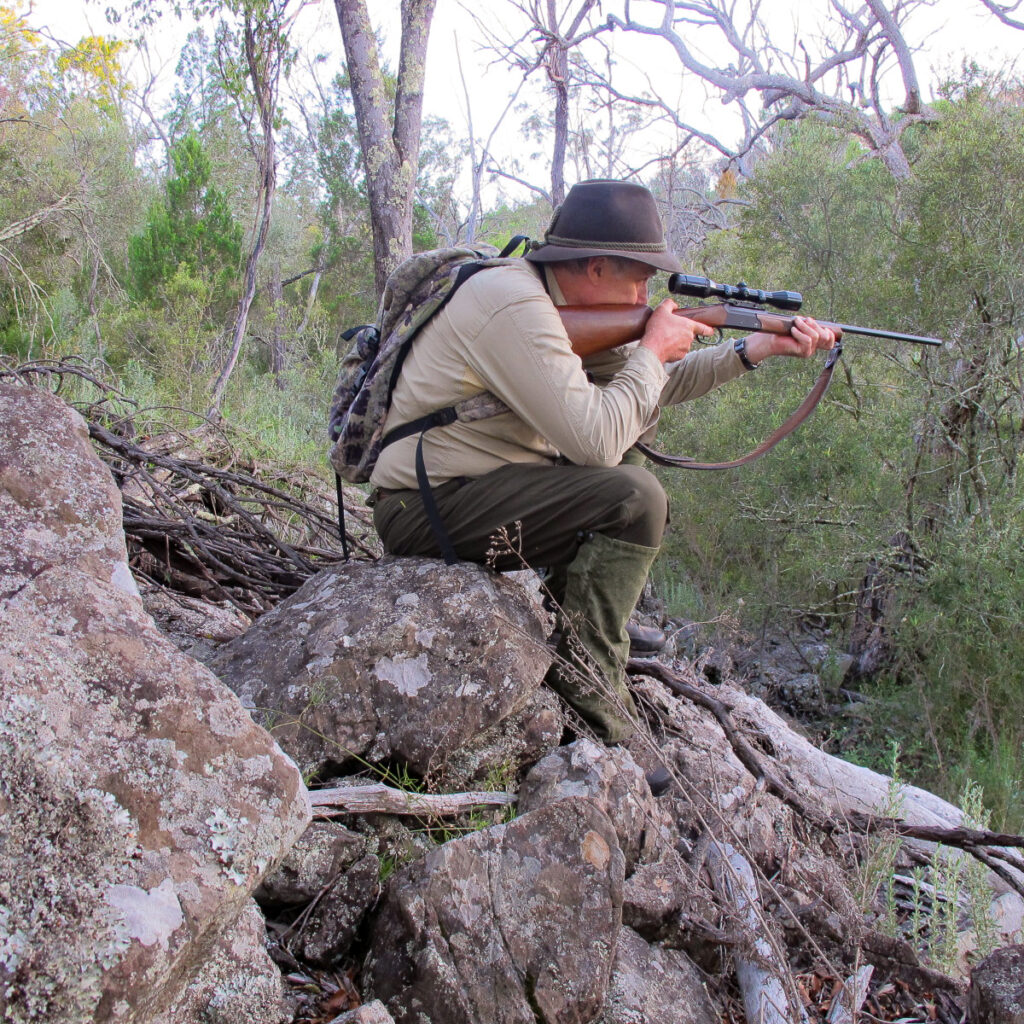
The other Boer goats ran off with one of their comrades down. I quickly navigated my way through the branches and rocks to hear and then see them running down the rocky side of the hill into the gully below and start ascending the adjacent hill. I sat down on one of the rocks and took aim through a small window in the bushes at a second goat that was about 150 paces away. Once again, the .308 did its job.
Upon close inspection of both the goats and the pigs I had shot, the Speer 150-grain flat-base Spitzers did not perform as well as I would have liked. Possibly a little too hard for goats and small pigs. This is in contrast to the Speer 150-grain flat-nose Mag-Tips that I have used extensively. I also have some 150-grain Spitzer boat-tails which I may try, but these have a long jump to the lands when seated deep enough into the case for an adequate grip.
The tilt-block kipplaufs such as the Haenel Jaeger 9, Merkel K5 and Blaser K95 are based on the relatively strong lock-up design patented by Franz Jaeger in 1908. They are very light because of the use of alloys and plastics, and there is certainly no over-engineering evident. The rear of the receiver is aluminium, the 0.86″ diameter breech end of the barrel is surrounded by steel which acts as the front of the receiver, and the steel tilting-block which locks the action at the top blocks the rear of the cartridge. This evidently is strong enough to contain modern high-pressure cartridges, though I can’t see it being as strong as say a Remington 700 action.
The cocker switch, forearm release switch and triggerguard are plastic on the Haenel and the trigger is aluminium. However, even the K95 uses a plastic triggerguard on the basic versions and an aluminium trigger. Similarly, the K5 employs these materials. I am certainly not a fan of the use of plastics except perhaps some lightweight injection moulded stocks on a rugged all-weather rifle. Paying for custom-made metal parts to replace the plastic parts is pricey. I would have preferred if the more expensive tilting-block kipplaufs made use of titanium parts for strength, light weight and corrosion resistance.
The tilt-block kipplaufs are take-down rifles popular in Europe and can be useful if backpacking long distances, not needing to take a shot on the way. They can be carried inside the pack when hauling a huge amount of meat.
They fit in a short case when broken down for car and airline travel. I rarely need to remove the scope from the rifle in the field (and I’ve removed the iron sights) so I opted for fixed EAW mounts that are much lower than the usual quick take-off mounts.
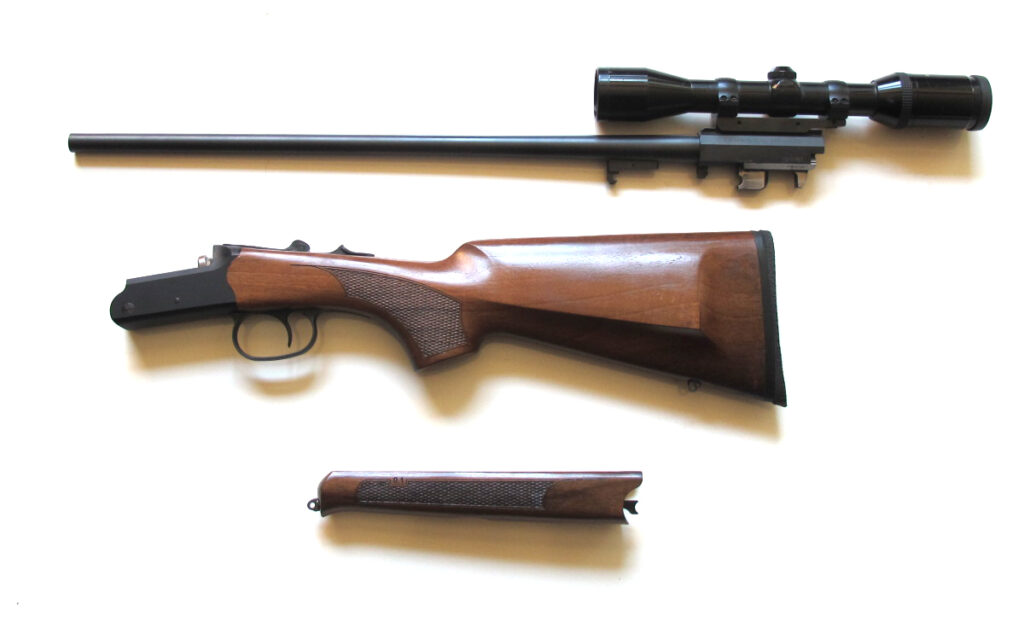
The Haenel has a recoil groove milled into the top of the 11.5mm dovetail which the EAW’s recoil lug fits into. I replaced the large screws with two neat Allen screws that tighten the mount to the dovetail. I can easily carry a small Allen key if I need to remove the scope. Recknagel makes a good take-off mount for the Haenel.
A fault with most kipplaufs in my opinion is the high-mounted scopes. The low rings on the EAW mount sit the scope at the ideal height for a good cheek-weld to the stock. Also for a lower centre of gravity for good handling and compactness, with just sufficient clearance to work the opening lever and cocker switch. Spare barrels chambered for different cartridges are available for the Blaser K95 and Merkel K5.
After I shot the two goats, I boned the meat so I could take back as much as possible. When shooting goats for meat, it is best to aim behind the shoulder into the lungs as there is a lot of good meat on a goat’s shoulder, whereas the backstraps don’t have much meat on them.
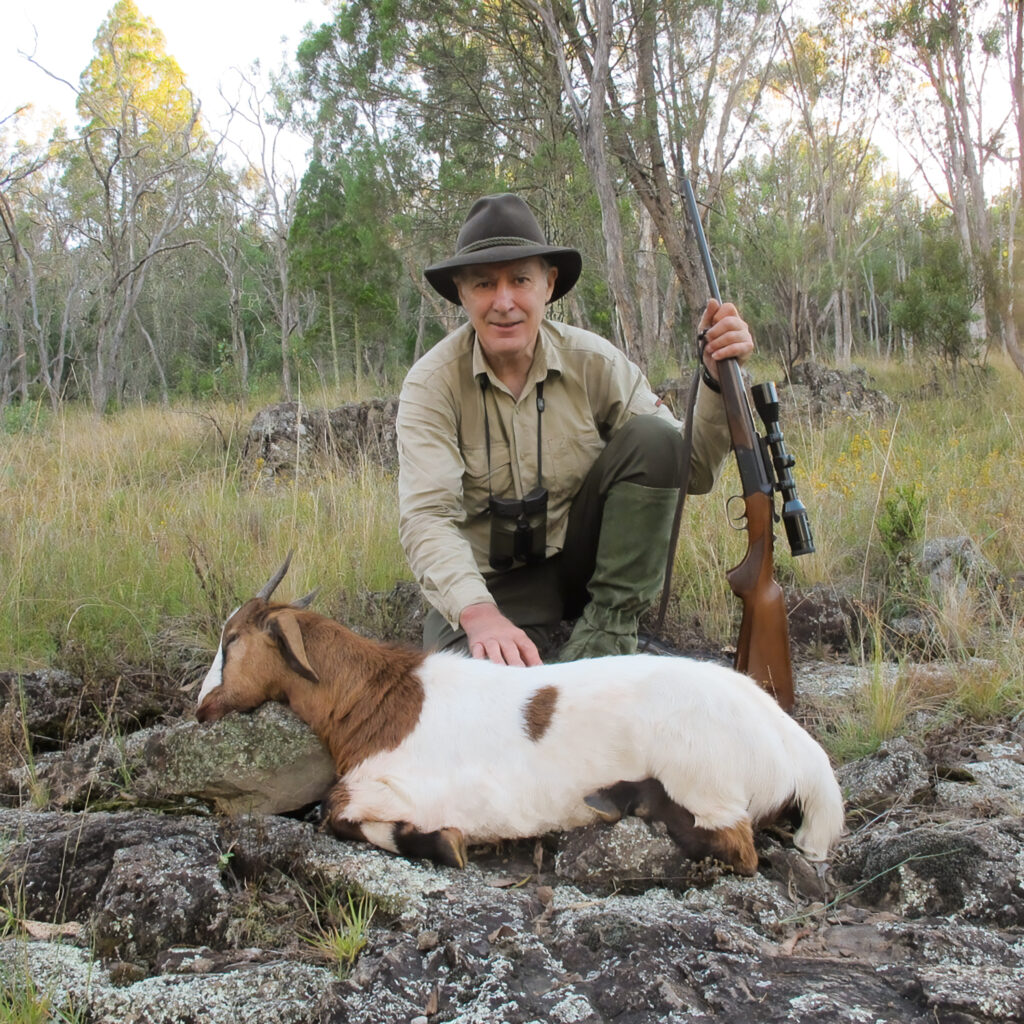
Wear long trousers with canvas knee-high gaiters and also long-sleeved shirts when hunting goats in the warmer months and take a compression bandage in your pack, because of the presence of snakes in summer.
A broad brimmed hat made of rabbit pelts reduces fatigue in the hot sun, helps when going through thick bush with the spider webs, and branches scratching your face. I carry double the amount of water when hunting goats in the hills in summer. Perhaps next goat hunt I’ll take the kipplauf into some hard-to-reach remote places in the hills in search of the holy grail – a goat with a 50″ spread.
Share this article

Related
Articles



Related
Recipes