

Trijicon Huron 3-9×40
Made in the US, Trijjcon optics have been gaining in popularity for some time and most shooters will associate their scopes and optics with their coloured, illuminated reticles.
The reticles are illuminated via fibre optics and the radioactive element tritium which negates the need for batteries. These reticles automatically glow brighter as the environment they are used in grows brighter, which is exactly what is required, with no need to turn up or down any brightness control like most electronic reticle scopes/optics. Clearly, their simplicity and toughness are why specific Trijicon models, such as the ACOG (Advanced Combat Optical Gunsight), are some of the preferred optics for military battle rifles worldwide.
Although popular in the US, Trijicon hunting riflescopes are not as admired in Australia and after using them, you have to wonder why. My introduction to the scopes came recently when my mate Terry acquired a lightly used Trijicon AccuPoint 3-9×40 with the illuminated yellow triangle post reticle. When he evaluated his Trijicon side by side with a Leupold VX3 and a Leupold VX5 at dusk, the quality of the glass in the Trijicon was apparent, when he could detect no difference between the Trijicon and the Leupold VX5.
The American standard deer hunting scope has always been the 3-9×40 with a 1″ tube, and for good reason. They tend to be lighter and are obviously less bulky, which equates to a better-balanced rifle/scope combination. The main advantage of the larger 30mm tubes is being able to allow greater latitude with reticle movement inside the tube, but most modern engineered hunting rifle/scope mount combinations don’t really need this extra amount of adjustment.
I have owned and used several quality scopes with 30mm tubes and quite frankly, for my type of hunting, they are just too bulky and tend to unbalance what would otherwise be a well-balanced hunting rifle/scope combination.
However, I do possess a Schmidt & Bender 1.5-6×42 with the red dot in a 30mm scope tube. It is a phenomenal scope, and without doubt, one of the clearest I own, but it is bulky and does tend to unbalance a walkabout hunting rifle, but is fine for stand hunting. Additionally, the battery-operated red dot type reticles are just one more thing that can go wrong on a hunt.
I came to the conclusion that I needed (or just wanted) a new scope, but definitely with some form of bullet drop compensation contained within the scope’s reticle. The Trijicon’s quality was quite a revelation to me, so when Terry advised me that Trijicon had released a stock standard type 3-9×40 riflescope with a 1″ tube, the Huron, without any reticle illumination, but with a BDC Hunter Holds reticle, I was indeed interested. The Huron 3-9×40 is a Second Focal Plane (SFP) scope and is also offered with Standard Duplex and German #4 reticles.

Some years ago, I used a Leupold VX3 with their BDC Boone and Crocket reticile and was suitably impressed, so with Trijicon offering the 3-9×40 Huron with Hunter Holds reticle, I decided to give it a try.
With first impressions, the scope appeared to be quite handsome and well made, radiating obvious quality and seemed every bit as clear as other high-quality scopes I own. Incidentally, the 3-9 is the only scope in the Huron range that has the 1″ tube, with all others having 30mm tubes.
The Huron has an Easy Focus eyepiece which is one of my favourite features and the scope’s lenses are multicoated for anti-reflection and anti-scratching with Trijicon’s own formula coatings. The easily grasped turret adjustments look to be slightly larger than others, but they also have a quick zero adjustment.
You simply pull the adjustment up, move the ‘0’ to the mark on the turret, then push the adjustment back into place. My only concerns were that the reticle may be too fine in the centre of the cross-hairs in lowlight conditions and I would have preferred that the outer/thicker reticle bars were a tad thicker. However, time on the SSAA range has so far dispelled my concerns.

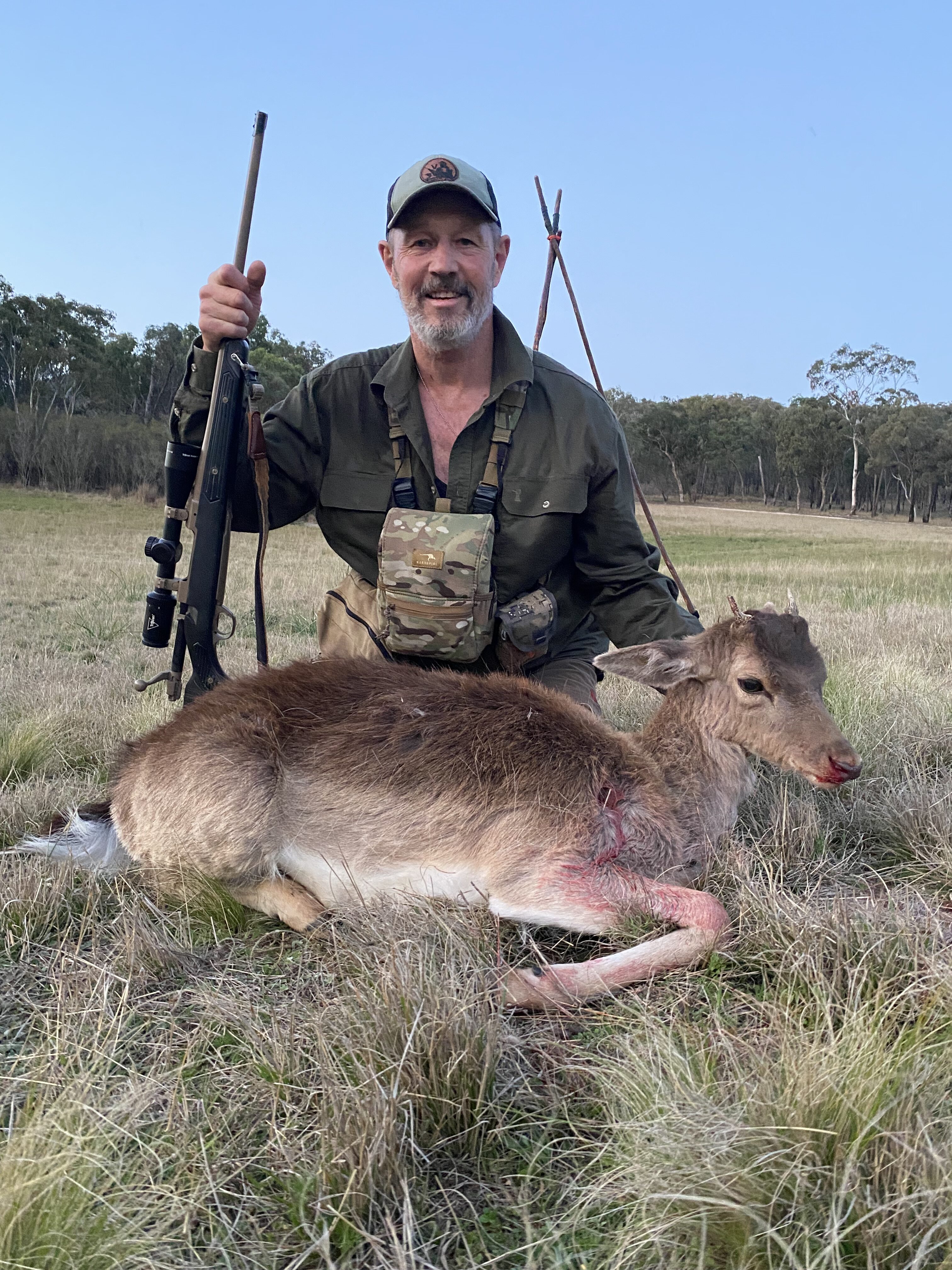
I mounted the Huron on my favourite hunting rifle, my old paddle stock Ruger .270 and after getting rounds onto paper with a handful of old reloads, I broke out the Hornady Superformance .270 130gr GMX ammo. The next group produced the smallest group that I’ve ever shot with that rifle: 3-shots into a .5″ group at 108 yards. It has been my experience that a rifle will either love or hate this kind of super performance ammo. Terry’s own Merkel .270 did not digest it well and all groups hovered around 3″ or more at 100m.


Everything appeared to be going fine at this stage, so I made some minor adjustments to put the group 1.5″ high at 100 yards, which should then be consistent with a 200-yard zero. We then moved out to 300 yards where we proceeded to have a few shots at a steel gong target, using the first hash mark under the centre cross, which Trijicon states should be a 300-yard zero.

My next two shots hit right where Trijicon said they should, but were a smidgen to the right, but a few clicks left soon fixed that. To say I was becoming more impressed with this scope after every shot would be an understatement. Well made, clear, precise and reasonably priced, you can’t ask much more than that from any scope and the BDC Hunter Holds reticle was performing as advertised.
In the real world, with a light hunting rifle, a 300-yard shot at any game animal is a long way. Having respect for the animals I hunt and considering my own ability under field conditions, I think 300 yards is about as far as I am prepared to have a shot at any game animal. However, in time I intend to have a crack at steel targets out to 400 or 500 yards just to see how the Huron’s Hunter Holds reticle performs at those extended distances.
In recent times, there has been an abundance of affordable, high-quality scopes (mostly European) on the Australian market. Due to the COVID crisis when the normal supply of hunting equipment was interrupted, my deer hunting mates in Victoria discovered the Meopta range of hunting scopes and love their performance and are now converts.
Likewise, the Swarovski Z3 range are also wonderfully clear and good value hunting riflescopes too, as are the Docter array of German scopes. I’ve also had a Zeiss Conquest 3-9×42 on my Kimber .338 Win Mag now for many years and find that it is at least the equal in clarity of my Leupold VX3 scopes.

Comparison test: Leupold VX3 2.5-8×36, Zeiss Conquest 3-9×42, Swarovski Z3 3-9×36, Schmidt & Bender 1.5-6×42 and Trijicon Huron 3-9×40:
I set up some magazine pages in the backyard, and just on dusk I did a ‘side by side’ comparison between the scopes. As the light dimmed, it was apparent that all five scopes were performing to a high level, but as the light faded further, the Schmidt & Bender and the Swarovski were the clearest of the bunch, being near impossible to pick between them.
However, I was pleasantly surprised when the Trijicon ran a close third place, with the Zeiss Conquest and then the Leupold following up the rear. Again, they are all wonderfully clear scopes, but the Trijicon was only just shaded by the Swarovski and the Schmidt & Bender, which speaks volumes for the clarity of the Trijicon glass.
It’s an excellent scope for my purposes, (lots of walking in steep country with a light mountain rifle) and I wouldn’t hesitate in recommending it, if you’re in the market for a quality 3-9×40 hunting riflescope.
Visit tsaoutdoors.com.au for contact info.
Share this article
Related
Articles


What to carry hunting: Essential gear for safety and success


Related
Recipes
Sorry, no related items found.