Can shooting help control vineyard starlings?
One day my phone rang. And, on the other end of the line was a young lady I’d recently met on an Army promotions course. “I was thinking of going to Mudgee to visit the vineyards, would you like to come?” said the voice. I had recently been up that way and knew a few people in the industry, so I replied: “Yeah sure. Should be fun.”
And it was. Among the most memorable parts was dropping in at one of my favourite vineyards in the area, Lowe Family Wines. Sitting at the table, the owner David Lowe led us through a wine tasting, all the while entertaining us with humorous tales of the business. But the conversation was by no means one-way. He took a keen interest in our backgrounds too. In our early 30s and in the Army Reserve, David was interested to find out what made us tick, including my credentials as an environmental scientist and hunter.
As things transpired, that weekend wine tour made a lasting impression. A few years later, the young lady who had invited me became my wife. And for the past 18 years, we have been enjoying visiting cellar doors together when travelling the highways and byways of this great country.
We have also made a point of pairing our wine varietals properly with our wild harvests, ensuring we complement their respective flavours to the fullest. Red wine with red meat is always an excellent rule of thumb to follow. But this is just the start. Think Pinot Noir with duck, Zinfandel with venison, Pinot Grigio with rabbit, Sangiovese with wild boar, Grenache with goat. The list goes on.
Moreover, the chance meeting with David in 2004 has taken on a whole life of its own. Since then, we have continued to catch up with him at wine tasting events. In 2013 we were meandering home south from a hunting trip at Tenterfield, busting bunnies and chasing goats with my dad. Passing through Mudgee, it was a no-brainer that we’d drop in at Lowes.
As the sun set over the vineyard, David joined us at the tasting table and we sampled recent vintages, cheese and olives. Having achieved certification as a fully organic vineyard, there was plenty to discuss about his approach to pest eradication – whether creepy crawly, fungal, feathered or furry.
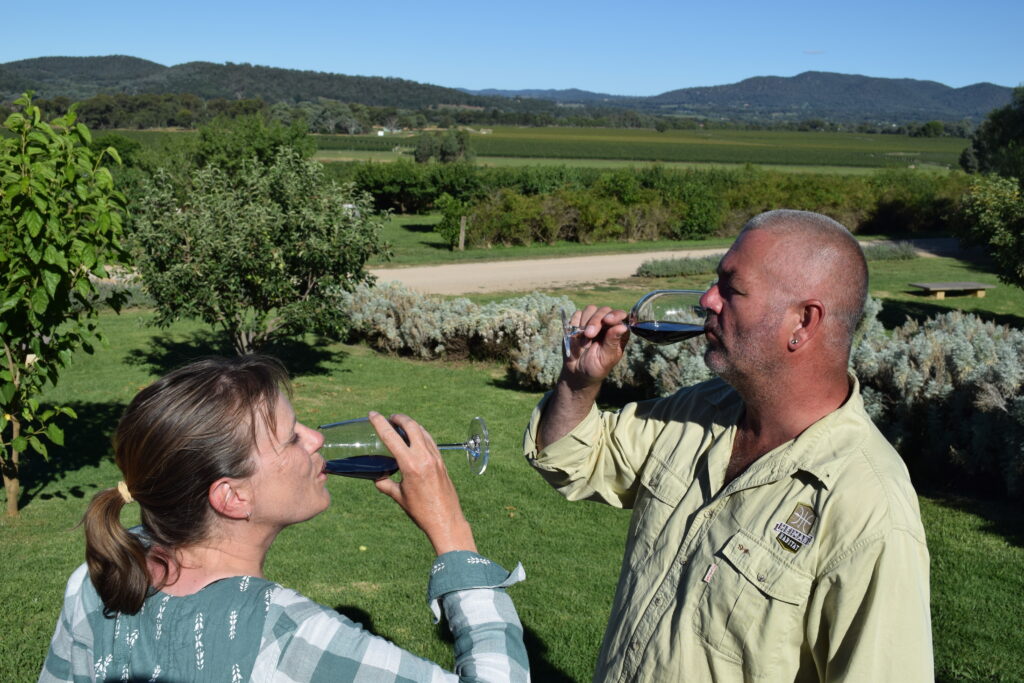
Eventually, we motioned to leave – telling David that we would need to find a place to set up camp for the night. “What are you doing tomorrow, mate?” he asked. “Just driving home,” I replied. Well, instantly, David offered that we could camp in a grove of shade trees right below the cellar door. And a half-hour later, as he said his goodbyes before heading home for the night, David dropped by our camp with a couple of half-empty tasting bottles and a box of .22LR. “Do you think you could get rid of a few rabbits for me?” he asked, grinning. “I can do that,” I replied, smiling like a Cheshire cat.
Next afternoon, I managed a short hunt before the sun set, and then was up early the following day while the mist was still blanketing the property. In the couple of hours that I’d spent patrolling the rows of vines I’d bagged six rabbits, which I happily showed David when I handed back his spare ammo later in the morning.
And I have to say it’s unexpected moments like these that really put a smile on your face. The gratitude I felt for the generosity and trust that David showed us that day has stayed with me. Kath and I have remained active members of his wine club, have watched his progress in the industry with satisfaction and his bottles have been our drinking partners at some of the most significant events of our lives together. So, when a recent road trip promised to take us back through the Mudgee region again, I picked up the phone. “David, Kath and I will be popping by. Thought we’d stop in and say hi,” said I. “Excellent. The starlings are everywhere up here assaulting my vines. Do you reckon you could do something about them while you’re here?” replied David. “Sure thing, mate. I’ll pack a shotgun and see you in a couple of weeks.”
So it was, after a road trip through the Central West – taking in sites like Wellington Caves, Siding Spring Observatory and the Warrumbungles, we arrived at Mudgee. Following a night of fellowship at the house of an old Army mate, we arrived at Lowe Family Wines to enjoy some time around the tasting table chatting with David about his new vintages, then to see what needed to be done about the starlings.
From our vantage point looking down over the vineyard, I could spy two flocks – of a couple of hundred birds each – and both sets appeared pretty skittish. However, what caught my eye most was the way the birds reacted to the several tour groups that were meandering through the vines, learning about the ripening and picking process. As soon as the groups walked within 50m of the main flock, 2-3 outlying birds – 30m from the main flock – would fly off, tweeting an alarm sound. This would trigger the entire flock to take to the skies.
Interesting… this told me that the flock had posted sentries to alert them to intruders. It meant that – as a hunter – I was never going to move within ‘cooee’ of the flock, regardless of how stealthily I stalked. But there was something else I noticed too. When the flock took flight, they always flew in an anti-clockwise direction – regardless of the direction of the incoming intruder. As they did this, they completed a semi-circle – no higher than 10m off the ground – before most birds landed somewhere about 100-150m away. Simultaneously, roughly 20 birds in the flock would venture further afield to a dead tree where they would roost with a clear vantage point over the broader environment. I learned from this that my best approach towards the flock would be from the west. That way, when they took off they would actually come closer to me – which would mean I’d have a chance to take them on the flank.
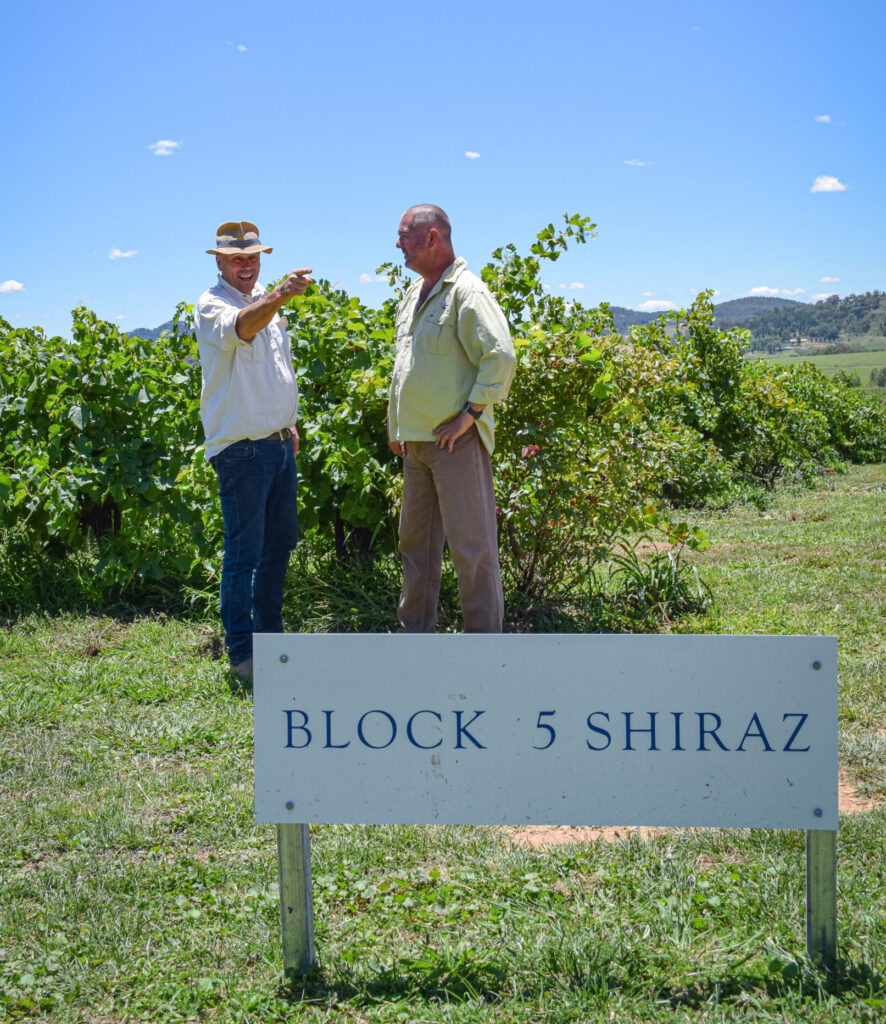
The tasting was coming to a close. But before David excused himself to entertain other guests, he and I took a walk down to the vines to talk about when would be best for me to return with a firearm to remove some of these pests. The cellar door was open between 10am and 5pm, so we agreed that I’d steer clear during the day. Instead, our little family would spend some time sightseeing in the local vicinity.
With the 19th century gold rush town Gulgong 20 minutes up the road, and Australia’s ‘oldest surviving gold mining town’, Sofala, just an hour’s drive from Mudgee, there’s no shortage of history in these parts. And Mudgee’s swimming pool is one of the best council-run pools we know. These attractions – and the vineyards of course – are just some of the reasons that the Mudgee region is such a tourism drawcard. So, we set off with a promise to return to Lowes before the cellar door closed, giving time for us all to enjoy an antipasto platter – and for Kath to imbibe a late afternoon drop of Mudgee liquid magic.
As you picture all this, you may begin to wonder whether there’s something a little incongruous about shotgunning starlings on a vineyard. However, wine-making remains simply another form of agriculture, afflicted with its own array of challenges, including those that are posed by pest animals. Hares, rabbits and even deer can threaten the viability of crops, and foxes will use vineyards as a refuge from which to stalk lambs or chickens in adjacent fields.

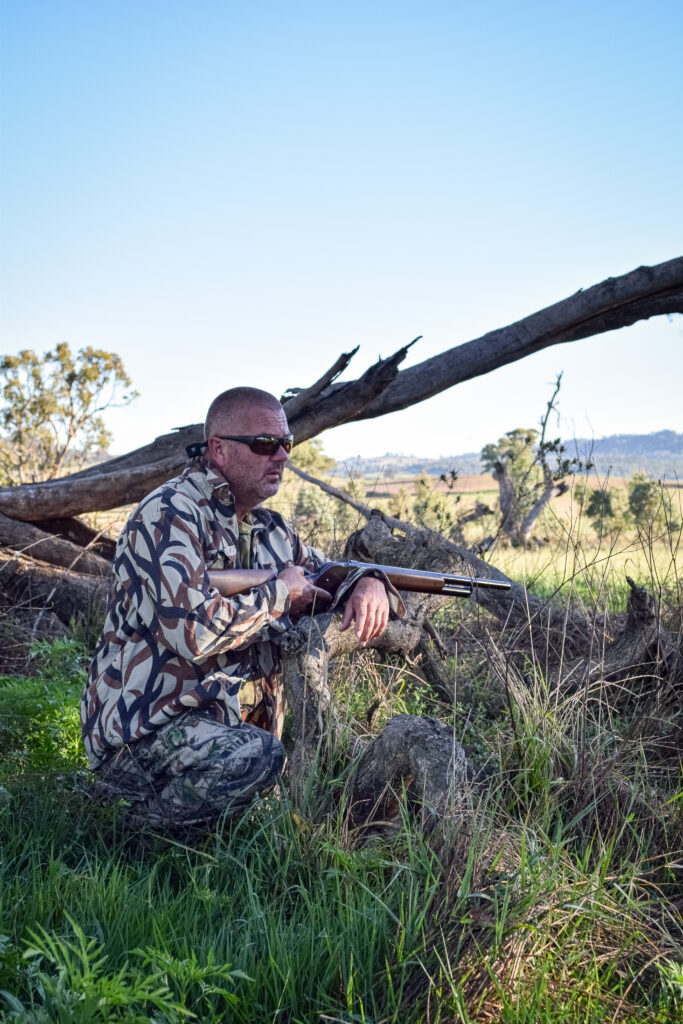
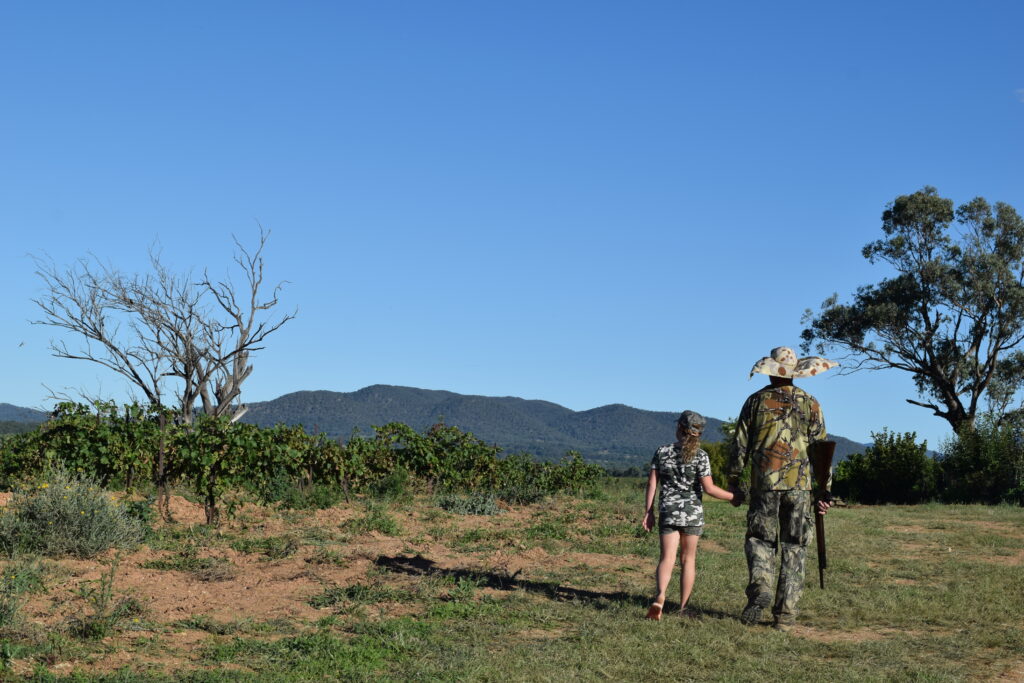
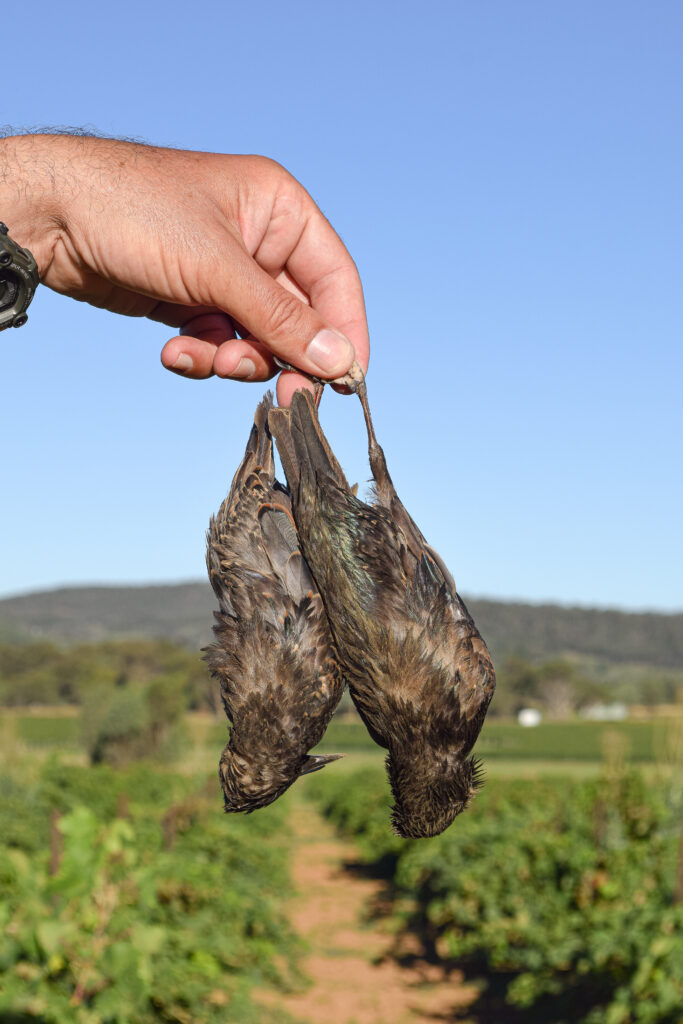
So, off I went with my Australian International Arms Chisholm Trail reproduction of the Winchester 1887 12-gauge lever-action shotgun. As the birds were flying anti-clockwise, I headed to the western edge of the vineyard with the intention to walk in from there. And, you know what – the tactic worked. As I approached along one of the rows, a flock took off ahead of me. They wheeled in the sky – going north in the first instance and then circling back towards me. With one shot aimed directly at them, I dropped two birds as they flew past. A shot from behind dropped another three. The remainder of the flock circled back and landed in the vines at the other end of the row.
True to form, a small group of them perched on the old dead tree. It was closer to me than the flock, so I approached them directly. From under the branches, I took aim at the birds above who seemed strangely unconcerned by my presence. Boom! Two more feathered pests fell from the heavens. Regrettably, the rest of the flock circled deeper into the vineyard.
It was about this time that I learned the true obstacle to hunting in a vineyard is the vineyard itself. The vines are arranged in ‘blocks’ which are square to rectangular in shape, and here the rows were 100m long. Each block comprises rows, with the vines grown on a fence, supported by many strands of high tensile wire to hold the heavy bunches of grapes.
So, every time the birds took off, I needed to walk well over a kilometre to attempt to edge close enough again to reengage them. It wasn’t long before I felt like I was chasing my own tail around the vineyard.
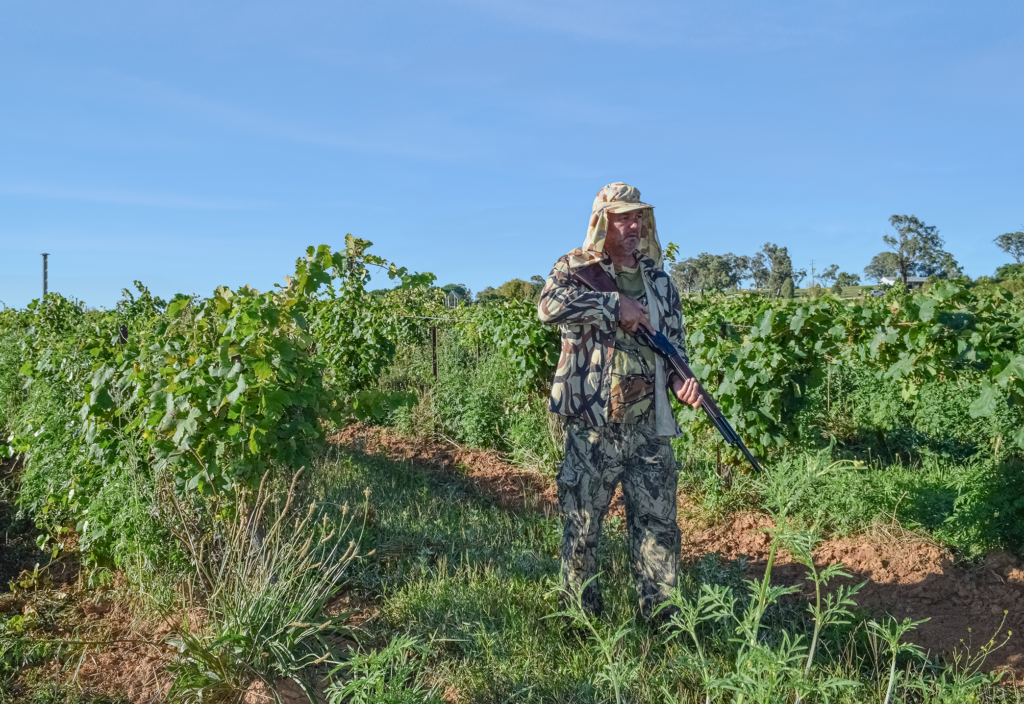
Over the following half-hour, I bagged only two more birds – and these were at the carpark as I exited the vineyard. Still, I always enjoy a challenge, so we delayed our return home so that I could spend a few more days on the hunt. In the mornings, I would arrive early with a fox whistle, while in the afternoon I focused solely on the starlings. And then a strange thing happened.
On day three, as I started my afternoon hunt and approached the restaurant’s garden with my daughter in tow, the flock took off. But this time they didn’t circle. Instead, they picked up and went deeper into the vineyard. And every other time I approached them that same day, they again flew directly away from me.
And so it was that I learned another thing, which is that starlings are highly adaptive to intrusion. Which gives me something to reflect on before I head out again next time. Perhaps I’ll need to return to the property with a posse and move in an extended line through the blocks, 50m apart. Perhaps indeed. After all, when your quarry adjusts to your tactics and changes its behaviour, it pays to have a Plan B.
Introducing the European starling
Sturnus vulgaris – commonly known as the European, English, or common starling – was introduced into Australia in the 1850s through to the 1880s. This act of environmental vandalism was committed by acclimatisation societies and landed gentry in the vain hope that they might destroy insect pests to crops. Native to Eurasia and northern Africa, the starling is now a global species – indeed, it’s a global pest breed.
When breeding, they nest in tree hollows and the like, to the point that they’ll even nest in the cracks in old fenceposts. The birds are aggressive when competing for nesting sites and readily drive out our native species.
When not breeding, starlings can congregate in large groups of up to 20,000 birds. At nighttime, they roost in dense foliage for cover. At sunrise, they disperse in smaller flocks and head to a variety of feeding areas.
Breeding season peaks between August and September but can last up to January. A clutch of eggs can have 4-8 eggs. Starlings can breed twice in a season. So, if you want to hunt them to support a land manager’s vertebrate pest management strategy, stalk them on crops in late summer through winter before they breed.
Since their introduction to Australia, starlings have spread across 30 per cent of the continent, where they have a considerable and negative impact on agriculture and the environment.
Soft fruits, especially cherries, peaches and apricots, as well as all varieties of grapes, are particularly susceptible to damage from starlings. Accumulation of their faeces at roost sites provides a breeding ground for many germs that can cause illness in people and can affect the health of the roost tree itself. Their faeces can also contaminate grain in silos and livestock feed lots.
Across primary industries, the average level of crop loss attributed to starlings is as high as 15 per cent and some growers have reported 100 per cent. In economic terms, starlings cost horticulture and agricultural industries almost $300 million a year, making them by far the worst and most costly of introduced birds.
Further, they compete with native hollow-nesting species – such as parrots and cockatoos, owls, treecreepers, martins and pardalotes – which adversely affects Australia’s biodiversity.
Share this article
 Website
 Facebook
Related
Articles


Related
Recipes