


ThermTec Ares 660 thermal scope
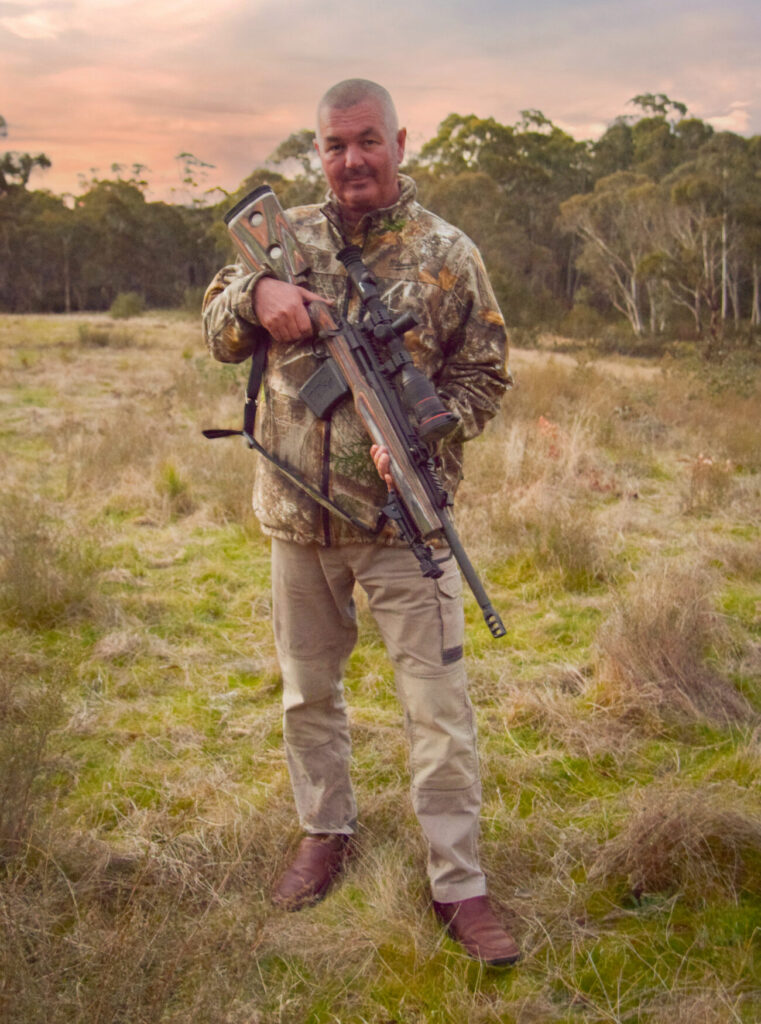
Decades of experience in the Australian Defence Force and Australian Federal Police included me training others in night vision equipment. So, the next generation of thermal imaging equipment hitting the commercial market is of much interest. This led me to the ThermTec Ares 660 Dual Field of Vision (FOV) Thermal Sight.
The first thing I noticed was the care taken in the packaging. Everything was snugly tucked away so nothing moved about. Inside there was a smart padded carry-case with a moulded interior for when the riflescope isn’t in use. Nestled inside this was the scope complete with mounting rings, user manual, USB cord, additional battery turret and the eyecup.
ThermTec was established in 2011 and specialises in the research, development, manufacture and distribution of thermal imaging products. Their worldwide network provides thermal imagery security cameras and handheld thermal sensors to various industries.
ThermTec supplies monoculars and riflescopes to Australia through its local distributor, Hunt The Night, whose YouTube channel has a swathe of demonstrations and instructional videos. You can check out the company’s products and their application to hunting and commercial vertebrate pest management.
Night vision versus thermal
Night vision devices, your phone’s camera and the human eye work on the same basic principle – they take visible light energy reflected off a surface and a sensor then turn it into an image. This means, without a light source like the sun, a spotlight or the reflected light off the moon, you can’t see anything. Even night vision goggles (NVG) only amplify the available light from the stars and the moon. With no external source of light they are useless. This is why NVGs have a built-in active light source such as an infrared LED for no-light or extremely lowlight situations.
However, thermal imagers are different. While some people refer to them as ‘cameras’, they are more correctly defined as ‘detectors’. That is, they detect heat. While we can feel heat energy, we can’t see it. That’s because heat and light energy exist on different bands of the electromagnetic spectrum.
While a camera can identify light from the visible spectrum, heat (thermal energy) can be ‘seen’ by thermal imagers that perceive energy from the infrared bands. What’s more, thermal imagers can sense tiny differences in heat – as small as 0.01°C. When viewed through a thermal imager, these small differences in wavelengths are rendered onto a screen which converts them into visible light that we can see.
The first real breakthrough in thermal imagery came in 1929 when an electronic television camera with infrared sensitivity was invented for British Air Defence. Subsequently, thermal imaging devices were developed as a military capability and the technology remained classified until the 1950s. During this period, thermal technology advanced to capture the first thermal imagery on film.
In the 1960s, thermal imagers started to define different temperatures and lenses were introduced to clarify the image. From the 1980s, the technology became ever more accessible to the point that, today, thermal imagers are used as handheld diagnostic tools among a wide variety of industries including automotive, electrical, firefighting and more. They are also now readily available to those within the hunting and vertebrate pest management community.
What to expect for your money
When it comes to the commercial market, not all thermal imaging scopes are born equal. Generally, anything under $5000 is likely to be superseded tech, not waterproof, lack functionality and/or manufactured to a standard achievable by a budget-minded entry level user.
The next price gamut is $5000-$10,000. These products service the median consumer to high-end professional. Within this bracket, the difference between scopes exists mainly in the variety of functions and the sensor, display, optical and operational characteristics. Then we have $10,000 and above. Here you start looking at military applications with MilSpec ruggedness and next generation technological developments. At $6799, the Ares 660 sits within the affordable sector of the professional user. So, let’s have a look at what this scope offers.
Scanning the specifications for the Ares 660, it’s clearly brimming with features and functionality. It offers a dual field of view (FOV), with the revolutionary lens having a dual/switchable objective lens of 20mm/60mm focal length.
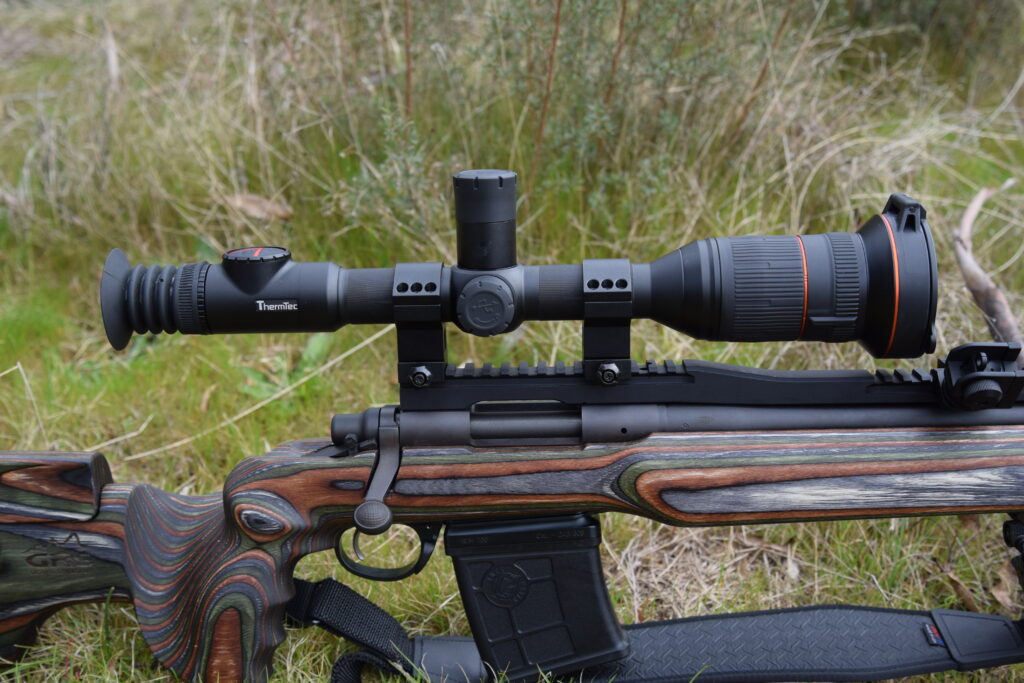
Focal length is a key metric because the longer it is, the narrower the FOV and the higher the magnification. In the case of the Ares 660, the FOV varies from 21.7° × 17.4° to 7.3° × 5.9°. Depending on the hunting conditions, each of these properties provides the necessary information to make good decisions. Once a target is located, just change the FOV to zoom in. From there, the scope offers a 1-5x variable digital zoom to really finesse the point of aim.
Enabling a simple scan of a paddock – from either a bench or from the shoulder – this variable objective lens largely negates the need for an additional thermal monocular to use as a spotting scope.
Having optics is one thing. But to effectively read the infrared band you need a detector. To this end, the Ares 660 features an in-house ThermTec microbolometer that delivers a resolution of 640 x 512 pixels of 12µm in size. It has the spectral range of 8-14µm and a noise equivalent temperature difference (NETD) of < 35 mK (25°C, F# = 1.0), which combined, makes it a high sensitivity detector. This input is displayed on an AMOLED screen with 1024 x 768-pixel resolution at 0.39″ in size.
Focus at your fingertips
Some users may choose to affix the Ares 660 to a dedicated firearm that’s used as a night hunting rifle. Alternatively, you may prefer to use different rifles/chamberings for various target species. The Ares 660 has five zeroing profiles, making it highly adaptable for use with multiple firearms. You can save the zeroing data of each individual firearm and it will be ready next time you mount the scope, regardless of which rifle you’re using.
I planned to test the Ares 660 on my new Remington Model 700 Police Tactical in .308 on a GRS stock. But I decided against busting bunnies from long distances at the expense of $2.75 per shot and blowing the quarry to dust, leaving nothing to eat. At 20 cents a shot, a .22LR provided dinner far more economically and the .308 can be saved for hunting deer and pigs.
During the first couple of outings, I simply mounted the Ares 660 to my rifle and spent time familiarising myself with its features – no rounds in the chamber, nor magazine fitted. The Ares 660’s operation is simple, intuitive and ergonomic. I could adjust everything from the seated benchrest position without fault or discomfort. Sure, I made some rookie errors, but I quickly improved with familiarity.

In the field, I spent many evening hours happily viewing the world around me. The exceptional image quality is simply a beauty to behold. At a distance of 100m, I could see feathertail gliders 10cm long jumping from tree to tree. When they stopped, I could still distinguish them on the branches even though the trees themselves were giving off heat after a day absorbing the sunlight.
At 175m, and using the 20mm lens, I could clearly see a small herd of four-legged animals. Switching to the 60mm lens, I could plainly discern three deer. When I zoomed in to 5x magnification, one of these animals took up the entire reticle with the aim point readily established. All this and I hadn’t even zeroed the firearm to the scope yet.
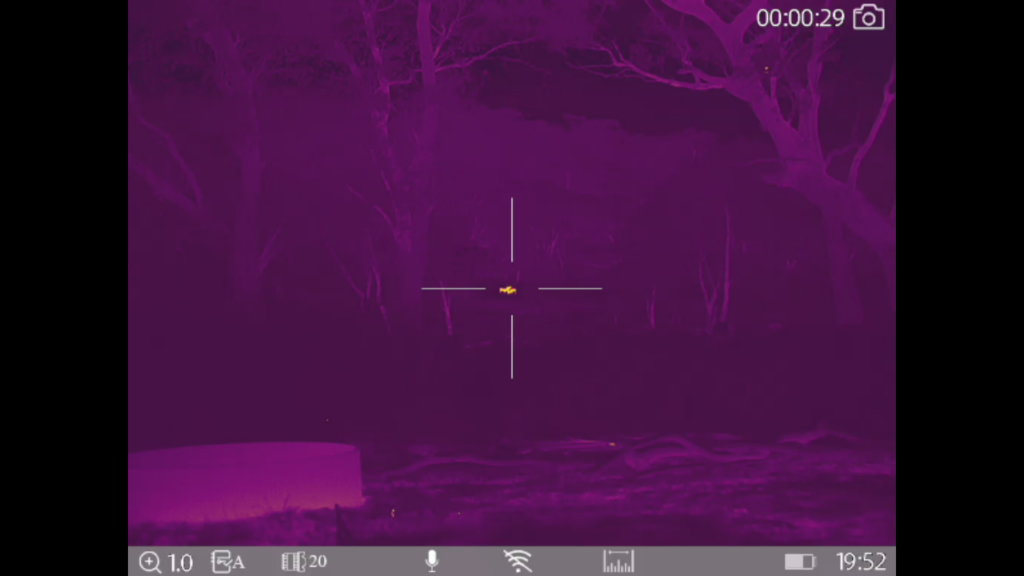
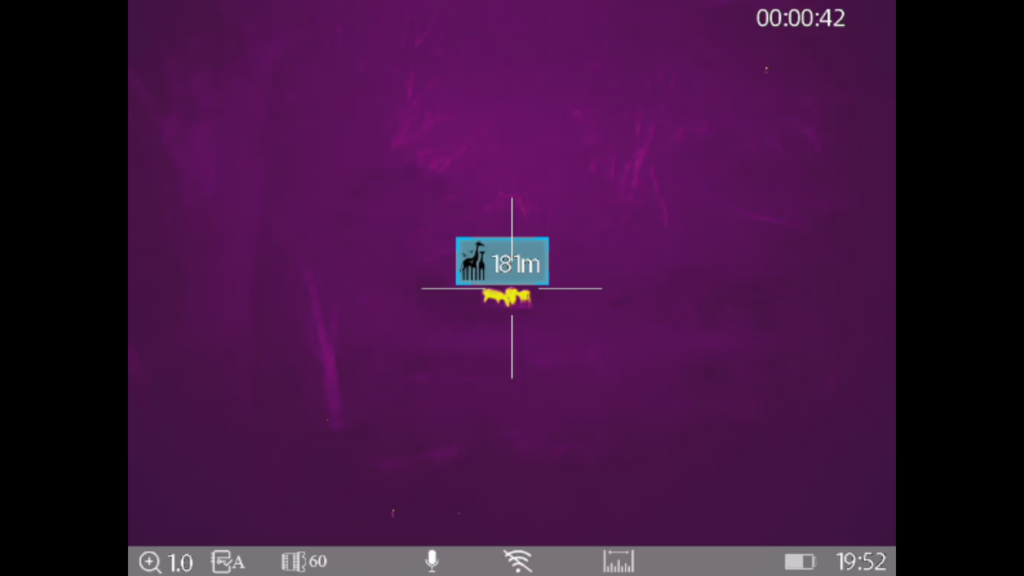
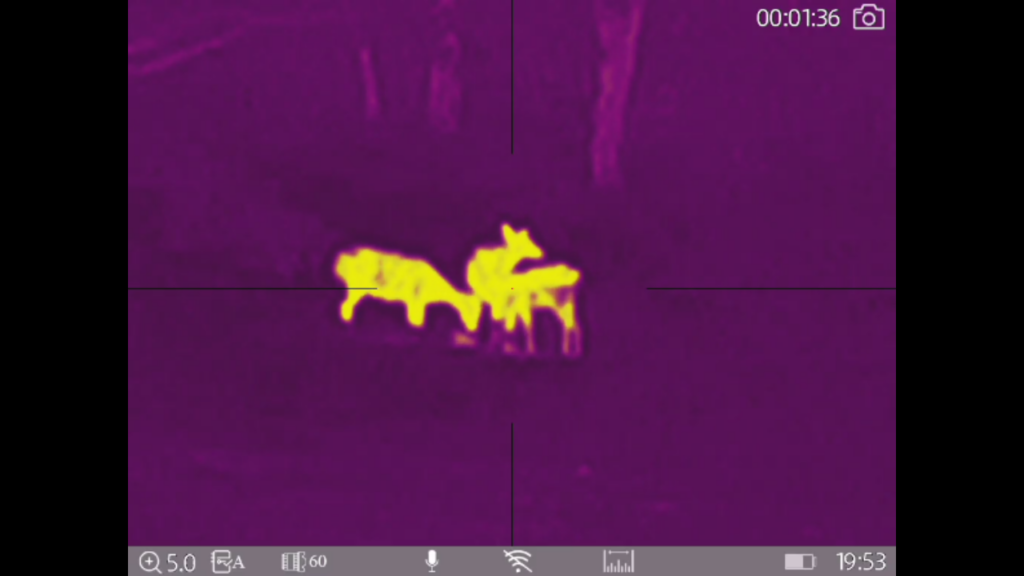
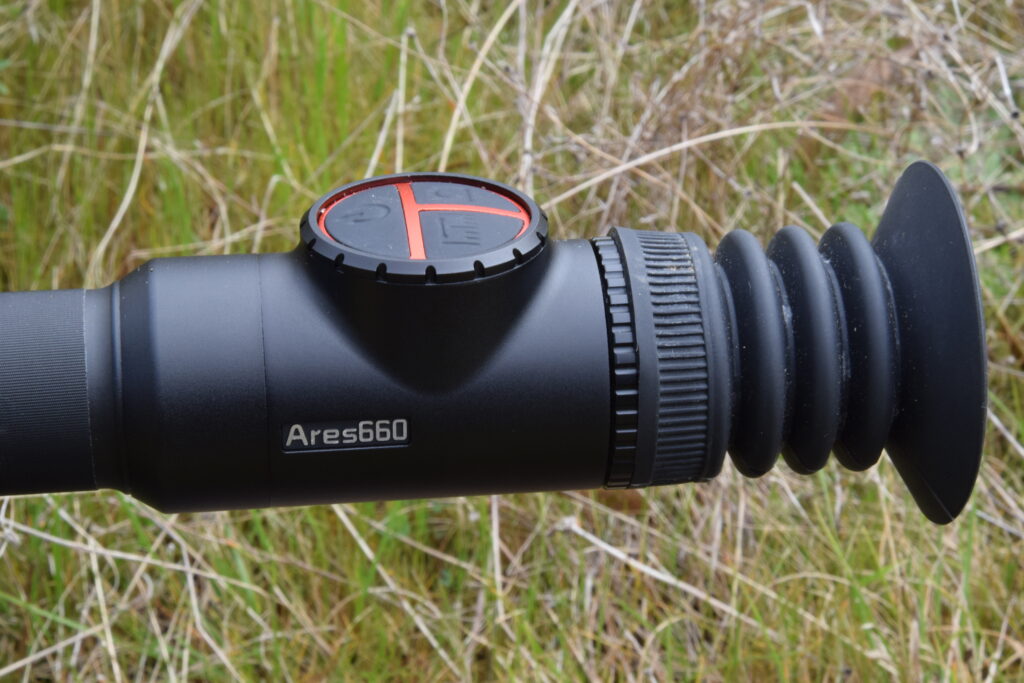
Making this magic happen is a logically configured piece of equipment. Forward of the eyecup, there’s a dioptre adjustment ring to help sharpen the image on the screen to cater for your level of vision – much like prescription eye lenses do. In front of this ring is a small vertical turret that houses the power button (with a standby function so you don’t waste any of the 6h battery life). Below this is the picture/record button for capturing still images and video. Directly adjacent to the picture button is the artificial intelligence (AI) rangefinding button. Using the 20mm objective lens, the AI rangefinder was ‘spot on’ straight out of the box.
Using the 60mm lens, it was still okay until operating the digital zoom, where the AI rangefinder seemed to double the actual distance between the scope and the target. Indeed, this was the only fault found with the Ares 660.
In front of this turret mounted button assembly there are three further turrets midway down the tube. The left-hand turret is the rotary function that operates the main menu and digital 1-5x zoom. The vertical option is the battery compartment, and the right-hand side turret is the USB-C port for downloading your images and video (and for firmware upgrades and tech support).
Forward of these is the objective lens focus ring that makes everything come into attention. Further on is the magic maker, being the dual FOV ring. A simple rotation effortlessly changes between the 20mm/60mm variable objective lens. Simply rotate until it clicks into place. Lastly, there is the lens cap.
Menu magic
Once you’ve turned on the scope, the main screen tells you exactly what’s happening. On the bottom left-hand corner, the display indicates the level of digital zoom. Next to this is the rifle profile selected, then the FOV selected, microphone, Wi-Fi and AI rangefinder (these last three are struck out if the functions are disabled). Finally, on the far right is the battery life and time setting.
While rotating the left-hand turret operates the digital zoom, if you short press the button on the face of the turret it will take you through screen adjustments like brightness and contrast. These will appear on the left-hand of the screen. This allows you to adjust the display screen for the light sensitivity of your eye. A long press of the same button will take you to the main menu where the adventure begins.
At the top of the list is the Colour Palette, which provides the choice of six display colour settings for the screen’s heat signatures. There is also Wi-Fi and hotspot functionality to enable you to share images remotely through the ‘Smart Thermal’ app available via Apple or Google Play stores. Imagine being able to allocate your images with the property owner or your family as you take them.
There are also seven reticle designs to choose from. These include: red, blue or green centres and black or white cross-hairs; picture-in-picture (PiP) view; and a dimmable on-screen display (OSD) with three colour modes.
There is a heat tracking function to mark the hottest part of the target on the screen in real time. Turn on the microphone and you can talk your way through the hunt on video to playback later in MP4 format. And there’s no need to be afraid of taking too many pictures or video as there is 16GB of internal storage.
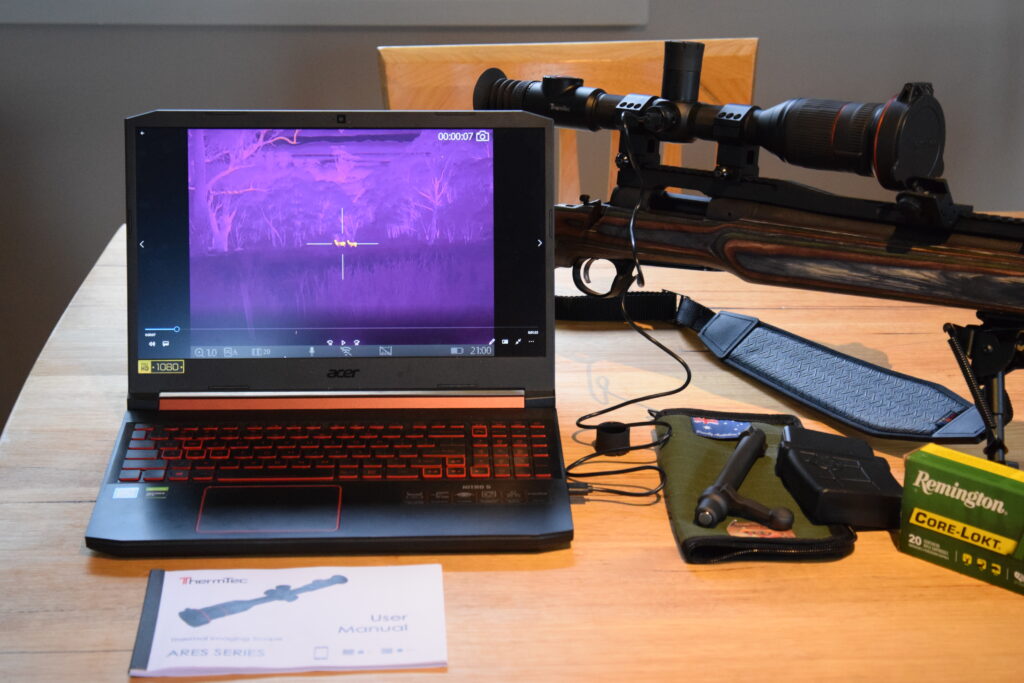
In terms of zeroing, you have the option to choose between one-shot auto zero or freeze-frame manual zero. The one-shot zero is easy and reliable. In this mode, choose the zeroing distance and insert the rifle name/calibre. Once you’re ready, select auto-zero. At this stage, you’re asked to confirm the range to target before you’re given 15 seconds within which to take your shot. From your point of aim, the software will detect the fall of shot on the steel plate target and make the adjustments for you.
Using the manual zeroing method, first take a shot at the target, then take aim at the point of aim again, and select the freeze frame function. From here the X and Y co-ordinates can be manually adjusted after observing the heat signature of the fall of shot. While this method takes longer than auto-zero, for those who wish to stay in control, it’s fairly intuitive.
Regardless of whether you select auto or manual zero, you’ll need to zero the firearm for each FOV separately. But with a one-shot zero on a steel plate, it’s easy to double check.
Supporting all this tech, the Ares 660 offers an IP67 protection rating, meaning it’s waterproof, dust-proof and fog-proof. The three-year warranty provides peace of mind as does the offer of ‘lifetime technical support’ including firmware upgrades as the tech team continues to enhance its background support.
Conclusion
The ThermTec Ares 660 from Hunt The Night heralds a new era of thermal technology for the civilian market. It offers excellent sensors and outstanding ergonomics, delivering an advanced and well-rounded thermal optic.
Visit huntthenight.com.au or call 1300 486 444 or 03 5925 7780.
Techs and Specs:
Type: Uncooled
Resolution/pixel: 640×512/12µm
Spectral: 8µm-14µm
NETD: <35mk
Frame rate: 50Hz
Objective lens: 20mm/60mm
Field of view: 21.7 x17.4 / 7.3 x 5.9
Digital zoom: 1-5x continuous zoom
Eye relief: 50mm
Exit pupil: 6mm
Dioptre: -5 to +5
Reticle: Choice of seven
Reticle colour: Black, white, red and blue
Display type: Amoled
Display resolution, pixel: 1024×768
Display size: 0.39″
Colour palette: Choice of six
Max. recoil power: 850 Gs
Mounting brackets: Standard 30mm rings
Shooting record: Yes
Auto zeroing: Yes
Manual zeroing: Yes
Zeroing profiles: 5
Picture-in-picture: Yes
Wi-Fi: Yes
AI ranging: Yes
Image calibration: By lens cover
USB interface: Type-C
Photo/video playback: Yes
Memory card: 16GB
Replaceable battery: 18650 or 18500 Li-ion battery
Battery reverse connection: Yes
Battery life: 6hr
Operating temperature: -20 to +50°C
IP grade: IP67
RRP: $679918650 or 18500 Li-ion battery
Battery reverse connection: Yes
Battery life: 6hr
Operating temperature: -20 to +50°C
IP grade: IP67
RRP: $6799
Share this article

 Website
 Facebook
Related
Articles



What to carry hunting: Essential gear for safety and success


Related
Recipes
Sorry, no related items found.