


Reading a stag’s antlers: What genetics, age and nutrition reveal
There are few more stirring sights in the wild than the image of a mature red stag bellowing his challenge for all to hear in defence of his harem. I recall fondly that this was one of the first outdoors experiences I shared with my son, as we sat quietly on a ridge bathed in afternoon sunlight and watched a master stag strutting his stuff. Of course, what drew and held our attention was not just his posturing but the magnificence of his rack, which looked to be better than 14 points.
Without doubt the allure of hunting a red deer stag lies in the potential trophy to be had, for in many cases the quality of his antlers determines if the shot is taken or not. Antlers are a stag’s pride and joy and have a wealth of insights to offer the observant hunter. Interestingly, many of us in admiring a recently harvested trophy might not fully appreciate the cycle of life they represent.
Growth
Antlers grow progressively larger over a stag’s life and are shed annually, usually in September or early October. By late February they have reinstated themselves atop a stag’s head. The most mature and oldest animals cast first, with the younger stags, like spikers, following suit over the next seven weeks or so. It can take two days for a stag to lose both antlers as they rarely, if ever, cast simultaneously. Remarkably, antlers are the fastest growing of any mammalian bone structure. This amazing feat of nature can be seen first-hand in this YouTube clip. The quality of the growth is determined by three factors: genetics, age and available nutrition. It is the inherent differences in these three aspects which produces the variations to be seen between racks.
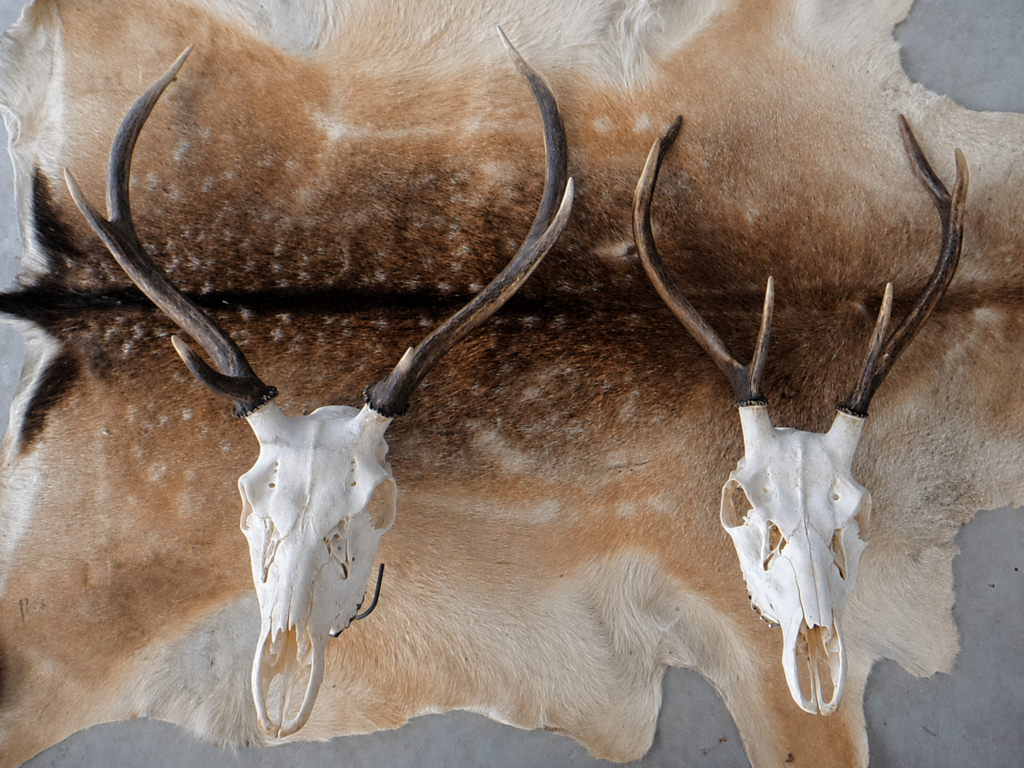
Red deer shed and regrow their antlers to a predictable pattern linked to their breeding cycle. Each antler grows from a point on the skull known as a pedicle. Both pedicle formation and subsequent antler growth is driven by testosterone levels and the need for each stag to have the best possible rack to dominate his rivals during the breeding season or roar. Testosterone levels vary significantly at different stages of the growth cycle. Understandably they are highest to stimulate pedicle growth, but surprisingly drop away to quite low, almost barely detectable levels during rapid antler growth. The levels start to rise again to facilitate antler calcification and velvet shedding before peaking during the breeding season and tapering off again resulting in the eventual casting of the antlers. In fact, antlers actually grow when testosterone levels are lowest and a stag has the highest levels of testosterone when he is in hard antler.
Antlers grow from the tip via a process of calcification which sees initial cartilage growth converted into bone. While growing, antlers are covered in velvet, a vascular layer which supplies the necessary oxygen and nutrients to the developing bone. Once the antler has achieved its full growth potential, the velvet is shed and the antler’s bone dies. This dead bone structure is the trophy so eagerly sought by hunters.
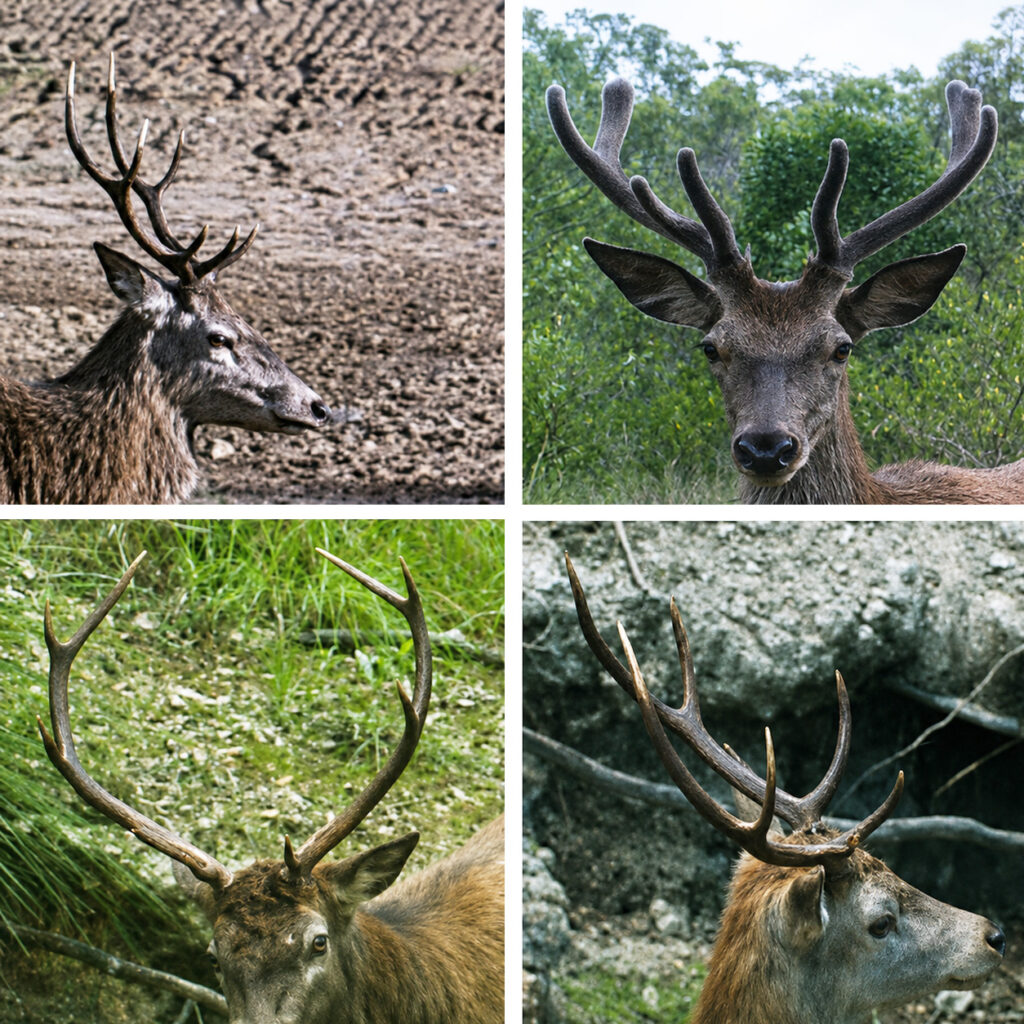
To the mature stag though they represent something altogether different. They are the essence of his masculinity and the key to his ability to attract and hold a harem against rival males during the roar. To this end in March every year the hills are littered with thrashed bushes and rubbed trees as the stag seeks to remove the now quite itchy velvet covering his antlers. This process also helps to colour the antlers and give definition to the tines or points, particularly the uppermost ones. Come April he is well equipped to compete with other dominant males to satisfy his evolutionary urge to pass on his genes to a new generation.

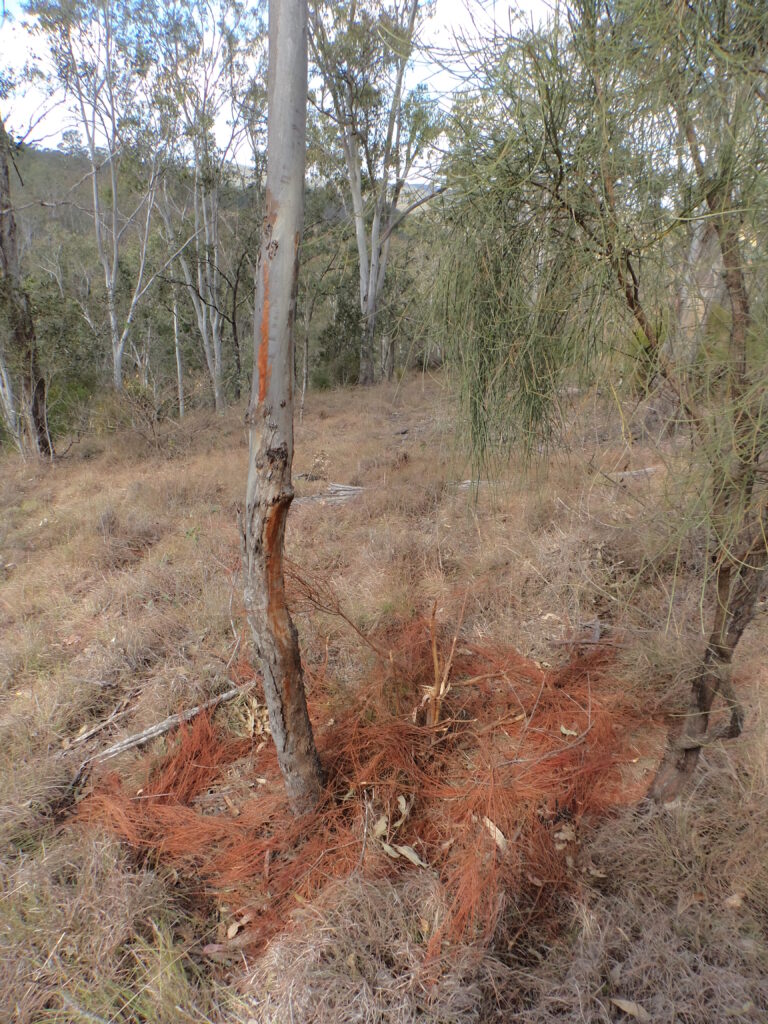
shredded bushes.
Form
Red deer antlers have an established form unique to the species. Though similar, no two racks are truly identical and many show asymmetrical traits which I believe bring a desirable uniqueness to individual trophies. Quite naturally as a stag grows older and more mature, so too does the size and quality of his antlers – to a point. As a general observation a red deer stag will reach his full potential at around 10 to 12 years of age and after that his rack will begin to deteriorate or ‘go back’, meaning his antlers actually become smaller and misshapen.
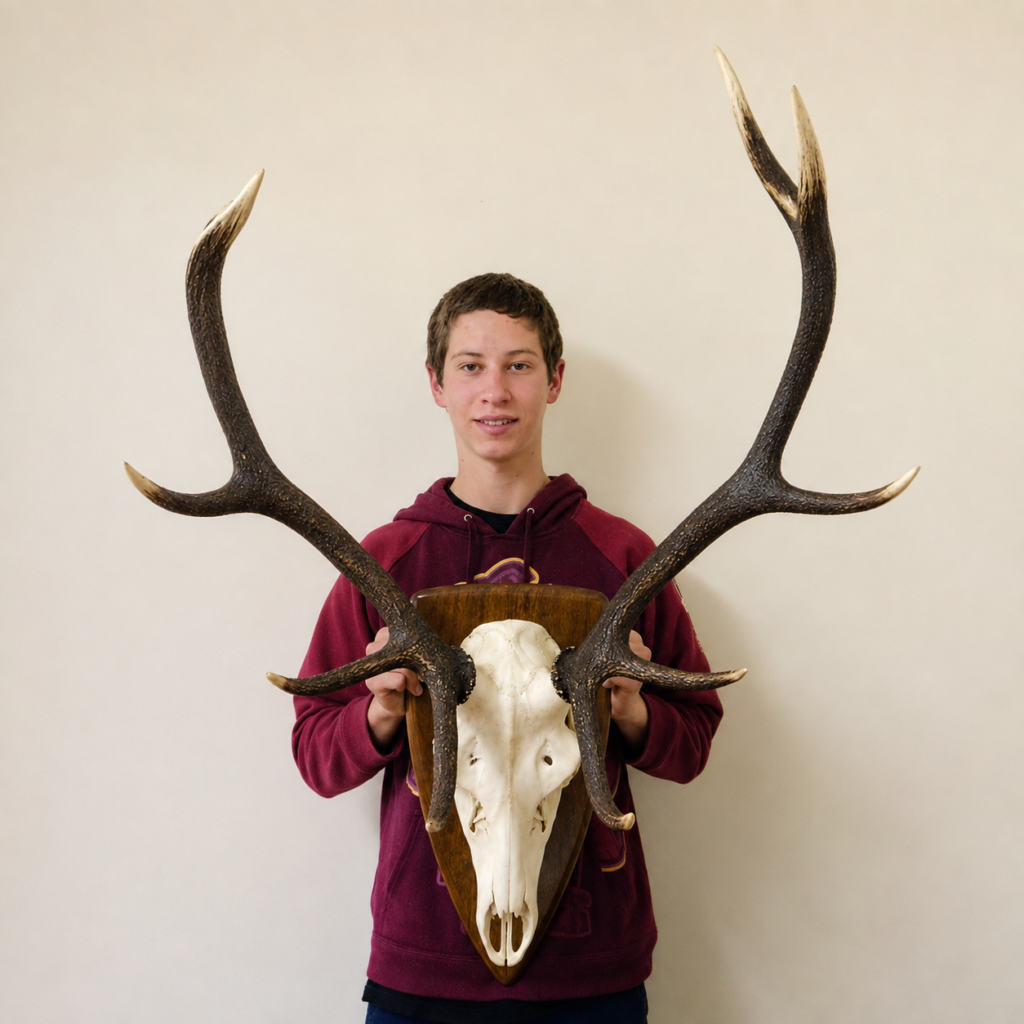
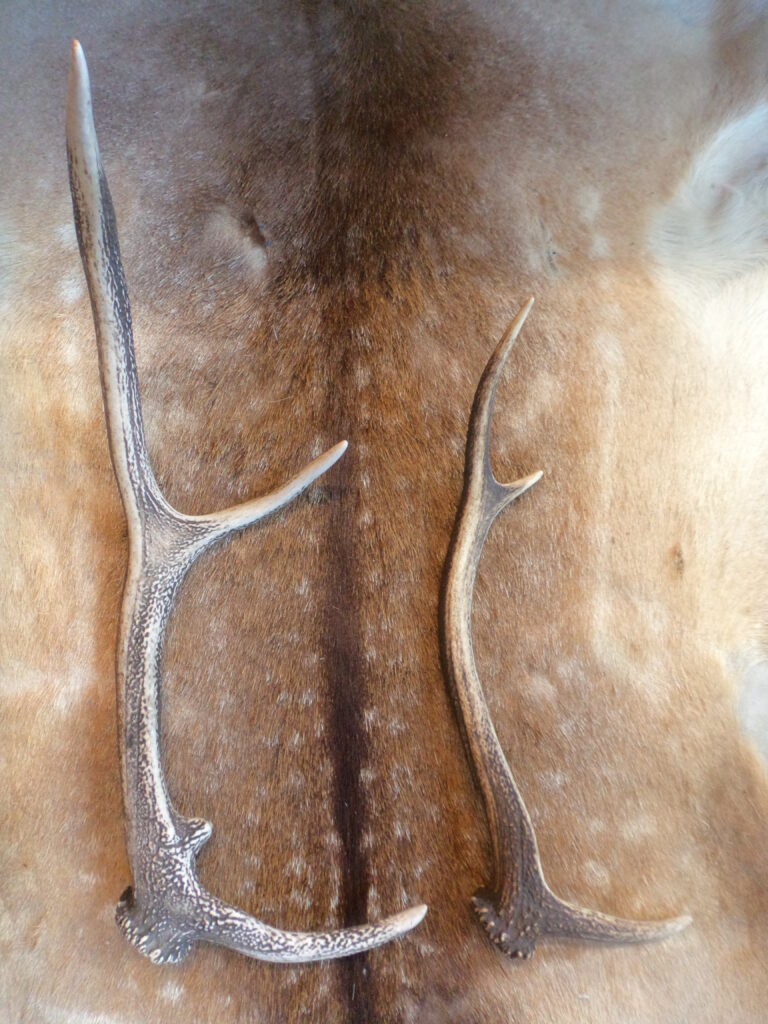
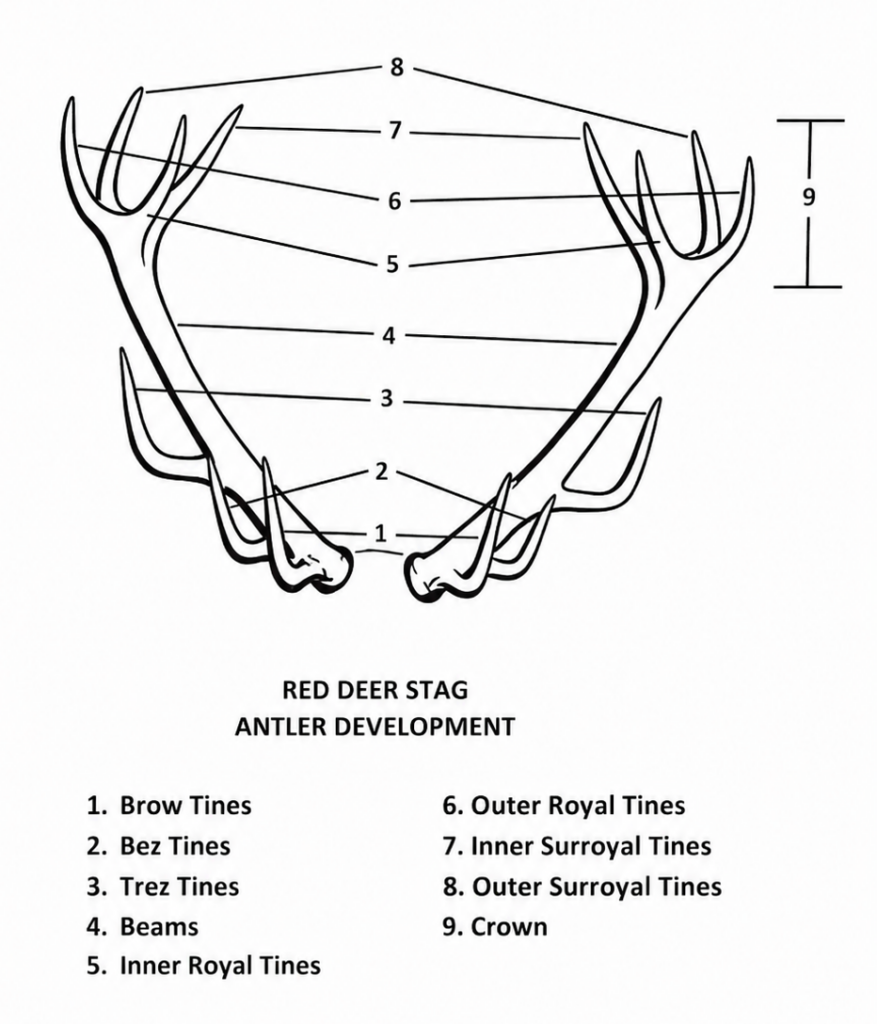
As antlers grow they become more substantial in terms of the spread, thickness and weight of the beams. Each beam, or upright, will develop tines or points which, with the passing of the years, become more pronounced; longer, thicker and more numerous. While there is an expected pattern to tine development, each stag is at the mercy of his genes. I have seen 10-pointers with secondary brow tines and no royals and vice versa. I have seen eight-pointers that have been both brutishly thick and elegantly slender. My point being it is common for antler development to be asymmetrical. Subsequently, it is therefore risky to try and age a stag by the size or quality of his antlers (teeth are much more reliable indicators) for as previously highlighted his genetic inheritance is paramount, second only to the nutrition available to support the prodigious appetite of a growing rack. This being said, certain features of an antler’s development can be linked to an approximate age.
| Approximate age (years) | Known as | Number of points | Typical/possible features |
|---|---|---|---|
| 1 | Fawn/yearling | 0 | No antler growth. Pedicles from six months. |
| 2 | Spiker | 2 | Small coronet and slender beam thickness. Very narrow spread beams. Two uprights. |
| 3 | Pricket | 4 | Small coronet and slender beam. Narrow spread beams. Uprights, brow tines. |
| 4 | Staggard | 6 | Variable coronet and lower beams thickness. Well spread beams (variable). Uprights, brow, trez tines (various combinations possible). |
| 5+ | Hart | 8 | Thick and weighty coronet and lower beams. Widespread beams. Uprights, brow, bez, trez tines (various combinations possible). |
| 6+ | Hart | 10 | Thick and weighty coronet and lower beams. Widespread beams. Brow, bez, trez, royal tines (various combinations possible). |
| 7+ | Royal Imperial Monarch Emperor | 12 14 16 17+ | Thick and weighty coronet and lower beams. Widespread beams. Brow, bez, trez, royal and surroyal points (various combinations possible). Well-developed crown with surroyals ‘cupped’ and as long as lower tines. Additional secondary, atypical tine growth. |
Trophy potential
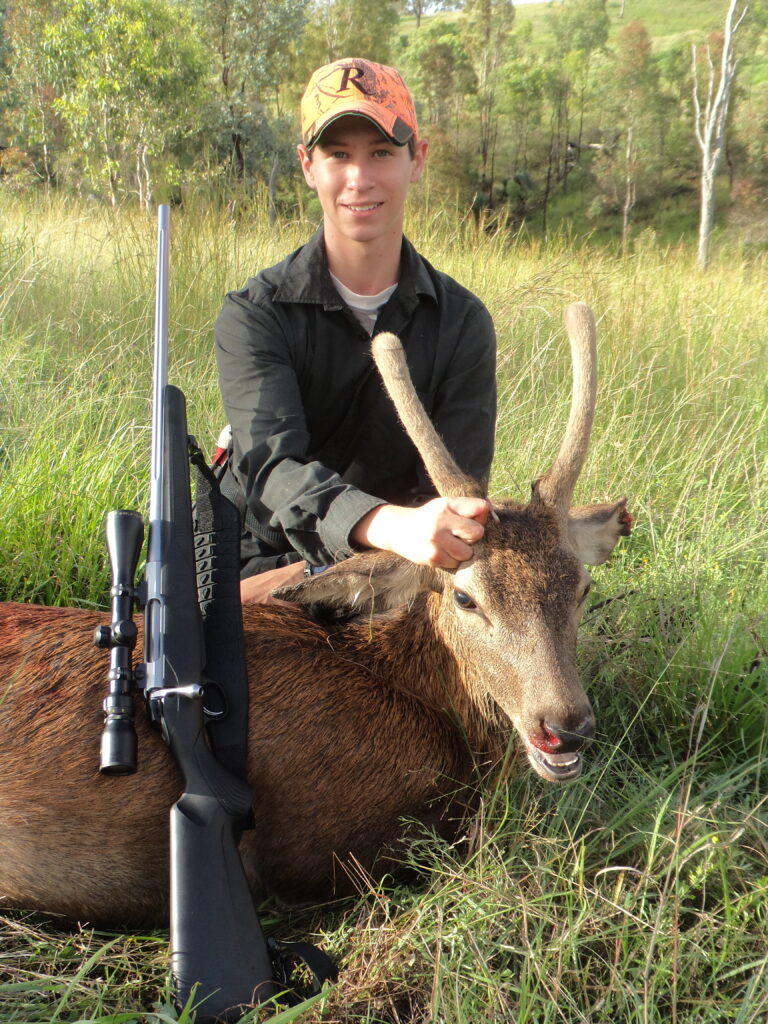
The deer stalker’s ultimate goal is to take that perfectly symmetrical 12- or 14-pointer, but the opportunity to grass a trophy red deer comes down to responsible and ethical hunting practices. Unless hunting for meat with antlers as an attractive by-product, hunters need to adopt the ‘let ’em go and let ’em grow’ mentality. Particularly if there is already a representative or superior head hanging in the trophy room. If animals with trophy potential are regularly harvested, rather than allowed to mature, the opportunity to take a ‘fair chase’ Royal or Imperial head will disappear. I appreciate fully the young or novice deer hunter’s thrill at taking that first stag and would not seek to deny anyone the experience. However, with maturity as a hunter comes the realisation that it is really about quality and not quantity and the true measure of a trophy deer hunter is the willingness to forego immature, lesser racks in the quest for a true Monarch of the Glen.
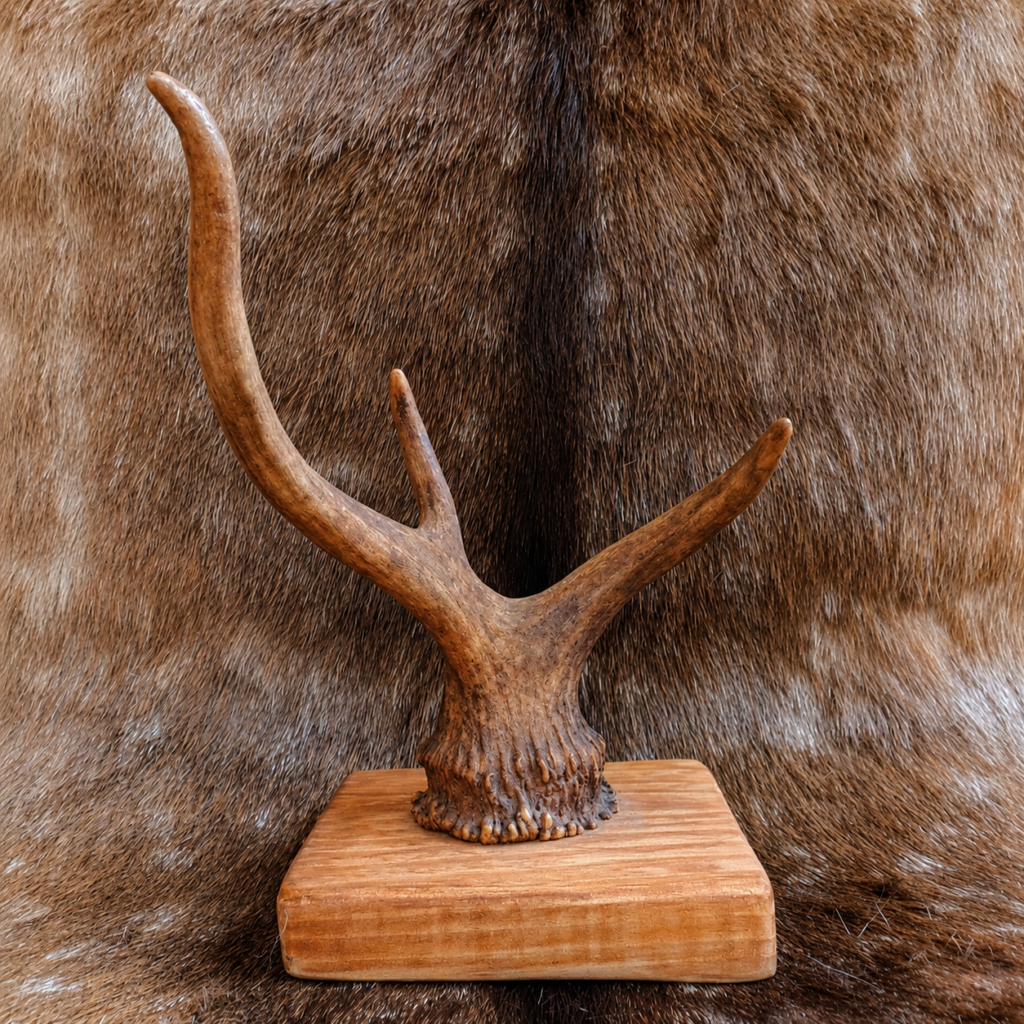
Since there is no point in shooting an animal in velvet, there is a limited window of opportunity to take a trophy stag. Primarily the season stretches from mid-March to early October, with of course the annual roar being absolute prime time. Beginning in late March and extending to early May, the roar sees the big boys come out to play, as usually solitary master stags shed their inhibitions and cautious nature to pursue mating rights. They are loud, active and visible meaning it is significantly easier to stalk in and grass them. This being said stags can be had in hard antler as late as October if you take the time to be afield. I have taken several quality heads from bachelor herds in early October and have seen among them stags without antlers, having recently cast, some in velvet and others still holding fast to hard antlers.
In the final analysis, regardless of whether you love them or loathe them, red deer have become a fixture in the landscape not just in south-east Queensland, but in many places across the country. They provide a valued hunting resource to the outdoor enthusiast and offer the opportunity to secure quality eating meat in the form of venison and with a little work a top-class trophy. The antlers that adorn a mature stag, especially those which have been allowed to develop to their full potential, are surely one of nature’s marvels which I am sure will continue to motivate like-minded hunters to gear up every Easter in pursuit of that perfect head.
Share this article
Related
Articles


Related
Recipes