The science behind random cam hunting gear
There has always been a common set of principles guiding the way to think about ‘why things are seen’. Granted that different disciplines approach the topic with their own unique twist, the core tenets remain the same. They all relate to the visual senses and can be summarised as ‘5 x S’ and an ‘M’:
- Shape
- Shadow
- Silhouette
- Surface/shine
- Spacing
- Movement.
With the rapid expansion of thermal imaging technology, radiation is a non-visual factor that has been added to this ‘age-old’ list. Given that hunters have always known that some animals seem to have a sixth sense, perhaps radiation is it.
Standing out
Although the meaning of all these words may seem intuitive, it’s worth discussing their specific relevance to the challenge of hunting game. That’s because they represent some of the key variables likely to stand between you and a decent stalk. Other considerations relate to aural senses and understanding game behaviour but they’re topics for another day.
Shape – The shape of an object (including prey) is distinctive, particularly when it’s in contrast to its surroundings. Clear-cut outlines will give you away. And remember, there are no straight lines in nature.
Shadow – This is a double-edged sword. Objects give away their presence by casting their own shadow. Conversely, something that is concealed in other shadows is harder to detect as it does not cast a shadow of its own.
Silhouette – This may occur when an object is sky-lined or is set against any flat/smooth surface such as water, sand or an open paddock. Silhouettes may also be cast against a single colour (eg, light green against dark green) or if you throw your own shadow against yourself.
Surface – This term refers to shine, colour, texture, pattern; texture versus pattern; or horizontal versus vertical. Examples include the glean of a gun barrel or bow limb and the shine of skin. Even cam paint shines so instead of using cam paint or shrouds, try not shaving instead.
Spacing – Nature is random. Have you ever looked out the car window at pine plantations in their neat rows? The same problem occurs with multiple hunters – we instinctively space ourselves the same distance apart, even when crawling.
Movement – Sudden movement attracts the eye. How many times have you spotted prey as it flaps insects with its ear? Now, imagine what a six-foot human looks like walking or doing its own flapping.
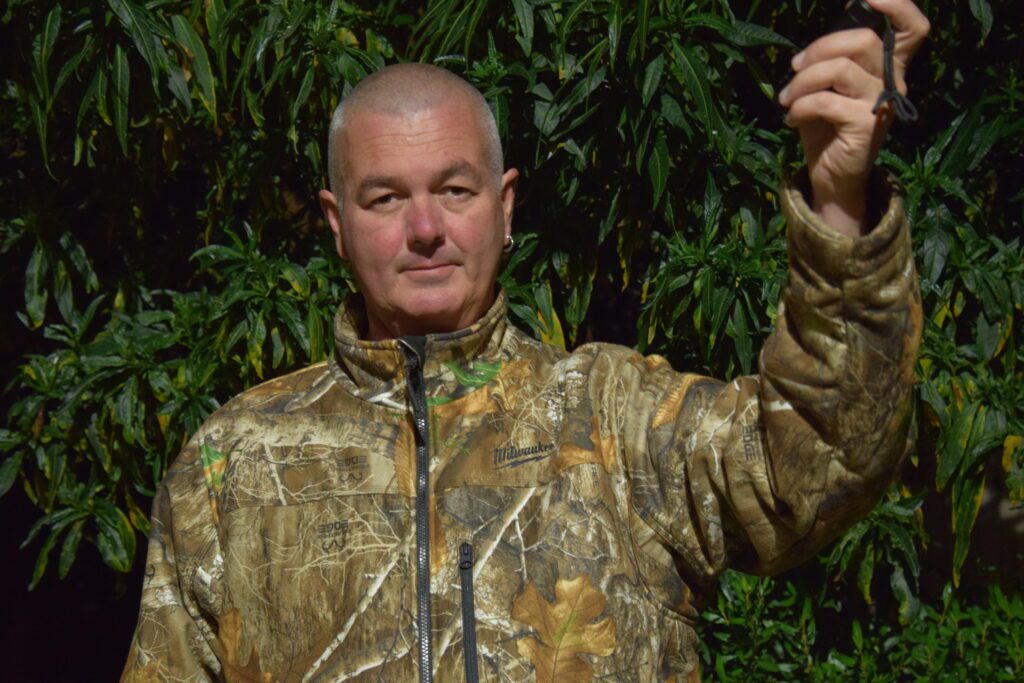
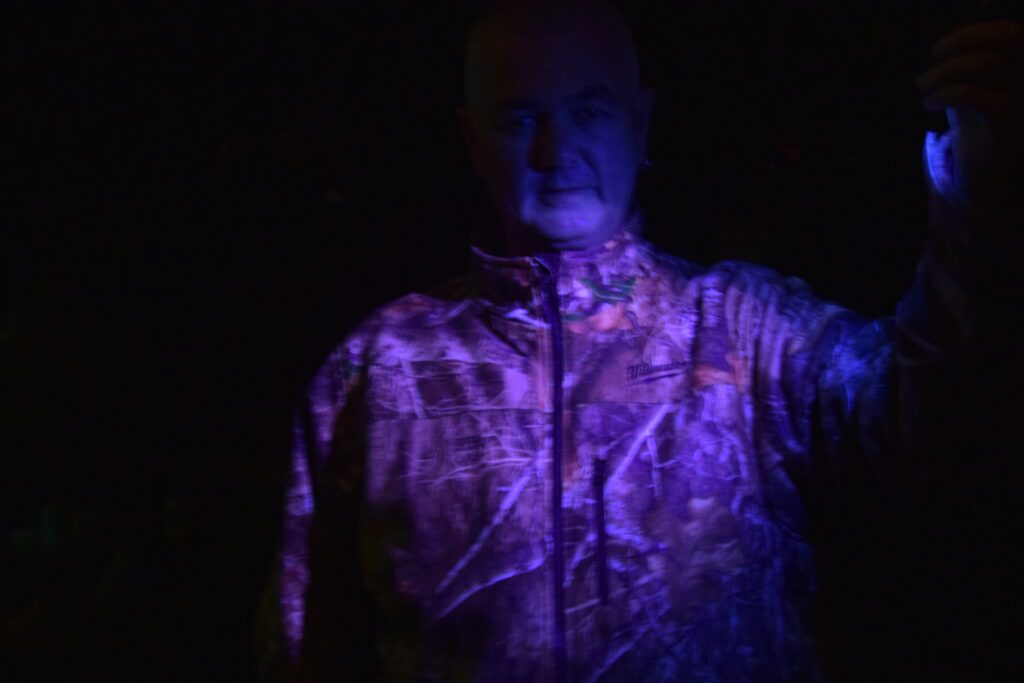
Radiation – This is not just infrared like a thermal sight, but UV too. Some animals see in near-UV. Thus, anything blue (like denim jeans) shines like a torch in their eyes, meanwhile reindeer have been found to rely on UV light to spot lichens to eat.
Industrial concealment
The principles of camouflage have been used for tens of thousands of years by indigenous populations across the world in both hunting and warfare. For example, some cave paintings show hunters wearing animal skins, masks and grass skirts to blend-in with their prey. Similarly, Native Americans are renowned for painting their faces and bodies with mud, ochre and other natural dyes to match the seasons and terrain. They also wore animal hides, leaves, grasses and twigs to look like their surroundings. By the mid-19th century, British soldiers in India cottoned-on to the art of concealment and camouflage when they began to dye their white uniforms with tea, coffee, tobacco juice, mud, mulberry juice and curry to reduce their visibility from a distance.
But it wasn’t until 1890 when the first widely circulated book on camouflage was written, The Colours of Animals, by an avid follower of Darwinism, Sir Edward Poulton. In it, he talks about the utility of colour and markings in both predator and prey, linking adaptations in camouflage to the principles of natural selection.
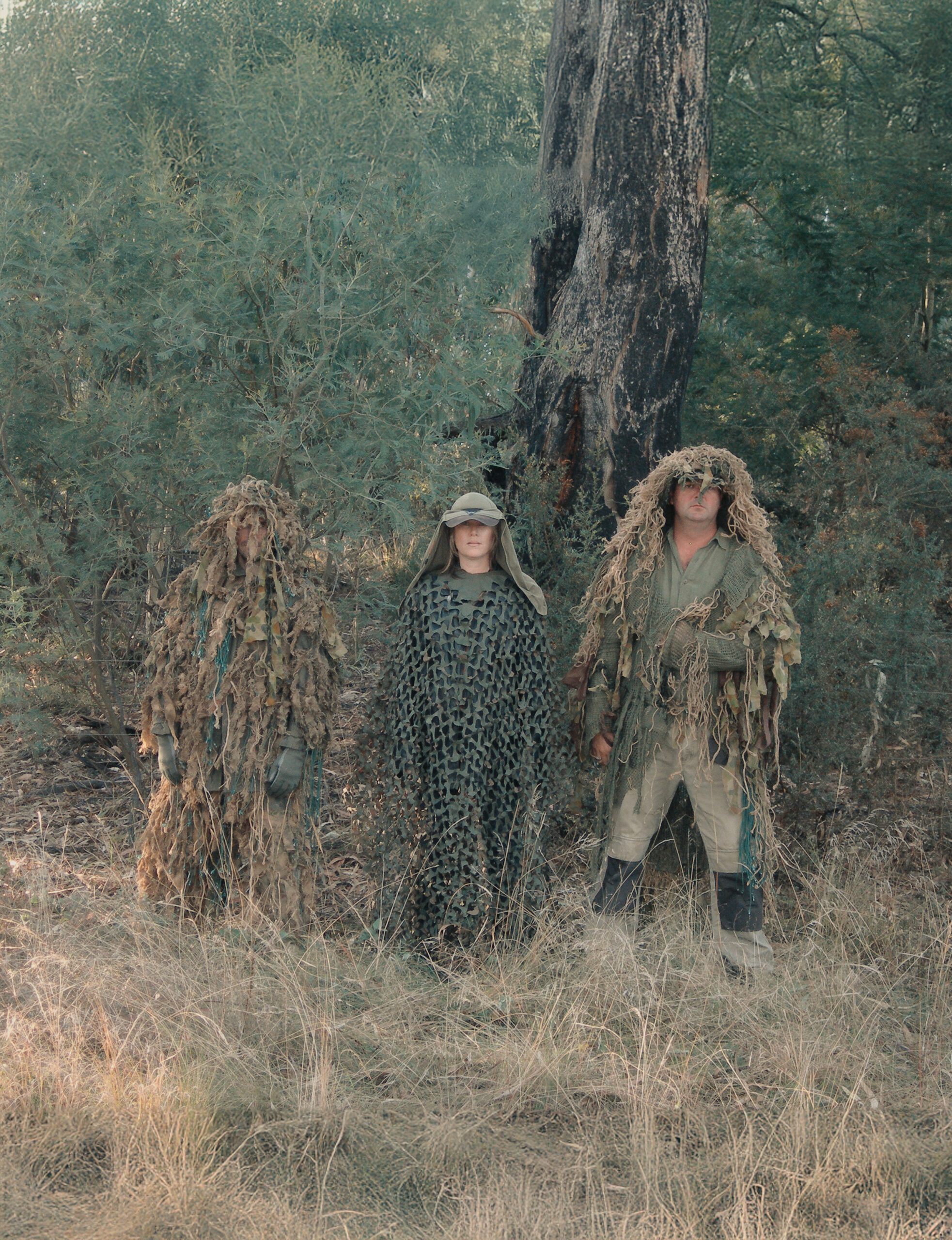
While Poulton’s book met with varied levels of public acceptance, the first reputed use of a ghillie suit by the military was soon after, during the Second Boer War in South Africa, by a Scottish Highland regiment called the Lovat Scouts, who were Britain’s first sniper unit and specialists in reconnaissance. They adapted the ghillie suit from the traditional clothing of Scottish gamekeepers and stalkers who wore it to blend-in with the natural environment. The word ‘ghillie’ is a reference to ‘Ghillie Dhu’, a fairy clothed in leaves and moss in Scottish mythology.
By the start of World War One, armies had established units of camouflage specialists with a primary focus on concealing buildings and large artillery pieces. As the War progressed, the US and British forces began painting their ships in ‘dazzle’ camouflage to avoid being shot by submarines.
But personal camouflage among military personnel didn’t gain prominence until the Second World War. Informed by scientific proponents of Poulton’s theory on camouflage, the impetus was industrial manufacturing developments that allowed for mass printing of patterns onto fabric. In response, many nations began to generate their own unique camouflage patterns, with different versions to match different battle landscapes (snow, desert, jungle, forest).
These days, camouflage has become a multi-million dollar business. In military applications, technology is being developed to conceal body heat from enemy sensors, to match fabric to its surroundings and to bend light to render objects ‘invisible’. More broadly, camouflage as ‘fashion’ has become a cultural norm.
Regrettably, when it comes to commonly available hunting clothing, the focus on fashion and mass producibility can often compete with functional utility. The reality is that much of the ‘camouflage’ clothing on the market is designed predominantly to appeal to the human eye. But what appears camouflaged to a human may simply look like one big, flat block of shiny colour to a game species. The contrasts and boundaries that we see in a fabric’s pattern may not be evident to a pig, deer or goat, and the synthetic material and dyes used in manufacture may emit a UV signature that glows (see Australian Hunter 82).

Getting the gear
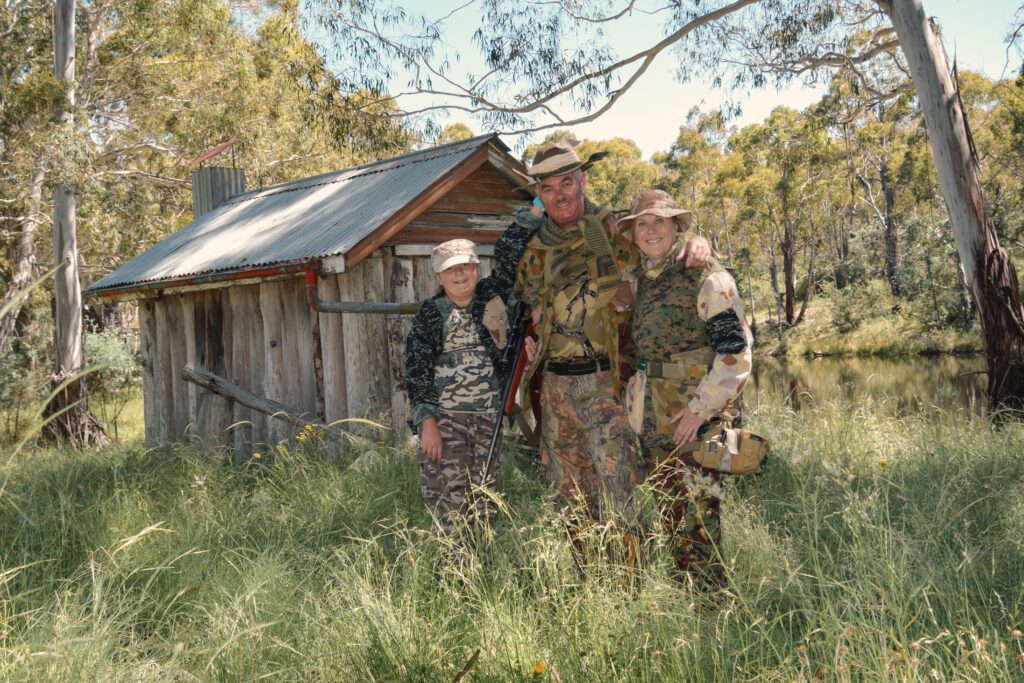
Unless you’re a skilled seamstress or tailor, the challenge in making your own camouflage clothing is to generate something that fits well enough to provide a similar level of comfort and convenience to off-the-shelf products. Although it might be tempting to simply reach for an old set of hand-me-down camos from an ex-military mate, remember – these cams were designed to fool human eyes, not animals’.
Besides, being old, faded and dull, they will likely ‘shine’ under the sun. So, while a standard set of army cams may appear to be suitable for the recreational hunter, it’s worthwhile to think about things a bit more deeply. For example, ask yourself: Is the fabric natural or ‘shiny’ synthetic? Will the camouflage pattern have any deceptive effect on an animal? Will the clothing’s shape and texture simply look like a flat plane or silhouette?
In the past, I’ve had times hunting in ex-military camouflage when I’ve been ‘spotted’ by an animal for no apparent reason. The most memorable occasion was during a hunt near Tenterfield. On that day, I’d managed to move into position for a perfect ambush on a mob of goats as they approached. The wind was in my face, I was shaded by the overhead limbs of a gum, with a hakea behind me, and I was feeling supremely confident. Then it happened… off to the right 30m away a goat stopped and looked straight at me. The last thing I saw of that mob was their tails going over the ridge at the speed of light! I wasn’t moving, so they must have been alerted to my presence by something else they could ‘see’.
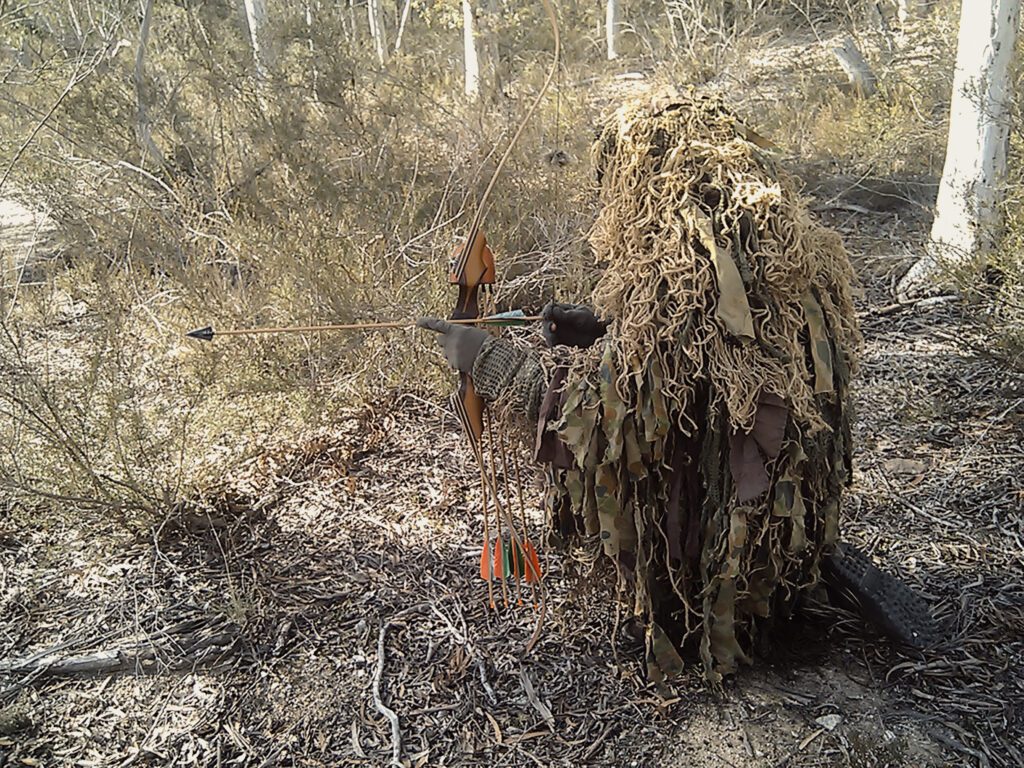
Regardless of your skills with a needle and thread, there are several styles of camouflage clothing that you can make to adjust your appearance. A ghillie suit (or Yowie suit here in Australia) is made from embellishing existing clothing by sewing on hessian and scrim. While effective, ghillie/Yowie suits may impose limitations on mobility and therefore be preferred by hunters who favour ambush techniques at a remote dam as opposed to active stalking/patrolling/tracking.
A different approach is to make simple adjustments to your existing wardrobe. Consider, for example, mixing and matching textures and colours. You might achieve this by pairing a flannelette or hemp shirt with moleskin trousers, then applying a layering effect with an open over-shirt and camo under-shirt. Beyond the obvious benefit of contributing to a ‘slip, slop, slap’ mindset, these measures can help mask your shape, surface and silhouette. Taking things a little further, there are several ways to turn ‘normal’ clothing into something quite different. Think about what can be achieved with some tie-dye techniques or fabric printing methods to generate distinctive patterns and colours that complement the characteristics of your preferred hunting locations and targeted prey. For my part, unstitching conventional camouflage clothing and patching panels back together in a harlequin pattern, that I call ‘random cam’, offers a unique approach that’s proving highly effective in the field.
To whet your appetite around ‘what’s in the art of the possible’, here’s some thoughts about how to get started on your own D.I.Y. camo clothing projects.
How to make a ghillie/Yowie suit
Obtain the following:
- Loose fitting trousers and shirt (or overalls, camo uniform, work pants)
- Baseball cap (unless your shirt has a built-in hood)
- 2 balls of hemp/jute or sisal twine
- Roll of green hoochie cord
- Scrim or netting (cam net, tennis net, military cotton netting)
- 25kg sized hessian bag
- Quantity of hessian sheet or more bags (try to get different gauges)
- Fabric dye (a base colour to suit your environment)
- Any old torn camo clothing and netting you have lying around.
Steps:
- Cut your quantity of hessian sheet in to strips about 3cm wide.
- Cut 1 ball of twine and the hoochie cord into lengths about 30cm long.
- Dye ¾ of the twine and hessian strips in your base colour.
- Sew the scrim or netting onto the trousers and shirt to form a ‘lattice’ on the outside with the other ball of twine as stitching.
- Cut up one side of the hessian bag.
- Sew the apex cut of the hessian bag to the baseball cap as an outer hood to form a cross between a monk’s ‘habit’ and a legionnaire cap.
- Cut the old torn cam clothing and netting (or even natural coloured work clothes of a natural fibre) into strips of varying sizes.
- Randomly tie/sew onto the lattice netting (on the trousers, shirt and hood) the:
- Dyed and non-dyed hessian strips
- Dyed and non-dyed lengths of twine
- Lengths of hoochie
- Strips of old cam clothing.
How to make ‘random camouflage’ clothing
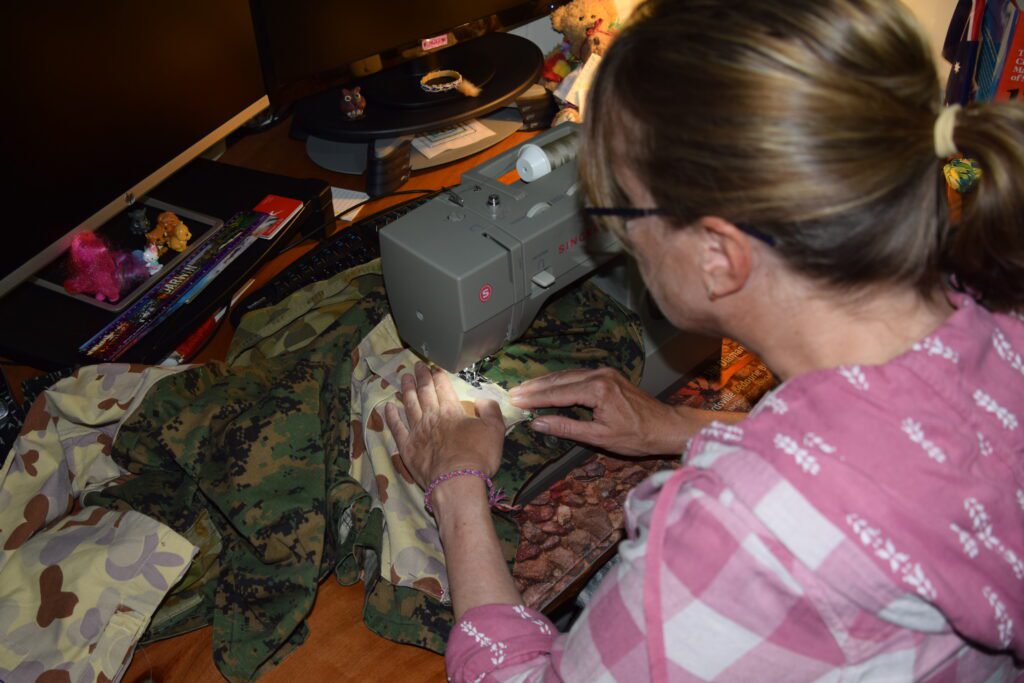
My unique take on military camouflage is to make hybrid outfits that combine many different camouflage patterns into one piece of clothing. The technique involves unpicking and stripping down many pieces of camouflage clothing in various patterns and colours to their constituent parts. Then, with the assistance of my good-lady wife Kath, sewing them back together with mismatched arms, legs and pockets.
I like to use the term ‘random cam’ to refer to the finished product. But while this name suggests a haphazard approach, my rationale relates directly to the principles of camouflage and why things are seen.
Firstly, the purpose in using panels with different colours and patterns is to help disrupt the shape and silhouette of the surface of the clothing and the wearer. To further interrupt the outline, patches of mismatched camouflage fabric – in the shapes of leaves and branches – can be added to create additional horizontal and vertical variations. Then, to disrupt the fabrics’ surface, consider including pieces of plain, rough textured material. Then wear the clothing as an open over-shirt with a different camo under-shirt to disrupt the animals’ depth perception – using shadows and letting the shirt move with the breeze like leaves and shrubs do.
The process of generating ‘random cam’ clothing will undoubtedly be time-consuming. It can involve considerable searching in tip shops, op shops and on ex-military social media sites to generate a stock of old combat uniforms from different nations, to add to your existing unwanted or now ill-fitting commercial camo with its various patterns. This costs money but, if you’re canny, less than the commercial route. Then there’s the task of unpicking seams and reconstructing outfits to meet your needs.
Once you’ve made your outfit, it’s not enough to simply pull it from the back of the car and reckon you’ll suddenly become invisible. You need to ‘season’ it too. Wash it in the tub to fray the material. Drag it through the dirt, etc. You might also like to treat your gear with fire retardant and game attractants.
Then, when you head into the field, add foliage to your clothing from the area you plan to stalk or ambush. Replace this vegetation every couple of hours as it droops because dead foliage gives off a different UV signature to live plants.
Making it count
There are many benefits to making your own camouflage gear. Aside from saving money on clothing that may not work, you get to adapt your apparel to meet your specific hunting needs. By applying the principles of ‘why things are seen’, trying a little D.I.Y. offers you the chance to exercise your inner ‘renew, re-use, recycle’ mindset in a productive way. Further, you’ll have the opportunity to balance the need for camouflage and concealment with your other needs – such as the requirement to move freely and effectively use your firearm or bow.
However you approach the task, use the opportunity to learn more about yourself, your hunting environment and the characteristics of your preferred game species. You can be rightfully proud of taking responsibility for adapting your appearance to make you a better hunter. And as they say, ‘the proof of the pudding is in the eating.’
Share this article
 Website
 Facebook
Related
Articles



Related
Recipes
Sorry, no related items found.