

Why the Browning B25 became a legend
John Browning’s B25 shotgun is an icon. Consult the internet on topics such as ‘best shotguns ever made’ and the B25 will almost certainly make any list.
Similarly, glance at firearm auction house catalogues and it’s apparent that B25s in good condition, especially higher-grade and engraved, are in demand.
Although no longer in regular production, the B25 still has a lot going for it. It was not only John Browning’s last firearm design but also the first mass-production over-and-under gun, with the first examples sold only a few years before World War Two. Although manufactured from machine-made components, it was assembled and finished by hand by skilled workers in the Fabrique Nationale factory in Liège, Belgium, with whom Browning contracted to manufacture the B25. The B25 has a reputation as a well-balanced gun that is reliable to a fault and handles well. Therefore, it’s not difficult to see why the B25 has been such an enduring design over the years.
John Browning was born in 1855 in Ogden, Utah, as one of 22 children sired by his gunsmith father, Jonathan. When his father passed away in 1879, John assumed the family business and his first successful design, a single-shot rifle, soon caught the eye of T.G. Bennett, president of the Winchester Repeating Arms Company.
In years to come, Winchester would buy no fewer than 41 designs from Browning, and some are still with us today in the form of the Winchester Models 1886 and 1894, the latter with around five million sales under its belt!
Simultaneously, Browning sold several designs to Colt and over the years he was to spend considerable time in the famous factory in Hartford, Connecticut, as numerous Colt products based on Browning’s designs were put into production.
The relationship between Browning and Fabrique Nationale, the legendary Belgian arms manufacturer, started in 1897 when FN was given the rights to manufacture a .32-calibre pistol of Browning’s design in Europe. Ten years later, half a million Browning Model 1900 pistols had been produced and FN’s association with Browning was cemented.
In 1902, however, a wedge would be driven into the hitherto highly successful relationship between Browning and Winchester, resulting in Browning meeting with FN’s directors to present the design for what would become the Browning Auto-5 shotgun. Notwithstanding the Auto-5’s stratospheric production figures, came Browning’s final design for a shotgun with superimposed, or over-and-under, gun barrels.
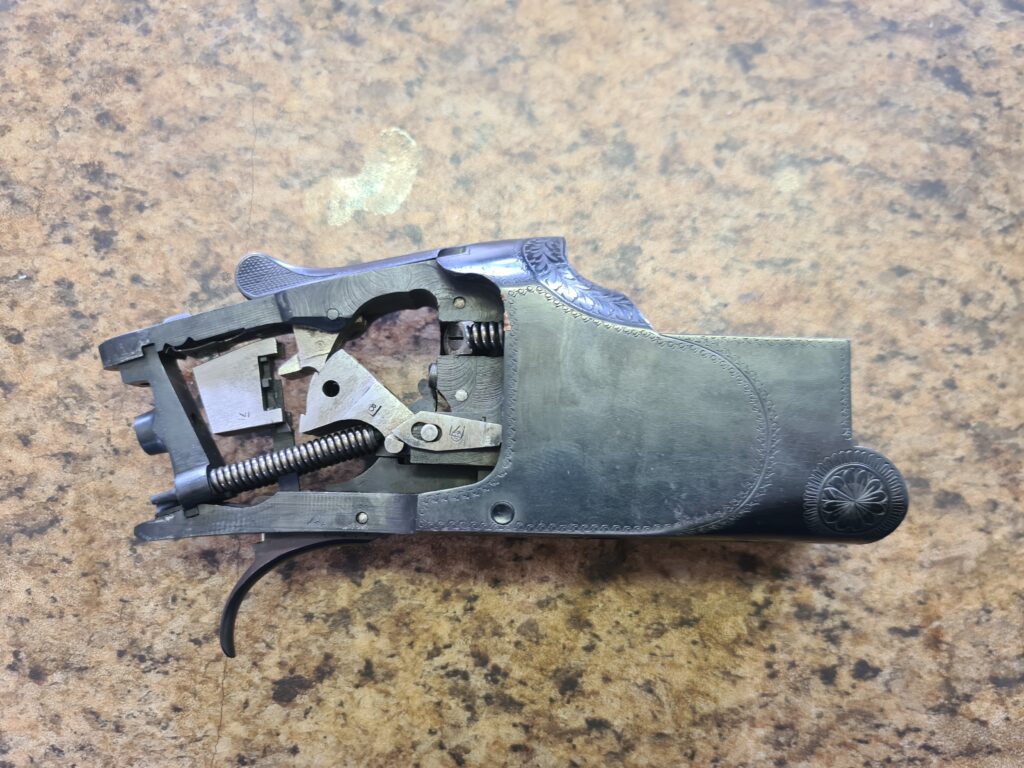
The first patent for what would become the Browning B25 Superposed shotgun was granted on March 30, 1926. The patent specification stipulated several of the over-and-under gun’s advantages as Browning saw them. The B25 design didn’t include a top-fastener such as the Kersten-style crossbolts found on many German and Austrian made over-and-under guns. It instead used a sliding under-bolt and enlarged hinge-pin that, Browning claimed, was stronger than the contemporary over-and-under guns being manufactured at the time.
The depth of the action body is historically the main enemy of the over-and-under design, and why Browning settled on a design featuring underlugs and a broad hinge-pin the width of the action, when he was aware of the trunnion-type lugs employed on the British over-and-under guns of the day, remains a mystery. However, despite the B25’s underlugs and hinge-pin, its action body was still shallow enough not to impede its handling characteristics.
At first, the B25 (or ‘Superposed’ in company literature) was only available in 12-bore. Barrel lengths were 28″, 30″ and 32″ (all with a solid rib), and three different factory-standard stock designs could be chosen from, with double triggers as standard. For a premium, a customer could order what Browning called the ‘Twin-Single’ trigger. The Twin-Single looked like a conventional double-trigger mechanism but consisted of two single trigger mechanisms rolled into one. You’d fire the lower barrel first by pulling the front trigger and the upper barrel as well by pulling the same trigger again (naturally, the sequence was reversed when the other trigger was used).
In the late 1930s, a selective single trigger design was added, which featured an easily accessible selector switch located in the trigger guard, but the definitive Browning B25 single trigger design (perfected by Val Browning, John Browning’s son) was only introduced in 1939. It is one of the most reliable single trigger designs ever made and would remain in production along with the B25 for decades. Val Browning also perfected the final design and configuration of the B25, after his father’s death at the FN plant on November 26, 1926.
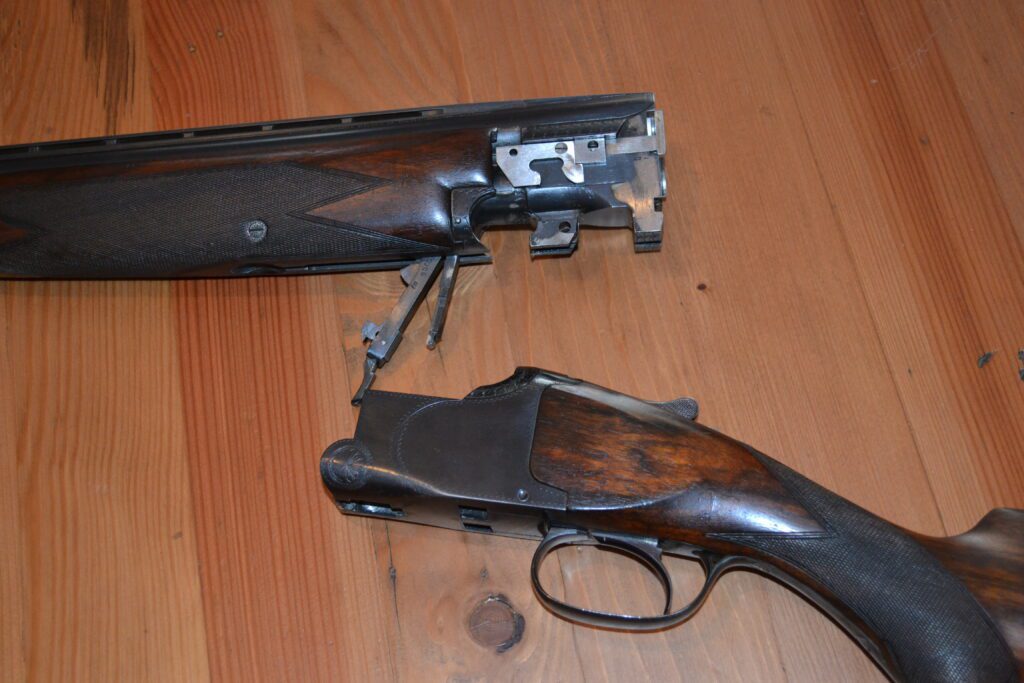
One of the most distinctive features of the B25 has always been the semi-detachable fore-end piece. With most double guns, the fore-end piece is usually a separate item that is removable by means of a latch or pushrod and once removed, allows the barrels of the gun to be detached. With the B25, the fore-end is disengaged by means of a latch located on the bottom, allowing the fore-end to be swung forward while still attached to the barrels and the barrels to be removed from the frame. Removing the fore-end piece from the barrels is another matter. This procedure entails the removal of the screw that holds the wood in place and driving out a friction-bearing pin to separate the fore-end iron from the barrel assembly. It is tiresome and shouldn’t be performed by anyone without the proper experience.
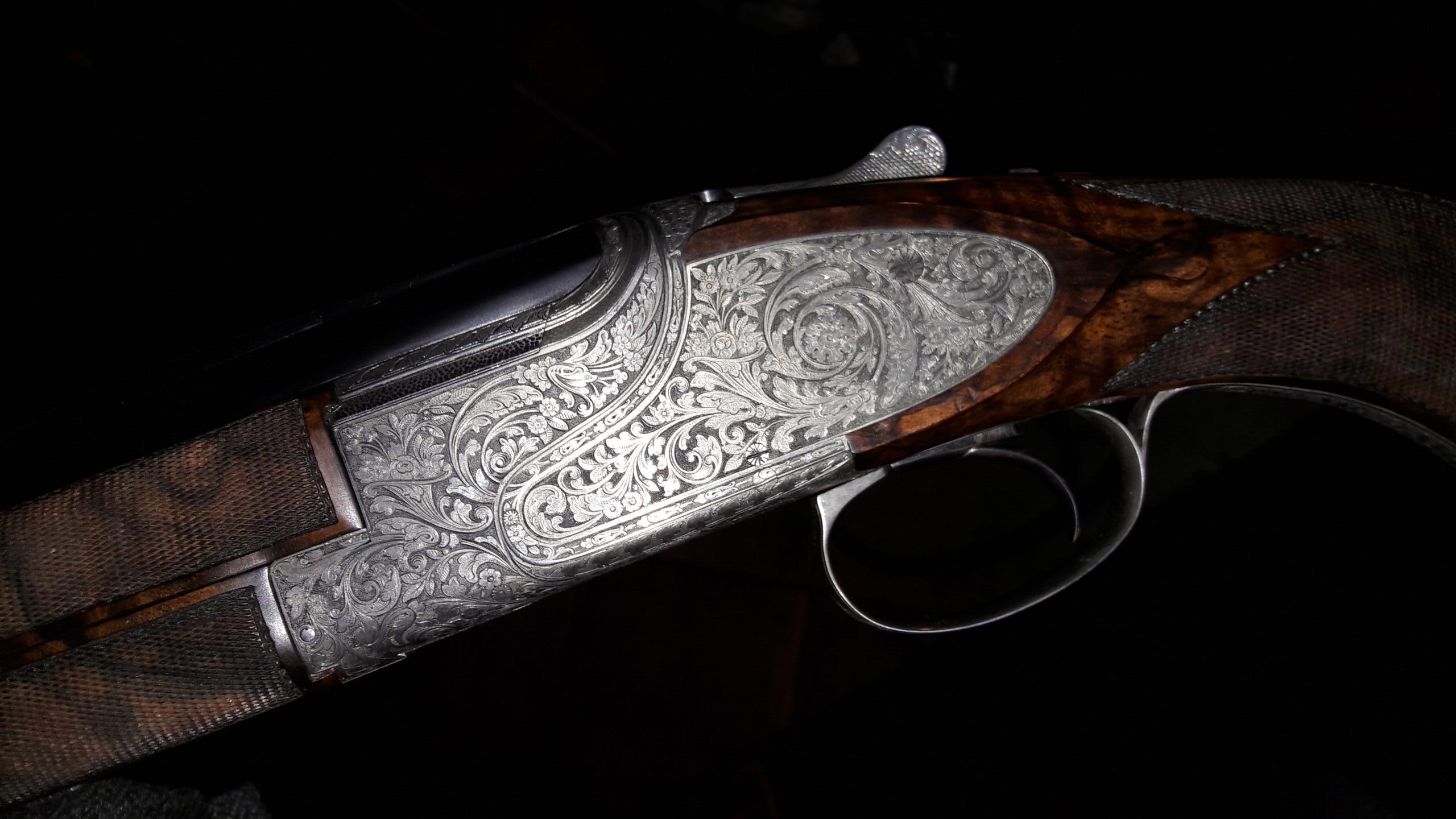
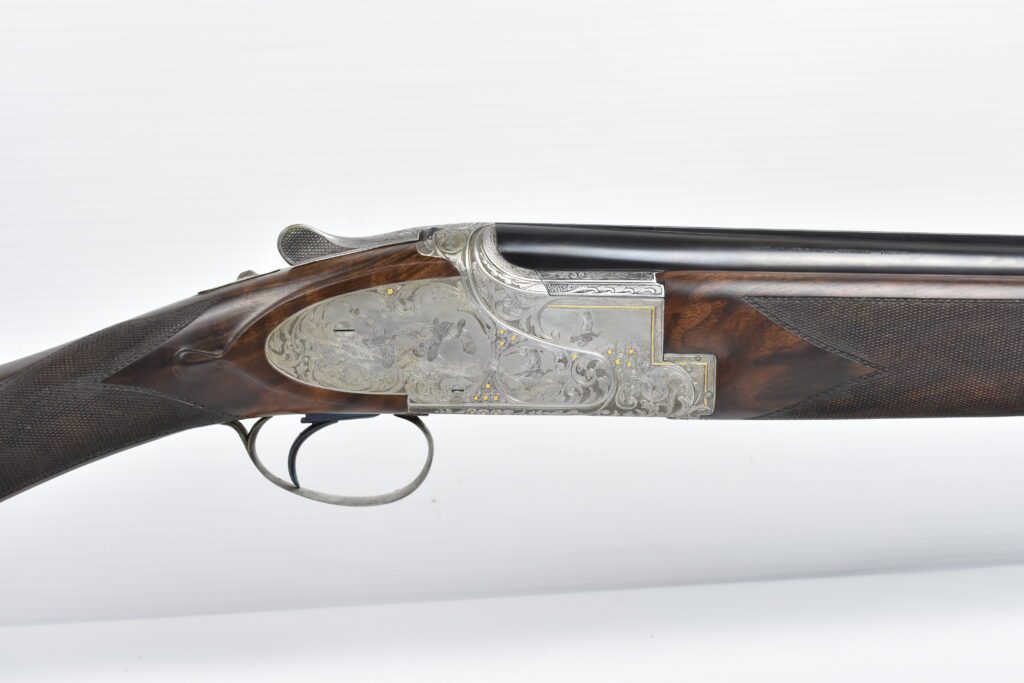
Even though the B25 was released at a time when the Great Depression was still fresh in everybody’s memory, it sold well, and steady orders kept the FN factory busy. Almost from the start, customers could order upgraded versions of the B25, finished in the FN custom shop located in the vast plant in the city of Liège. Over the years, many of FN’s legendary engravers such as Felix Funcken, André Watrin, Louis Vrancken and others would create masterpiece after masterpiece, and indeed, many high-grade B25s feature workmanship comparable with the best turned out anywhere. Interestingly, many of the engravers that were employed by the FN custom shop over the years were ladies, and their works are as highly regarded as those of their male counterparts by serious collectors.
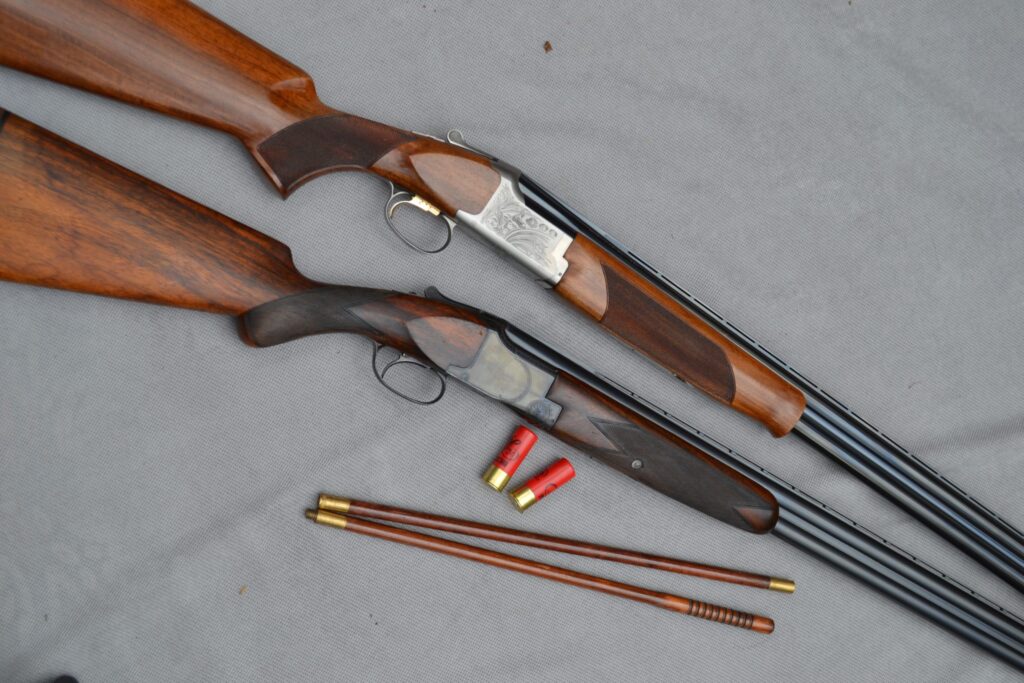
WWII and the resultant occupation of Belgium by Nazi Germany brought B25 production to an abrupt halt, as FN’s production was diverted towards the needs of the Wehrmacht. A handful of B25s were completed during the war from available parts, but B25 production only resumed in earnest in 1948, and the following year also saw the introduction of the long-awaited 20-bore version. Although initially only available in Grade I (the entry-level B25 with minimal engraving, plain wood and blued receiver), the 20-bore B25 would quickly become an important part of the B25 story, and they are popular today with collectors and shooters.

As mentioned, the B25 was available from the beginning in various grades with differing levels of embellishment to suit every taste and budget. In the US, the major market for the B25, the Standard Grade B25 was the entry-level model prior to WWII, followed by the Pigeon Grade, Diana Grade, and finally, the Midas Grade. While the Standard Grade sold for $107.50, the Midas Grade, with extensive engraving, fine wood and the best hand-finishing lavished upon it, sold for a whopping $374. By comparison, a best-quality Purdey 12-bore game gun without any accessories sold for £130 prior to WWII. Thus, the top-grade pre-war B25 wasn’t cheap.
Post-WWII, the line-up of available B25 models was extended by the addition of several new models, including dedicated Trap and Skeet models. From 1950, the full line-up was available in both 12- and 20-bore, and indeed the decade of the 1950s is considered by many collectors to be the finest era of the B25. This is not only for the wide variety of models offered but also for the superb quality turned out by the FN factory. The FN custom shop was as busy as ever during this period and for US customers the Pointer Grade (slotting in-between the Pigeon and Diana Grades) was added to the line-up as well as an Exhibition Grade model featuring even more embellishment than the Midas Grade.
Rather confusingly, B25s intended for the British and European market used a different designation system. Whereas the entry-level B25 was known in the US as the Grade I, the same gun was marketed as the A1 in Europe and the UK, and the sequence continued along similar lines whenever higher-grade models were involved. For instance, the D4G model was the highest grade custom B25 that could be ordered without sideplates. If a customer desired something more ornate than the D4G (which featured beautiful wood, a silvered receiver and gorgeous scroll engraving of a coarse but intricate pattern that took more than 200 hours to complete), the Custom Grade was the next step up. As mentioned, B25s that went through the skilled embraces of the FN custom shop are prized by serious shooters and collectors, and for good reason – superb workmanship.
In addition to single guns, the FN custom shop also made multi-barrel and even multi-gun sets on special order. A friend of mine has for years been using a 12-bore B2G-grade B25 with three sets of barrels, trouble free, to good effect. The three sets of barrels differ in length (30″, 27.5″ and 26″) with different choke constrictions in each one. The longest set is meant for wildfowling, choked full and full, the 26″ tube meant for skeet shooting with open chokes and the 27.5“ barrel falling somewhere in-between. Multi-gun sets are far rarer, and they feature scaled but matched guns in 12-, 20-, 28-bore and .410 with similar engraving patterns and wood.
The 28-bore and .410 B25s were in production for only 18 years, up to the end of B25 mass production in 1977, and they are therefore even rarer than 20-bore guns. They were made on dedicated frames to reduce bulk and weight, but otherwise featured the same level of workmanship that the by now well-established 12-and 20-bore versions enjoyed. Until recently, the only Browning B25 in 16-bore was a single pre-production version, currently residing in the Browning Firearms Museum in Ogden, Utah.
Producing the B25 was never an inexpensive undertaking. The intricate design did not lend it easily to mass-production as some of the parts (notably the fore-end assembly) required extensive hand-fitting and finishing, all of which increased costs. Despite this, the level of quality was maintained virtually throughout the production span of the B25. Even the entry-level models required huge amounts of hand labour to manufacture and assemble, and final fit and finish were carried out by specialist workers at the FN factory. The result was plain to see – the FN-made B25 was a superbly made creation throughout its production lifespan and featured a level of quality rarely seen today.
Aside from John Moses Browning’s design genius, the B25 created a new niche in the shotgun market. It placed a well-designed and superbly made over-and-under shotgun within reach of the man on the street. In addition to this it offered a whole range of upgrades to their better-heeled buyers, all of which was superbly executed by FN. The B25 will undoubtedly go down in history as the design that dragged the over-and-under shotgun into the modern era but also as the gun that could literally do it all. This is from entry-level guns all the way through to specialised Trap and Skeet models as well as the very pinnacle of custom-made elegance. Very few other sporting arms can lay claim to a similar achievement.
Ironically, the very things that made the B25 a success would eventually contribute to its downfall. From the late 1960s, various small changes were incorporated to the basic design that made production easier and, hence, cheaper. Hand labour, especially skilled hand labour, has always been a major factor in production costs and it became a primary reason for the eventual demise of the production B25 shotgun in 1977.
Browning had for some years been attempting to save on production costs to keep the B25 alive. By the 1960s, stiff competition in the form of the various Italian makers was a reality, and worsening sales along with costly production eventually meant the end for the B25. In the late 1970s, FN halted production of the B25 and instead commenced production of the Browning Citori, essentially a simplified B25 very much geared towards mass production, at a purpose-built plant in Japan.
At this stage, many thought that the B25 was finally done for and, as has happened with the pre- ‘64 Winchester Model 70 rifles, there was a rush to acquire FN-made Browning B25s. To a certain extent, this continues to this day. Thankfully, their generous numbers ensure that entry-level B25s remain one of the biggest bargains on the used-gun market.
Luckily though, the king of over-and-under guns was not quite ready to cash in its chips just yet after it was removed as a regular item from the Browning catalogue. Post-1977, the B25 remained available as a special-order item called the Presentation Series, initially produced in four different grades featuring various levels of embellishment. The Presentation Series did not catch on and was discontinued in 1984. To keep the B25 alive, though, was a matter of pride for FN (who, by now, owned the Browning Company as well) and the next move in the seemingly never-ending saga was the reintroduction of the B25, even down to the original A1 model. Even more astonishingly, it is now available in 16-bore as well.
What was different this time, though, was that the B25 was now strictly a custom-order item available only through selected dealers from the FN custom shop. The regular series of Japanese-manufactured Browning over-and-under guns, in certain models sold under the Miroku name as well, remain available as the bread-and-butter shotguns in the Browning line-up. The B25 is sold to those who desire a gun made along more traditional lines or simply have a hankering for the services of one of FN’s master engravers.
Naturally, with production down to a trickle, a new B25 is a gun intended for someone of financial substance but, after examining several newly made B25s recently, I’m happy to report that they are as well made today as ever. As a matter of fact, I’m willing to stick my neck out and say that they are currently as good as anything out there.
Those interested should read the fantastic book: The Browning Superposed – John M. Browning’s Last Legacy by Ned Schwing.
Share this article

Related
Articles



Related
Recipes
Sorry, no related items found.