
Bowhunting Brisbane Valley’s roaring red stags
So much planning! My son Scott, from Far North Queensland, would join me during a Brisbane Valley roar.
I’m long retired these days, but the lad finds extended time away from his employment somewhat hard to jag. Yet the timing of our hunts was exactly everything; we needed to have our feet on the ground, bows in hand when the red stags were vocal and on the job.
With the landowner on side, Scott juggled family commitments, work and travel arrangements so we could lock in late March for our hunt.
Scott and I have bowhunted deer and other game for over two decades. Way back when I was doing the single parent bit and he was in primary school, he tagged along with me to learn tricks of the trade and the absolute thrill of stalking deer, which do not, under any circumstances, want you close to them.
Bowhunting deer is demanding, thrilling and at times even heart stopping. It’s just not easy to get within arrow range (mine’s 50m) unless stalking and hunting skills are spot on! As an aside, if the concept piques your interest, check out issues 81 and 82 of Australian Hunter.
A foggy, soggy start
Our first few days’ hunting consisted of rain, even more rain, strong winds and very slippery conditions as a tropical low lashed the Queensland coast. Some rain is welcomed to dull those superior senses deer rely on to maintain their distance but with wind swirling 360-degrees all over the gullies and roaring through ridge tops, it sure made for tricky hunting. Easy going it was not! It was difficult enough to hear the stags, let alone approach them.
The only consolation during that ultra-damp time was the comfort of our camp. Changes of clothing, great tucker and dry beds with stags moaning now and again around us all made for a priceless experience. The game camera entertained us too. Set near a popular wallow, it confirmed stags certainly travel a lot when rutting, as we never saw any of the recorded animals on that property again.
Out on the job
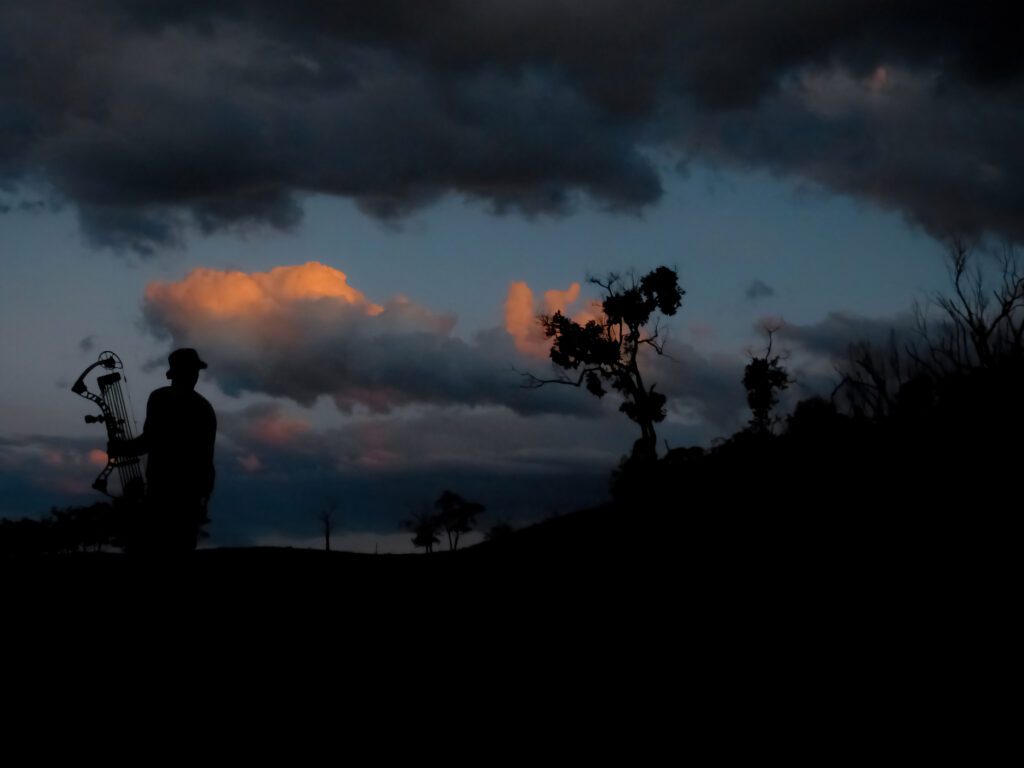
The first morning the rain eased we put the camo gear on, headed for a ridge top in the dark, and set about checking out some of the sources of noise echoing through the thickly timbered ridges. As usual, most roars emanated from lesser stags but it was still exhilarating to hear, stalk, then photograph these animals, which we then left alone.
But one stag was somehow different. His inconsistent roars were ending in a series of loud guttural grunts which smacked of maturity, so we put in time with the binos to find him. He finally came into sight and my sudden intake of breath caused a gentle whistle when I saw the size of his rack.
Assessing him was encouraging, thrilling even, but the lack of close cover presented big problems. There appeared to be little chance of sneaking any closer than about 70m, well out of out of my bow range. To get even that close still depended on remaining unseen by four eagle-eyed hinds. Difficult!
A plan that worked
But then, nothing ventured nothing gained. With Scott encouraging me I shuffled the backpack off, and we rehashed a scheme that had worked on another occasion but failed on a few others.
It was a variation on our tried and proven tactic of using doe calls plus subdued roars to coax a travelling stag into bow range. Surprisingly, we’d sometimes seen a stag holding hinds leave them – obviously none were receptive at the time – for a quick recce when we had provided sufficient inducement. It naturally depends on the animal, whether he is aggressive or driven by a testosterone overload and, as mentioned, it’s not infallible.
The inducement we use involves some serious antler clacking, brush breaking and the sort of ruckus associated with stags fighting which, although infrequent, will usually only occur when a hot doe is being contested.

Plan A was for Scott to remain higher up the hill and make the sound effects while I hid at the base of the slope in cover and ready for the stag if he decided to see if there was indeed a doe up there worth fighting for.
Within about 30 seconds of Scott’s ruckus starting up the stag was moving, a few decent grunts heralding his approach, and as it started to gather in intensity so did my heartbeat – this was the real deal!
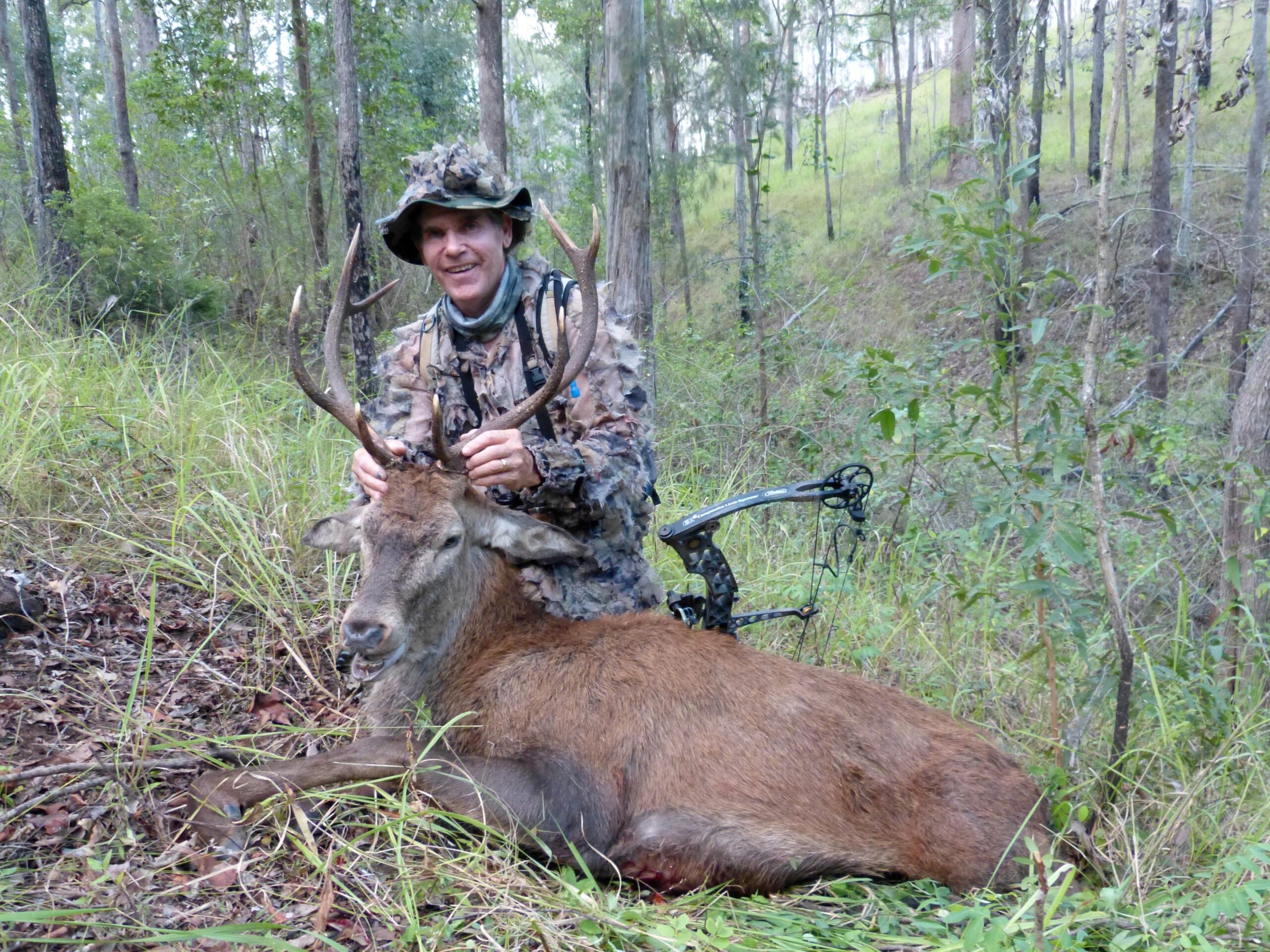
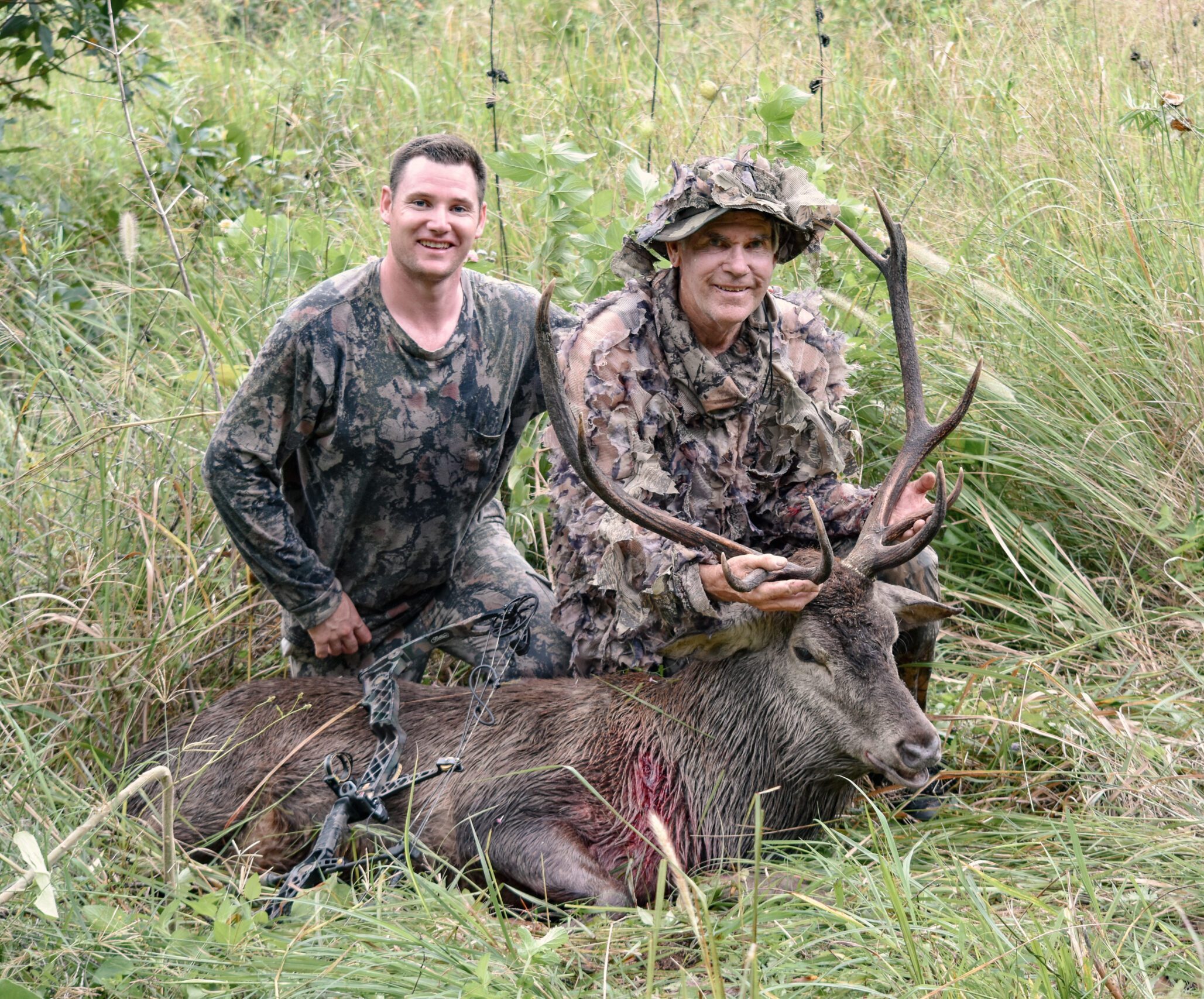
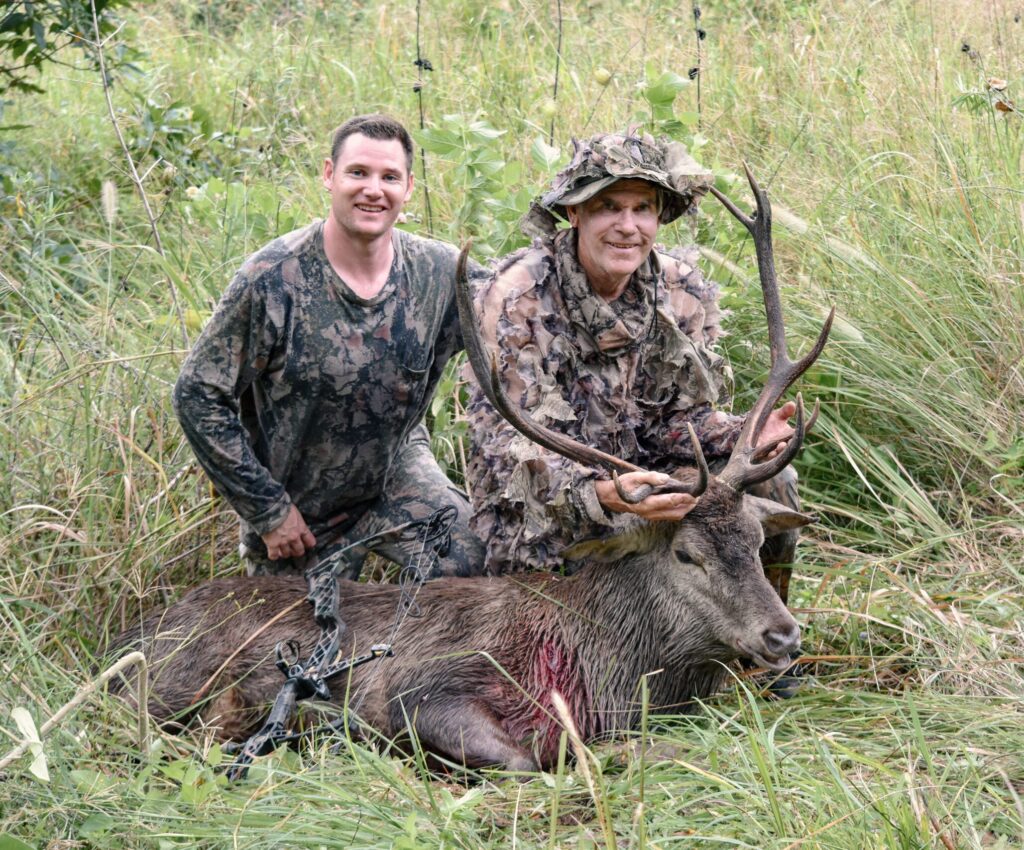
Easing back into a lantana bush, my face mask up and compound bow drawn, I held my breath as a big, dark stag materialised on my left. At 30m distance I stopped him with a small doe call and released the arrow which struck just behind the close shoulder, passing right through him and embedding in a tree; it was later seen to have also taken out both lungs.
Scott carried all my paraphernalia down the gully as I excitedly regaled the scenario on our way to the big stag, which was overtly a five by four but with a point noted on the right antler he progressed to a double-five.
My best in over two decades
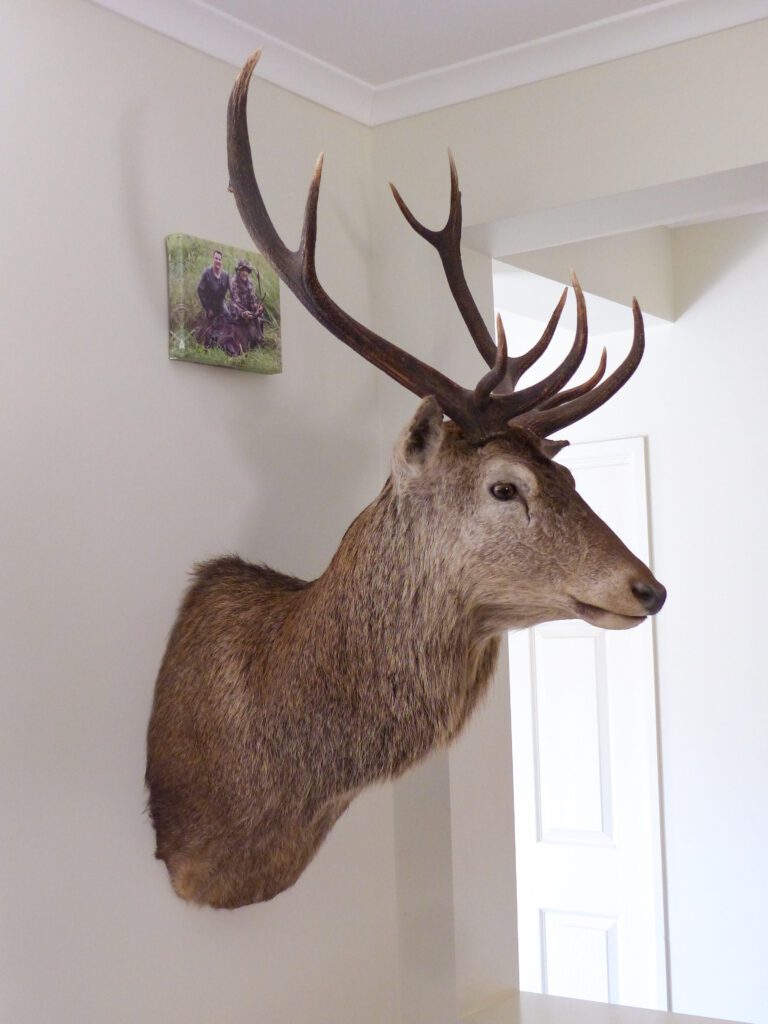
As this was the best red stag I’d taken with the bow in over two decades of hunting, his head had to come home, so we devoted the rest of the day to caping him and delivering the cape to the taxidermist a few hours away. It seemed almost unbelievable. After so much time, effort, sweat and lashings of disappointment I’d finally scored a head I wanted mounted. Sure, I’d seen ample better ones over time, but none were ever in my bow range.
That night’s campfire talk was all about our success and I joked about Scott being next. After all, we had two more days up our sleeves. Little did we know…
One for the lad
Scott’s stag came about in an entirely different manner, but with a similar result – work for the taxidermist. The next morning, we decided on a change of tactic, in that we’d camo and tucker up and head for a prominent ridge system to the west, which was an area we had so far neglected on these hunts. It was a savage slog to get up the gradient but as we’d done it for many years it was one foot after the other and just keep going.
Things were surprisingly quiet, as can happen, until we came atop a very steep and scrub-filled gully because from down in the thick stuff a stag would roar from time to time. As nothing else was doing, Scotty elected to scramble down on the leeward side of the valley for a look. The wind was good, he was young, so why not? “Tell me how it goes, mate,” I said grinning.
Fortunately, we had radios – vital, as it transpired. Sitting quietly, complimenting myself in still being able to get up that nasty long slope and genuinely enjoying the privilege of being in red stag range, I became aware that the stag below had ramped up the roars to a virtual scream, with another one roaring down there as well. This sounded like a genuine fight, deadly serious, and the terrific racket continued for a while.
Finally stopping, all was then silent for quite a spell when the radio chirped. My enquiry of “what’s doing?” was followed by an excited “stag down, come and see.” That was easier said than done and involved a knee-testing scrabble down that slope but eventually there was the lad, grinning from ear to ear, on the edge of the thick stuff.
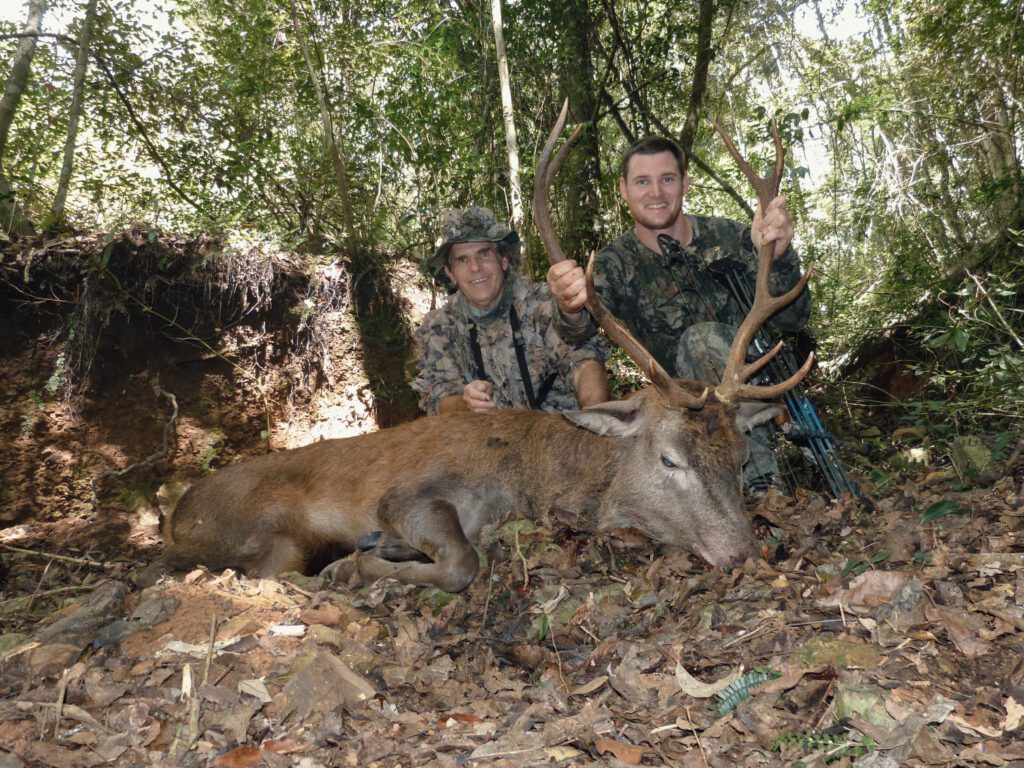
Following him through some nasty vines and other scrub foliage into a steep wash-out, I surveyed the very even double-five stag he’d arrowed. A beauty!
An 18m shot
Scott said he’d made it almost to the level of the action, when it suddenly stopped so he took cover. Waiting quietly and listening he became aware of rustling of branches and undergrowth, and he had just enough time to draw his bow when a stag emerged from the scrub below him. He took the 18m shot once the deer was in the clear and the stag breathed his last breath in the steep wash-out where we somehow managed to cape it. Ever caped a stag in a steep gully? Fun it was not!
Lotto win next?
In hindsight, it was unbelievably successful bowhunting. Admittedly we have certainly had our share of disappointing trophy hunts over the years, but a stag each going to the taxidermist during one rut was far beyond expectations. Could we repeat it? We might win Gold Lotto first…
Share this article