


Hunting giant Nile crocodiles in Mozambique
Those who have hunted the Dangerous Seven of Africa (elephant, lion, buffalo, rhino, leopard, crocodile and hippopotamus) tend to develop a preference for one or two of those species. The two that interest me most are buffalo and crocodile. I successfully hunted Cape buffalo in Zambia some years ago, so turned my attention to the Nile crocodile.
Unlike the way crocodiles are often hunted – by shooting perhaps an antelope, relocating the carcass near the water’s edge, building a blind and waiting for a crocodile – I wanted to hunt them by spot and stalk.
This method is most challenging because the wary big old crocodiles have acute hearing, vibration sense, smell and sight. They lay in locations they know are secure for them and where they can quickly scurry into the river and submerge out of sight.
I was hunting a 70km stretch of the mighty Zambezi River in Mozambique. The large crocodiles were mostly on the edge of the sparsely populated islands or sandbanks in the middle of the river. They are so alert that you can’t even get close to them on a boat before they slither, run or jump into the water. But I had no interest in shooting one from a boat, even if the opportunity arose.
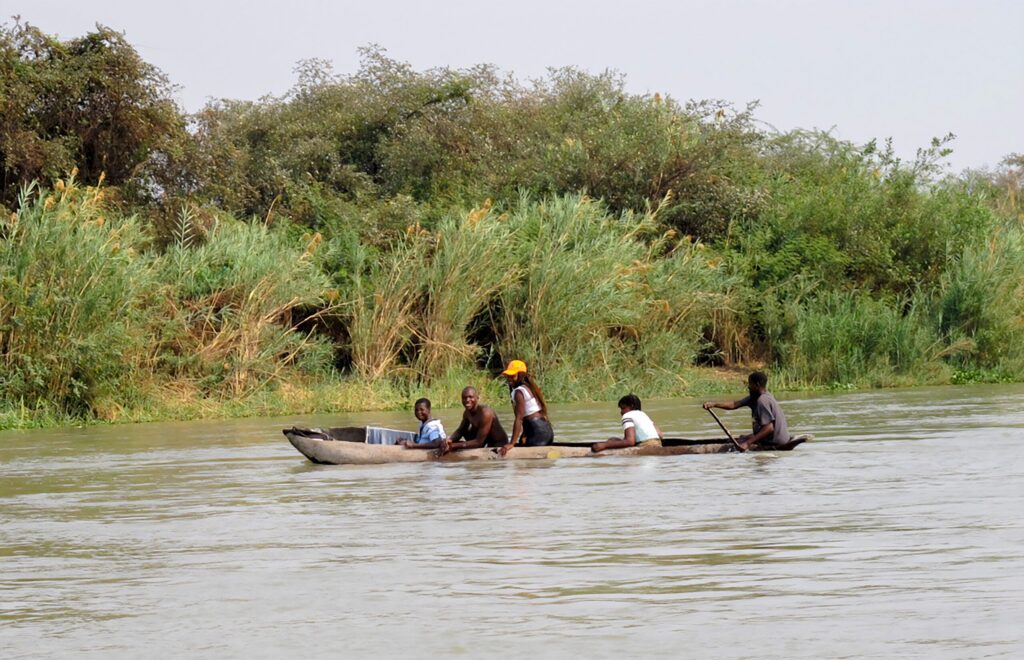
The crocodiles are used to the locals crossing the river in their wooden dug-out canoes, called mokoros, which are often propelled by poles rather than paddles. Two weeks before my arrival, a villager had been taken from a mokoro within 400m from my camp, and four people had been taken by crocs during the year from the side of the river our camp was on.
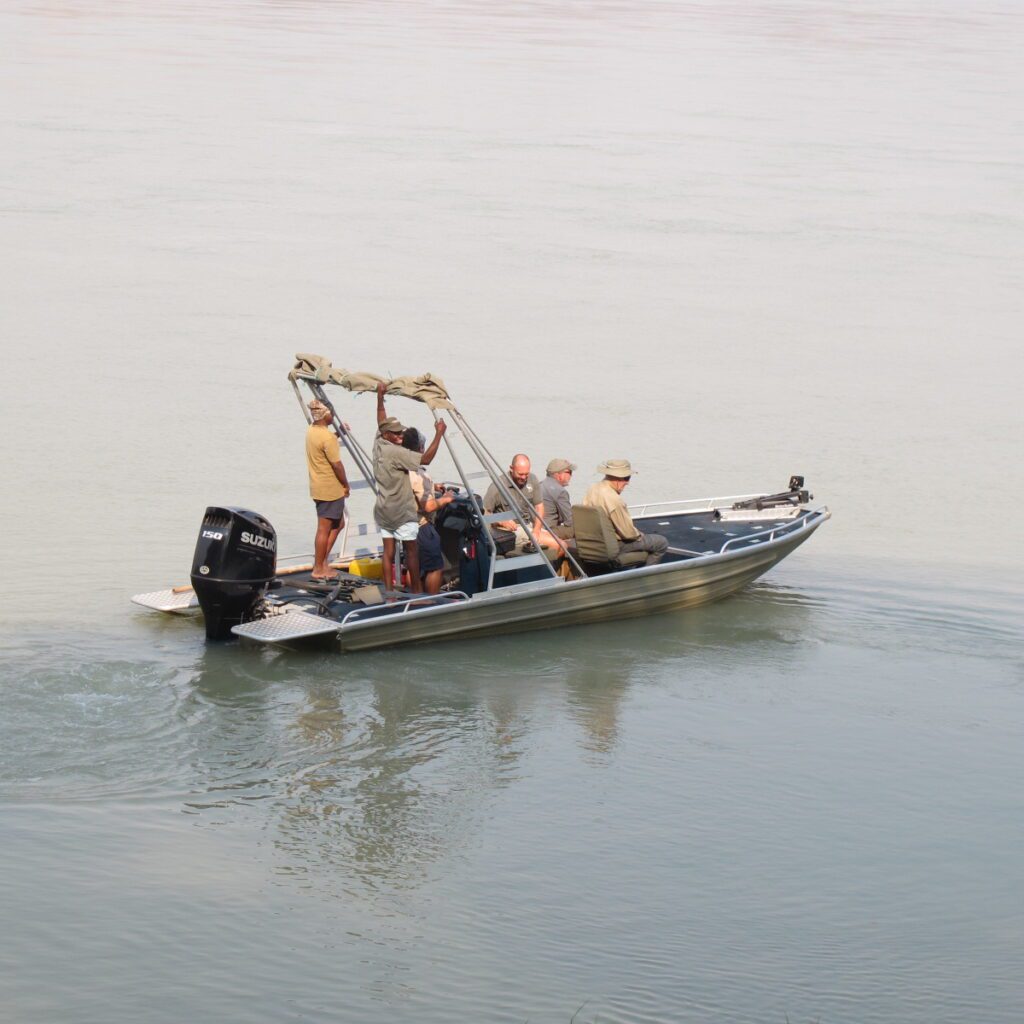
The Zambezi has such a strong current that a large boat with a big engine is required to properly search the river each day for a large croc. A boat such as this is very unusual to the crocs and makes them especially wary.
We would use our binoculars from the boat to try to spot the large crocs and then pass by them from a distance, hopefully without disturbing them. The boat would be moored on the other end of the island or sandbank out of sight and a stalk commenced to where they were or had been on a previous approach. However, most stalks end in failure because of the crocs’ keen senses.
There are two major kill zones for a crocodile. The first is the brain, which is about the size of a golf ball. It is easy to miss this target. The second is the spinal column of the neck, which starts a few centimetres from the end of the ‘smile’ and is about halfway between the top and bottom of the neck. On a broadside shot, this is the preferred option.
If you do not hit the brain or break the neck, the croc will propel itself into the water and submerge. No-one, not even the locals, will go into water where they can’t see what is below the surface in search of a croc they don’t know for sure is dead or where other crocs may be. So, if you miss the vital areas mentioned above, you don’t get to recover your croc, and your hunt is over if you wound the croc. Crocodiles require the utmost in precision shooting as well as being a difficult animal to stalk.
I made enquiries with my guides as to the preferred cartridge on crocs. By far, the most popular and recommended cartridge is the .375 H&H. It’s thought that if a hunter can handle the extra recoil and shoot a .416 with the same precision as a .375, the .416 would be the superior choice – but very few can shoot the .416 that well.
I was the first to have a .338 Win Mag in camp, but previously a client had used a .340 Weatherby and taken a large croc. They consider that a slower bullet gives better performance on crocs than the higher velocity of the .300 Magnums. I had read that military cartridges such as the .308 were illegal in Mozambique, but apparently this rule either no longer applies or was not being enforced.
A smaller calibre may hit a croc’s brain, but lighter bullets often lack the power to break the neck or shoulder and stop the croc from reaching the water. Also, the croc may not present a brain shot, which means that you must break its neck. It is not enough just to kill the croc; it must be a dead-right-there shot so you can recover it. The construction of the bullet needs to be such that it doesn’t fragment on impact but holds together and penetrates deeply. I was using the 225gr Barnes TTSX.
The temperatures were upwards of 40C. This is not much more than Australian temperatures in summer, but to Canadians and Americans at camp, it was unbearable. One of the reasons I brought my .338 Win Mag was to load it with temperature-resistant AR2209 powder. My .338 RCM, on the other hand, is loaded with Reloder 17 to get the higher velocity from a 508mm barrel, but double-based powders often behave too erratically when temperatures soar into the high 30s and beyond.
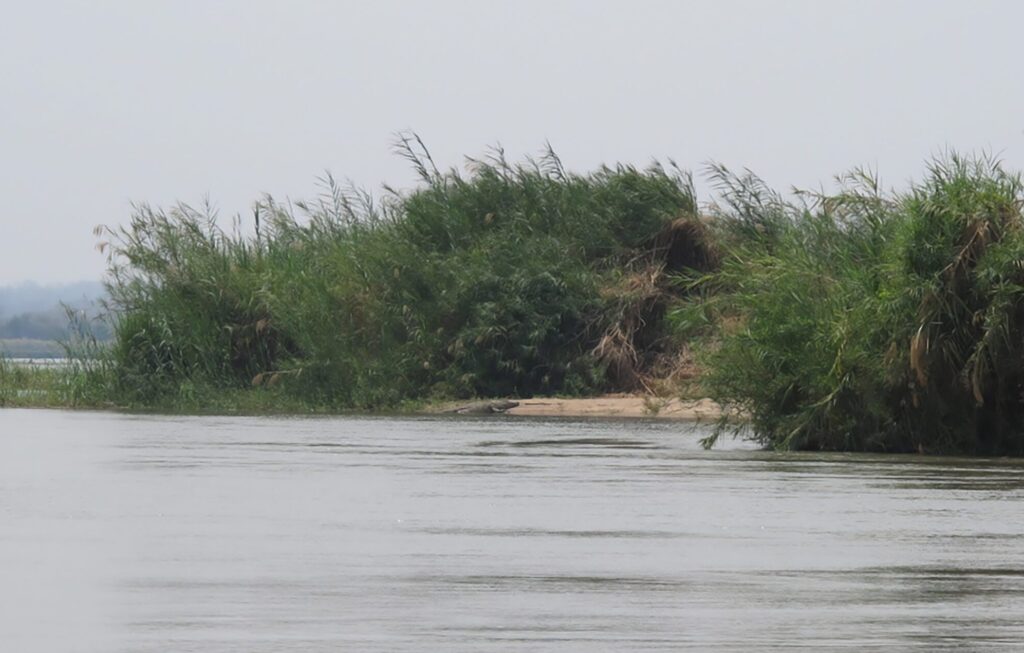
My seven-day crocodile hunt, arranged by Ian Head from World Safari Xpeditions, commenced each morning at 6.30am and finished with the last portion of the boat trip after dark in the evening.
On the second day of my hunt, we quietly approached the opposite end of an island and commenced a stalk through the vegetation tunnels to within shooting distance of where we saw a large croc the previous day. It was recommended I load a round into the chamber as soon as we were off the boat, on the basis that a croc would otherwise disappear into the water because of the noise before I was in position to shoot.
The Winchester Model 70 has a 3-position safety which works well in its rear position. Nevertheless, I had to be careful that the 635mm barrel didn’t ever point toward anyone. This, together with the backpack (which added height) when crawling through the vegetation tunnels or crouched over, made stalks more cumbersome.
We stalked to within 70 paces of where there were several smaller crocs, without them knowing we were there. Now 70 paces may not seem very close, but the crocs are low to the ground and seeing them clearly without being seen yourself, with small surface irregularities, grass and sticks, is not as easy as one would think. There were no large crocs there yet.
We quietly waited, keeping as low to the ground as possible. What appeared to be a large croc was swimming about 50m from the shore with only his head showing. He did this for about two hours while we waited in the blistering sun, becoming dehydrated. He then came ashore near the other smaller crocs. He was big.

The tripod was set up in front of me and I placed the Model 70 Super Grade on it. A good rest is most important for precise shot placement. The scope was wound up to 6x power, from the 3x power used for the stalk.
Before the trip, the elevation was adjusted down 12 clicks from 7.5cm high at 90m to zero at 90m, which also was zero at around 45m. On the first day, I checked the scope after the flight, and it needed a 3-click adjustment in both windage and elevation. I adjusted it to 1cm high at 90m on the advice that shots may be longer than 90m.
I aimed for the neck about 3cm from the end of the ‘smile’. The long-throated .338 Win Mag had the 225gr Barnes TTSXs leaving the 635mm barrel at about 2940fps.
The first shot hit where I aimed, but for insurance, I quickly followed with a second shot 3cm further down the spine and then a third which hit slightly above the first shot. Each of the first two shots broke the neck and the third probably would have stunned him had it been the first shot as it was close to the brain. All three bullets exited the 14½ft (4.42m) croc.
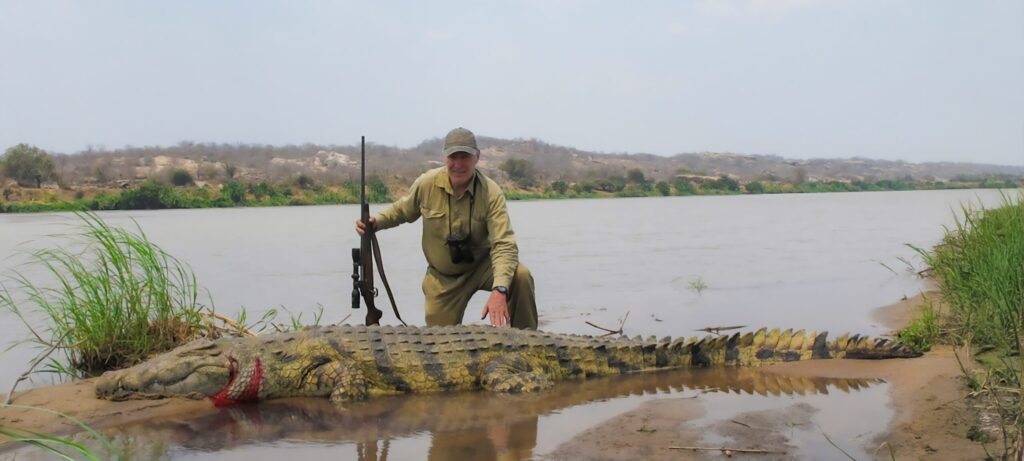
One of the guides went to get the boat, and on the way back, invited the local villagers over to get some croc meat. I had tail meat for dinner, and it actually did taste like chicken.
There were five more hunt days left. The original plan was to move to another area and hunt plains game if I finished my croc hunt early. However, I enjoyed the croc hunt so much that I asked if they had any more croc tags left and, if so, whether I could try for an even bigger croc. Yes, and yes, were the answers.
The next day, we saw a massive croc with a goat in its mouth near the bank of the river. We went past it from a good distance so as not to spook it and moored the boat upstream. We commenced a stalk on the bank, using a track that the local villagers used.
We heard the croc thrashing the goat in the water, not to kill it as it was already drowned, but to tear it into pieces to swallow it. We were now about 25m at 45 degrees above the croc, but he didn’t present an opportunity for a clear shot with all the vegetation in the way. Besides, he was also in the water, which meant we wouldn’t recover him, even with a perfect shot.
Just then two locals in their mokoro approached the croc and started throwing rocks at it. Later, we were able to determine that they did this because they wanted the goat that the croc had. And guess what? They got it! It wasn’t even their goat… just an opportunistic thing. But it wrecked the stalk. The croc disappeared downstream and didn’t reappear.
The following day, after heading downstream for about 40km and checking out several crocs and deciding possible stalks weren’t feasible, we saw a monster lying on the point of a sandbank in the middle of the Zambezi. This croc dwarfed every other we had seen, even the huge ones. This was the holy grail.
We moored the boat on the other side of an island that adjoined the sandbar. Through vegetation, we went and crawled into position on the sand so that we could just see the croc at 154m. Absolutely no way we could get closer. I set the .338 up on the tripod and zoomed the Swarovski scope up to 9x power, switching the safety off.
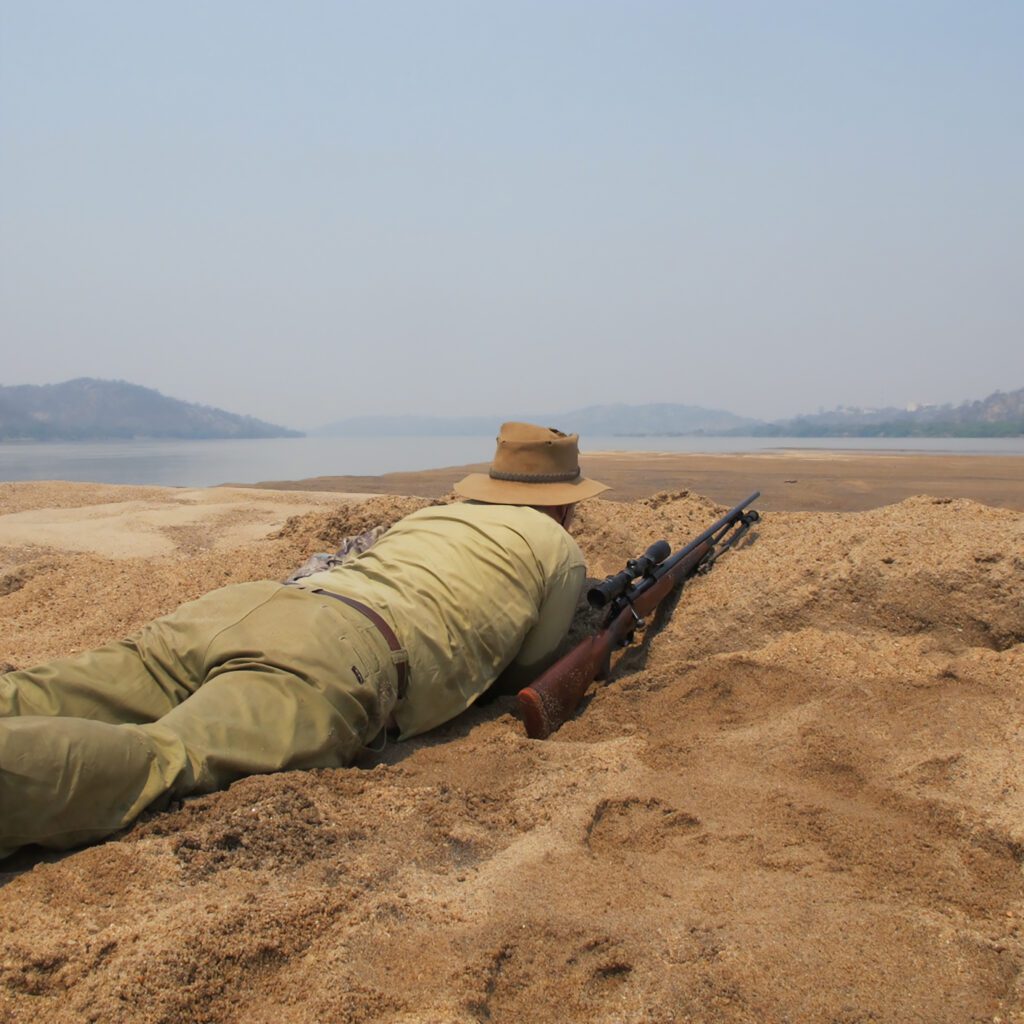
The beast had length, girth, height, a massive head and long teeth! He was quartering towards me. This was not a time to make a mistake with the shot.
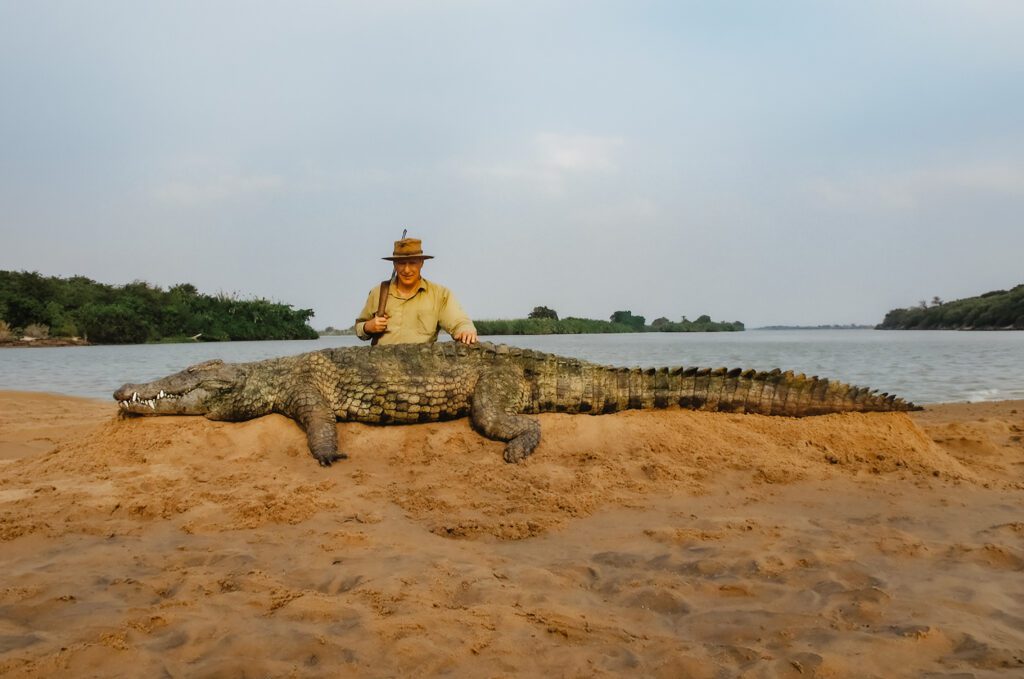
The first shot hit his spine, and he did not move. Immediately I placed a second shot into the same location, followed by a third. I jumped up and ran roughly 100 paces to be more at a right angle to his spine, knelt on one knee and placed a fourth round into his neck.
After reloading the magazine and chambering another round, I edged slowly towards him, ready to fire. At 20 paces, I waited about 10 minutes. He was dead. No bullets exited this time.
About three hours later, on approach to camp, one of the helpers in the boat called out in his local dialect to the other workers in the camp. As the boat moored, we were greeted with clapping, singing and dancing. Three of them used upturned empty 25L fuel containers as drums.
I watched both guides measure the croc at 17ft (5.18m). One of them told me that the largest recorded Nile croc ever taken in Africa was in the 1970s and it went 17ft 4.1″ (5.28m).
A thrilling and near record-breaking hunt I will not soon forget.
Share this article

Related
Articles


Related
Recipes
Sorry, no related items found.