

The sound of survival: Why you need an emergency whistle
What’s the one thing we always carry as campers, hunters, bushwalkers, birdwatchers or fishers? The answer for most is a set of car keys. But if you’ve left your vehicle in the carpark and find yourself ‘geographically embarrassed’ in the great outdoors, these keys are unlikely to be much use to you (unless you’re a MacGyver).
At a time like this, you may find yourself instead scrabbling through your pockets and backpack to locate something else to help bring a rescue party to your aid.
Depending on who you are, and what you do outside, what you have available will vary. Many people attach a small button LED torch to their key fob – as an emergency signal for help at night, to guide their way around camp – or simply to find the keyhole in the front door at home. But a torch won’t be much use in the daytime. Others are prepared with shortwave radios for remote communication. That’s great, but CBs need batteries – and these go flat; sometimes when you’re relying on them most.

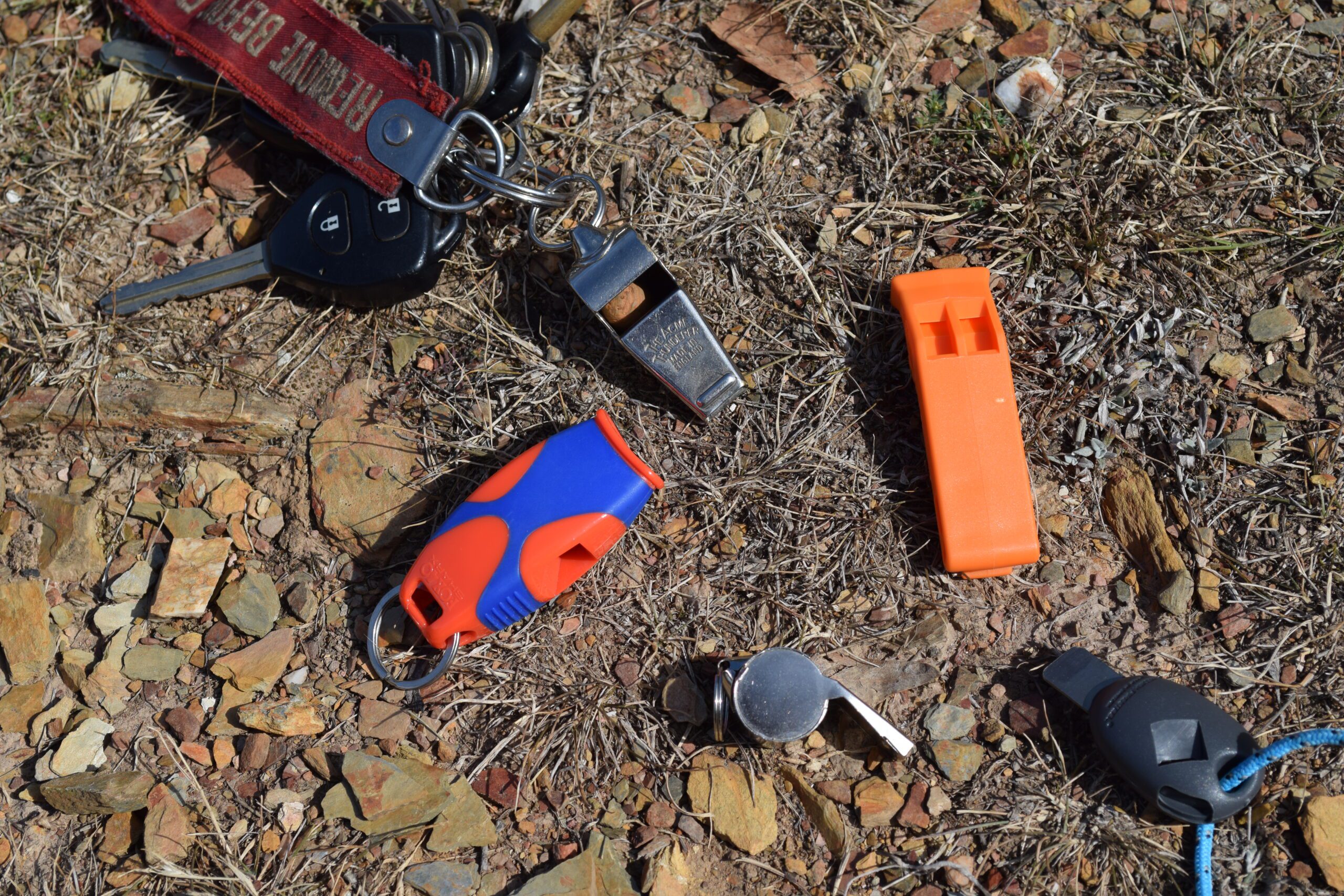
It is less common to find individuals who carry a simple whistle to attract attention. Except of course, if you’re a member of the SES or the military. Remember the last time you saw a news report of search and rescue personnel looking for a missing person? They’re generally blowing whistles. The same applies to armies across the globe when they really want to gain someone’s attention (like on a gunnery range). And when you think about it, it’s no surprise. Whistles are small, light and can really punch above their weight.
The reality is that whistles are an underrated safety and survival device that are simply much louder than the human voice. In fact, as a rule of thumb, a whistle’s sound will carry up to three times further than a really loud human yelp for help.
And consider too: if you’re in an emergency situation – and particularly if you’re panicking a little – your voice may turn rusty, and it will certainly go hoarse quickly. Whistles take far less energy than yelling. Best of all, they can penetrate background noise, making your calls for attention more likely to be heard by rescuers, regardless of your location.
If you find yourself needing to use a whistle, remember that there are internationally recognised distress signals for whistle blasts that can help you to be found more quickly by campmates, or by a professional search and rescue team. So, it’s a good idea to know these before you step off.
International whistle signalling code:
- 1 whistle blast = “Where are you?”
- 2 whistle blasts = “Come to me”
- 3 whistle blasts = “Help me!”
Each whistle blast should last three seconds with one second in between blasts.
Wait 30 seconds or longer to hear a reply and then repeat the signal. If you hear a reply, respond with one solid blast to help your searcher home in on your position.
So, think about it. Wouldn’t it be a good idea to pop a whistle on your key chain – just in case? Then add one to your quiver or backpack for extra peace of mind. Better still, take one for each member of your family and travel party. In a country as big as ours, it doesn’t take much to find yourself off the beaten track and spatially dislocated.
With whistles on hand for backup, we can spend less time trying to keep everyone within range and safe – and more time doing the things we really enjoy in the great Australian outdoors.

Fox 40 Sharx emergency whistle
This is designed specifically for the outdoors. It is made from durable polycarbonate and co-moulded elastomer which makes it easy to handle, slip resistant and adaptive to outdoor conditions, including temperature variations from -20 to 80 Degrees Centigrade. It’s also pea-less (no moving parts) which means it’s unlikely to freeze, jam or deteriorate.
The whistle blast makes a screaming noise with a dual frequency tone that claims 120 decibels (dB). The Guinness Book of Records’ summit for the loudest scream ever recorded is 129dB, but the normal level is about 90dB. At that rate, the Fox 40 Sharx emergency whistle should be louder than almost any ambient noise you encounter – whether it’s breaking waves, gale-force winds, a waterfall, or the sound of your 4WD’s engine. And we can attest that a simple, sharp one-second blow from a five-year-old is enough to have your ears ringing.

The promotional material says it can be heard more than a mile away (1.6km), so we put it to the test. As a general standard, manufacturers check whistles in a controlled environment using a statistical formula of frequency, loudness, atmospheric pressure and humidity which (by applying formulaic fairy-dust) equals distance.
Whatever. What really matters is what happens when you go out scrub. So that’s what we did. We tested the whistle at 1km, 800m and 500m in:
- The open, in ‘line of sight’ with still air.
- The open, in ‘line of sight’ with slight crosswind.
- Lightly forested conditions, along a dirt road, in ‘line of sight’ with wind assist (ie, with the listening party downwind).
As a result, we found that the distance calculated under test-tube conditions is not the same as the distance achieved when you are actually in the bush. The best result we had from the Fox 40 was 800m in the open in still air, or in lightly forested conditions with a tail wind – which is half the manufacturer’s claims.

Even in the open, a slight crosswind swallowed the noise and the whistle’s maximum distance was 500m. So, it would be fair to treat the manufacturer’s claims with a pinch of salt – whether you are looking at the Fox 40 Sharx or any other whistle..
Even so, 800m is a good effort. The only louder whistle we could find was a World War Two artillery pea-whistle that is intended to be heard over the sound of military ordnance. These traditional whistles are great, but they have their limitations when compared to the Fox 40. For one, this newer turns louder the harder you blow it. And this is unusual. Whistles with peas can be ‘over-blown’ – at which point the whistle simply stops making a noise. It’s the same if the pea becomes wet. Being without a pea, the Fox 40 Sharx doesn’t have this problem. Also, the Fox 40 is made up of twin double chambers that are designed to self-clear if submerged in water. And we reckon this could be a handy feature in many emergency scenarios. Add the Hi-Viz orange colouring, and the Fox 40 Sharx emergency whistle has the credentials to make it a top choice for search and rescue, outdoor and personal safety. It’s widely available from Aussie outlets for about $20-$25.
How loud is loud?
Humans can hear sounds between 0 and 140dB. Yet 0dB does not mean that there is no sound, but merely that we cannot hear it. That is the same for over 140dB.
Audible
40dB Whispering
60dB Normal conversation
70dB Street traffic
85dB Beginning of hearing damage range (earplugs should be worn)
Extremely unpleasant
90dB Screaming
95dB Legal limit for exhaust noise
Extremely loud
100dB Emergency/police siren
110dB Thunder/chainsaw
120dB Front row at a rock concert
130–140dB Jet engine at take-off 100m away
Permanent damage to hearing
150dB-plus Fireworks, firearms, rockets and spacecraft
Share this article
 Website
 Facebook
Related
Articles


What to carry hunting: Essential gear for safety and success


Related
Recipes
Sorry, no related items found.