A mixed bag: Cats, foxes and hares
It’s funny how things work out. My dad has been home brewing beer for as long as I can remember, gifting some to friends and relatives. A bottle recently ended up in the hands of a property owner an hour’s drive from dad’s home, passed on by a family friend. While dad hadn’t met the bloke, the farmer was so pleased with the brew that he invited dad to hunt on his property, any time he liked, provided he brought more with him. Delighted with the offer, dad headed out for a meet-and-greet, to recon the property and to learn more about it. In doing so, he soon learned that feral pigs were getting into the oats planted to feed the beef and dairy cows. There was apparently a real need for some targeted vertebrate pest management. And dad was happy to oblige.
The only trouble for dad is that he’s 75 years old and there are few locals able to hunt with him. So, naturally, he turned to his eldest son and asked if I’d like to be his hunting buddy. Which is great, except I live 1300km away, across two state borders, and the inland roads enroute can be terrible, particularly after crossing the NSW border into Queensland at Boggabilla. But, with school holidays on the horizon, we took up the offer.
What pigs?
When we arrived at the property, we sought out the owner and introduced ourselves. While he already knew my background as a hunter, both my wife Kath and daughter Scout have hunting credentials of their own. Importantly, while Scout has been a bowhunter since she was old enough to pull back a string, she’d recently obtained her Junior Firearms Permit, and this would be her first foray hunting with rifles. Having shared some of our own home produce of jams and marmalade with the farmer, we set off to find the campsite he recommended, with enough trees to block the wind but sufficient sun to keep the solar panels busy so our camp fridges would stay cool. One fridge was empty with a view to filling it with wild harvest.
Walking to camp while the others drove, I looked for sign, finding pig tracks, but far fewer than expected. Sure, there was a bit of sign in some dried-up mud, but it was at least 1-2 weeks old and nothing major. It was the same situation that afternoon. Kath and Scout set out for a hunt along a creek bed near camp, while dad and I checked out the main dam. When we got back, we all agreed, the pigs were there but they’d been AWOL for at least a week.

Trapping 101
While surprised by the apparent lack of pigs, I was far from disheartened. We’d told the property owner that we’d help deal with his ferals, and that’s what we were going to do. While the pig sign had been scarce to this point, the same couldn’t be said for cats. I’d already found two ferals lazily sunning themselves on a hay bale at a shed near the campsite. On seeing me, they simply loped away slowly like they’d never seen a human before. And I had just the equipment with me to deal with them. Specifically, I own a fox cage trap – and it’s proven useful for more than just its advertised purpose.
Fox cage traps can be bought and owned legally without a permit and I periodically set up my cage trap near my chicken coop, baited with a temptingly smelly meal of sardines or mackerel in oil. As it turns out, cats – not urban foxes – were the assassins of my chickens and my fox trap is a humane way of dealing with them. Having trapped them successfully, I take them to the local RSPCA who work out what to do with them next. While useful at home to protect my chooks, I also take my cage trap on hunting trips. This way I can passively target cats and foxes while actively hunting other target species. I consider it my own small contribution to protecting local native biodiversity.

Cage trap
Scott’s cage trap is a Heavy Duty Fox Trap with Floor Plate (AT200) from Elite Pet Products, purchased from Powells’ Stockfeeds. It’s 43cm high x 38cm wide x 85cm long with a mesh size of 25 x 25mm. It has a rear steel plate door for release/extraction with a 1-piece ridged trap with a metal floor plate. It retails for $290.In urban/residential areas, cage traps are preferred over foot hold traps as fewer injuries are sustained, and because non-target collar-wearing animals can be easily taken to the nearest council pound or RSPCA depot for assessment. In some states this is a legal requirement. Meanwhile, trapped foxes can be transported away from the area for euthanasia. Any non-target species caught are easily released, with early detection reducing stress.
Feral finds
Despite the lack of decent pig sign, we headed out spotlighting after dinner to see if we could find the source of the farmer’s purported piggy problems. It was night one, the sun had disappeared, and the moon had risen. Given that we had only three days hunting scheduled, there was no time to spare. But things were not as we’d been led to expect. As the night progressed, we saw nothing at all. It seemed like the animal world had been given the memo that the Heimans were in town, and it was time to go to ground!
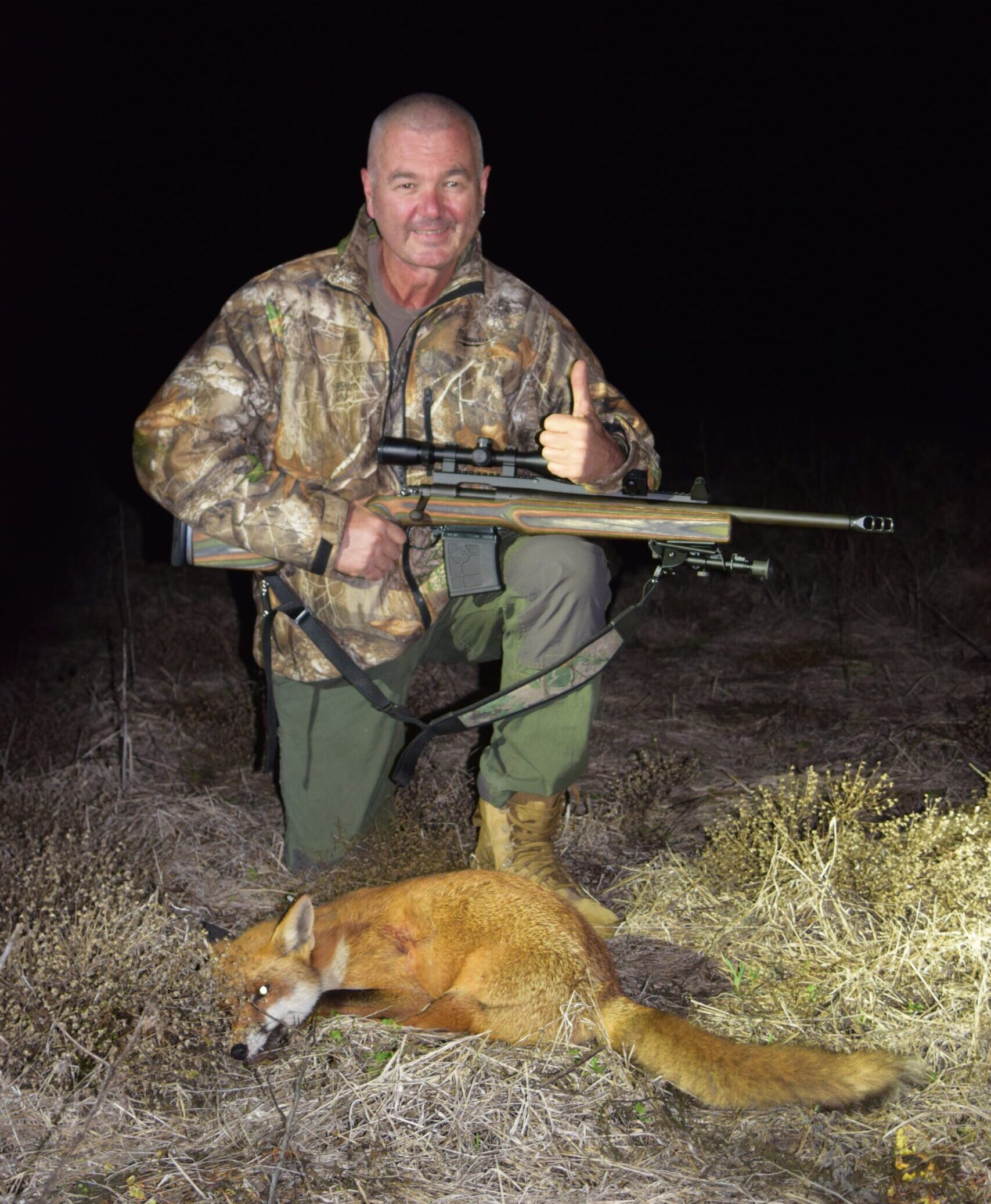
Nevertheless, all was not lost. As we entered the last paddock for the night, Scout’s excited young voice proclaimed: “There, there, right in front, over near the tree.’’ Then we saw it. Caught in the vehicle’s headlights were a set of eyes about 150m directly in front. As dad halted the car, I handed him the spotlight and he tracked the fox as it darted from cover into the paddock of stubble. I took aim, dad whistled, the fox stopped 100m from me. Quartering away, with its head turned looking straight at us, its eyes shone brightly. Taking aim at roughly the 5th rib, I controlled my breathing and ‘Bang’, my new custom-built Remington 700 had just notched up its first feral by putting a .308 sized hole in the fox’s chest.
As for the fox cage trap. It had been working hard while we’d been out. We checked it on the way back to camp and found it had caught an incredibly angry and massive tabby cat. Being around 60cm long from head to hind quarters, with another 25cm of tail, it was almost as long as the trap. Resetting the device, we hopped into the car for a well-earned break before an early start.
Dawn breaks
The following morning, dad and I went for a stalk towards the large dam on the other side of a small ridge near camp. It was an enjoyable day. Hearing the bird songs saying goodbye to the night and hello to the sun is a beautiful thing. Dawn in the Australian bush truly is salve for the soul.


As it turned out, foxes seemed to be more prolific on this property than pigs. Sidling up to the dam, with our backs to the scrub to break up our outline, we spied a fox sniffing its way through the morning dew just 25m away. I wrapped the sling around my arm to increase my own stability by transferring some rifle weight and to reduce elbow movement. Breathe, prep, sight, press – ‘Boom!’ Another fox down. Not surprisingly, it had dropped on the spot. After all, we were looking for pigs and I was loaded with Sierra .308 Win 165gr SBT GameKing ammo from Australian Outback. The sound of the shot reverberating in the hills put paid to any chance of hearing any more of the morning bird chorus I’d been enjoying so much. But my spirits were high.
On the way back to camp, we circled back past the fox cage trap and, lo and behold, it was occupied. I recognised the cat in the trap as one I’d seen on the day we arrived. So, the tally so far was two foxes and two cats a mere 17 hours since our arrival on the property. Not bad – but still not a pig in sight.

Oily goodness
It’s worth having a few tins of oily fish in the tuckerbox, even if you don’t own a fox cage trap. Served on crackers, oily fish in tins are a major source of vitamins and minerals, making them a handy snack while you’re out hunting. And by pouring out the excess oil on an exposed log or rock, you can sometimes lure in an inquisitive cat or fox with the strong smell. Just avoid tins of fish that advertise seasonings like garlic and onions. These are toxic to cats and foxes, and they tend to avoid them.
Husk of hares
The rest of the day was uneventful, so it was back to spotlighting. Still no pigs, but now that we’d dealt with a couple of foxes and cats, it seemed like the fields had come alive – with hares! I was still holding the .308 Win, but in the back seat of dad’s dual cab, was Kath holding the SportCo Model 62A in 22LR.
Off in the stubble, 100m away, I could see the eye shine of a lolloping hare. Dad edged the car closer and from the back seat a young voice piped up: “Daddy, that’s a hare, right?” “Yes honey,” I replied. “Can I shoot it?” asked Scout. It’s just one of those things that puts a smile on your face.
Scout climbed out of the car and took up a position using the car’s bonnet as a rest. Unfortunately, she missed with her first shot. Giving her some encouragement, I told her to take another shot but to slow down and remember to control her breathing. The next shot stopped the hare in its tracks with a good headshot. And this situation was repeated two more times in quick succession. Scout’s first game kills and all clean shots. That smile on my face still hasn’t disappeared.
On the way back to camp, there were a couple of longer shots available that weren’t ideal for Scout. So, I notched up a couple more hares, and it wasn’t until 1.30am that I finished skinning and gutting them all. Then they were neatly bagged-up in the Engel 40L fridge, set to freezer mode. In dealing with the game, I’d taken real care of Scout’s first hare and sent off the skin to Tarween Taxidermy when we got home. It’s great to have the fragile and thin skin tanned as a memento for her first game kill. I also marked the freezer bag which held the hare itself. It subsequently became hare and mushroom pie which was enjoyed all the better for knowing that Scout had achieved the wild harvest.

Target practice
A fantastic opportunity on a rural property is to increase your familiarity and proficiency with your own firearm, even if you’ve already done so at a SSAA rifle range. On arrival, I’d asked the farmer if there was a suitable location to zero-in a rifle and he provided the perfect spot.
I’d had a pair of matching rifles built, in .308 Win for me and .223 Rem for Scout, and while Scout had spent time at our local SSAA range using my Lithgow Slazenger .22LR, she’d not yet used her .223. That’s because I wanted her to gain familiarity with firearms using a single-shot bolt-action firearm with open sights, before moving her onto telescopic sights with the SportCo. Also, for Scout to share her first experience with her Poppy around, after all, he was the one who instructed me on firearms when I was a kid.
While I’d already put three rounds through her rifle at my local SSAA range to make sure I knew where the fall of shot was, zeroing the Bushnell Engage 3-9×40 scope was going to be all up to Scout. And I was super proud to be the person showing her how it was done – and to do that in front of my own dad. I had every confidence that she’d be well positioned to generate the skills to ensure she, like me, could contribute to humane vertebrate pest management efforts in her own right. But even I was surprised at how well she performed.
Scout achieved a grouping the size of a 50-cent piece – 1″ high at 50m – and she did it twice! Dad and I were absolutely delighted. And what a wonderful way to pass by the heat of the day.
Share this article
 Website
 Facebook
Related
Articles


Watagans pest control highlights missed opportunity for recreational hunters
Related
Recipes