

Botswana excursion delivers the goods
This hunt was with Nkwe Safaris in Botswana for six days out of Ghanzi, about a 280km drive south-west of Maun.
The focus was any Cape eland bull, with burchell’s zebras, blue wildebeests, grey duikers, steenboks and jackals also part of my package. I had hunted in Namibia four years earlier, also with elands on my list, but the opportunity to hunt this, the largest bodied of the African antelopes, did not eventuate.
Nkwe’s owner Jaco Visser, who has more than 20 years experience as a professional hunter with all manner of plains and dangerous game, runs the operation. Jaco absolutely knows his stuff. The hunting camp provides tented- and chalet-style accommodation. I stayed in one of the tents which have an outside shower and toilet, a couple of comfortable beds and are bug proof – really all you need for your time in camp.
There is a large, well set-out dining area with seating for 10, containing a bar – with drinks of beer, imported wines and spirits/mixers available. As for the food, I scored that a definite 10/10. It was prepared and served by the camp cook in the guise of Zimbabwe chef Godfrey, who also knows his stuff.
Nkwe has access to several properties, with game plentiful on all that I covered. The first three days of the hunt were conducted on a ‘mere’ 40,000-acre block, that’s an area of about 160 square kilometres. This zone carries about 1000 elands, roughly 40 per cent of which are bulls. There are roughly 600 zebras and who knows how many wildebeest? There are also kudus, gemsboks, blue and black wildebeests, springboks, waterbucks, giraffes, impalas, red hartebeests, ostriches and warthogs. A bird shoot for sand grouse, that are plentiful, is also available.
I hunted for grey duikers and steenboks on an adjoining area, also covering 40,000 acres. The game is all free-range, within the confines of the various blocks. Well-worn boots are needed as there is a lot of walking. Morning temperatures are about 5C with day highs of 25C. That is hot enough and puts the game down for a snooze by noon, when you head back to camp for the second seriously good feed for the day. There’s also the option to stay out all day with lunch in the bush. This depends on what game you are hunting.
Day one
As stated, my focus was on elands, so that’s what we hunted. It was a short story – there were plenty of zebras and wildebeests to contend with, plus many elands that easily ‘bust’ you in the bush, which is flat, dry, sandy and rocky. We walked about 10km for the day. No luck on the opening stint.
Day two
Usual start. We drove into the bush and began walking with Jaco leading the way, me following, then came Ampie, Jaco’s 21-year-old apprentice PH and Tex, aka Mr Magic, the Botswana bushman tracker. There was also a driver Danko, who is on standby for a call to come and collect you with the LandCruiser when required.
After the morning hunt went unrewarded, about an hour later we found zebras and elands mixed together. Elands seem to run ahead of zebras and there will often be wildebeests among them too, so there are plenty of animals that can give you away.
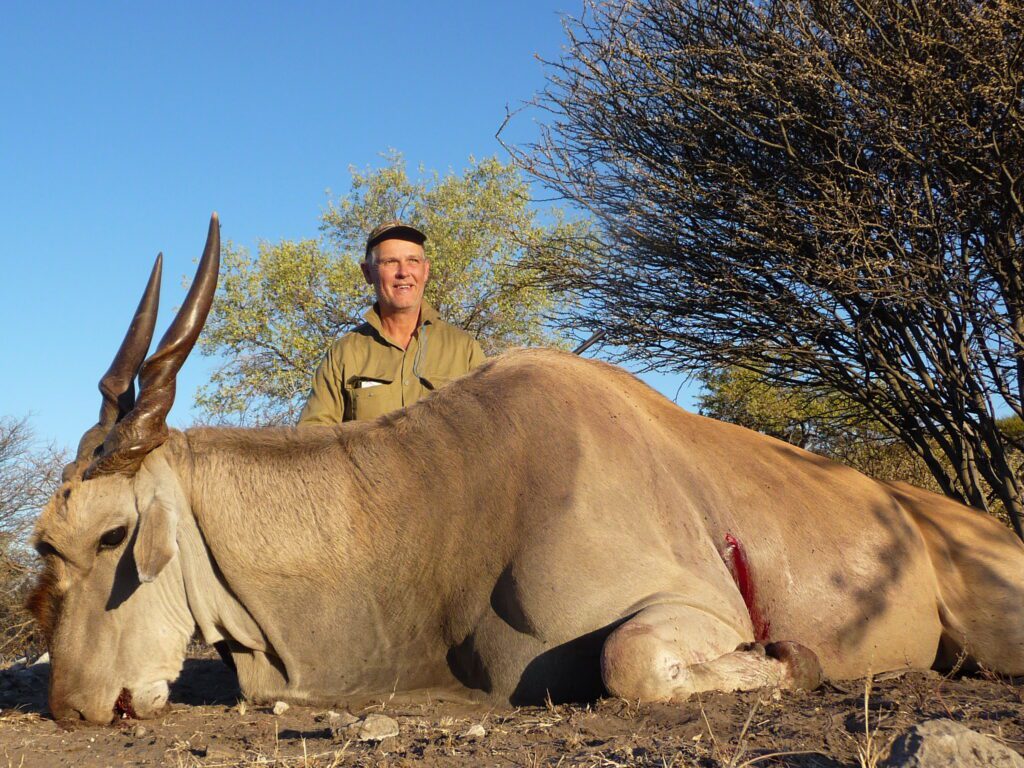
Jaco spotted a couple of bulls among other elands and a bunch of zebras. It’s amazing that a 700-800kg animal can be hard to gain a bead on with a clear shot, but luckily the larger of the two bulls stepped into the clearing, presenting a quick shot opportunity from about 80m. As I was ready on the sticks – a boom and the eland ran off rapidly. I made a good shot and the bull was downed. Dead due to a lung shot. These are huge animals. An estimated weight of 800kg was the reckoning for this one. I called it the 19.6km bull, because that’s how far we walked that day as per the tracking device on Jaco’s phone.
Soon after, seven bushmen arrived in a Toyota tray-back to gut the eland and load it onto the truck by hand with no winch. Off they went to the skinning shed.

I should mention that Jaco provides camp rifles for clients including a .270, 30-06, the 7mm Rem Mag that I used, or a .375 H&H. You only pay for ammo that you use. Alternatively, you can bring your own rifle and ammo, but it will cost you about $250 to import the rifle. Why bother?
Day three
Had an easy day’s start due to the 19km walk yesterday and as I was still jet-lagged from my flight. No hunting luck today.
Day four
This was the day for the blue wildebeest hunt, with the usual start. It was all over in about an hour, as we heard a bull ‘sounding’ (call it a grunt). So we approached cautiously as the bush is dry, but the breeze was in our favour. As we headed towards the wildebeest bull, two mature eland bulls, followed by about another dozen elands, walked right in front of us. They were perhaps 40m off and just stood there for a minute or so. They were merely looking so maybe it was the first time they had seen humans. They moved off and we headed towards the wildebeests.
Five minutes later Jaco spotted the ‘beest’ standing straight on. It was up with the sticks and boom – the shot hit just above the brisket. It was a good wildebeest bull I was told, also known as the ‘poor man’s’ Cape buffalo. The 7mm Rem Mag had done the job again. With correct shot placement it is an adequate calibre for any such plains game animals.
Days five and six
These were spent hunting for the elusive and lightning-fast duikers and steenboks. I did manage to miss a shot on two duikers (we all miss) before connecting with a third which Jaco reckoned could be Safari Club International (SCI) Gold Medal class with horns of 5″. Anything in the 4″ range is a good representative of the species.
These animals bolt at the slightest sound of an approaching vehicle, as we hunted from the back of the Toyota tray (you need the elevation to spot them). If you are really lucky, they might stop for say five seconds, look towards you and then bolt again. You must be super quick to take a shot at what is a relatively small antelope. Although you can hunt them in some quite open areas, there is plenty of bush for them to hide in.
Grey duikers and steenboks are two of the 10 antelopes that go by the tag of the ‘tiny 10’. Although we saw a few steenboks, I didn’t have a chance at a shot. That’s the way it goes. I also had a jackal available as part of the hunt, but we only spotted one that was on the trot, so there was no chance there either.
Overall, I had a great hunt and bagged the main point of my trek – the eland. Jaco estimated it was around 12-years-old and its best days were behind him.
Should anyone be interested in hunting with Nkwe Safaris, please feel free to contact me by email: [email protected] and I can answer any questions and provide a trophy list plus hunting and travel-related information. The best times to hunt are April to August.
Share this article

Related
Articles


Related
Recipes
Sorry, no related items found.