

How to treat hunting wounds properly
In my time as a hunter, I’ve seen possibly every example of embarrassing wounds – lacerations from dirty broadheads, tent pegs embedded in feet, punctures from pig tusks and countless fishhooks lodged in fingers. I’ve also seen the most laughable examples of bad wound care: oily dipstick rags for bandages, tampons stuffed into puncture wounds and pig-dog staples holding together actively bleeding lacerations.
And that’s where any semblance ‘care’ exists at all. Hunters might adopt a relaxed attitude to first aid for a number of reasons:
- The wound is considered too minor to worry about.
- GP appointments are hard to come by in rural areas and Emergency Department wait times are often more painful than the injury itself.
- They, or someone they know, have ‘done a lot worse’.
- The mechanism of injury is somewhat embarrassing.
As a former paramedic, I’ve been complacent about many of my own injuries too – especially for reason three above. I won’t share specific examples – for reason four above – but I’ve learned the hard way that if not treated properly, small injuries can leave a lasting mark even after the wound has closed.
Let’s cover management of common wounds encountered while hunting. Please note: the following treatments should be applied only after active bleeding has been adequately controlled with direct pressure.


High Pressure Irrigation (HPI)
Once bleeding has been controlled, any wound – except punctures – should be cleaned using High Pressure Irrigation (HPI). Direct a high-pressure stream of clean water from the top to bottom of the wound, flushing it thoroughly. Think of washing mud off your 4WD with a pressure washer.
You can use a syringe, a CamelBak bladder with hose or even a zip-lock bag with a small hole cut from the corner. Flush the wound several times until it is visibly free of debris. For stubborn particles, gently wipe the area with clean, moist gauze. Tweezers or forceps from your first aid kit can help remove any remaining bits.
Embedded objects
An embedded object refers to a penetrating object that remains in the flesh/muscle. It should not be removed, and instead, protected from further movement. If a blood clot has already formed around the object, removing it will cause further bleeding and possibly rupture blood vessels, nerves and other underlying structures.
Instead, protect it from further movement by applying a ring pad (donut bandage) over the object. Press the pad snug against all sides and secure it with a bandage. This helps control bleeding and immobilises the object. Evacuate the person as soon as possible or get medical aid to them. Applying a splint can be helpful for self-evacuation or extended evacuation times.

Lacerations
A laceration is simply a cut, often involving deeper tissue as well as the skin. Unless you are trained in wilderness medicine – or are John Rambo – field suturing is not recommended.
The following are:
- Once bleeding has stopped, clean the wound thoroughly using HPI to remove debris. Tweezers or gauze may be needed for stragglers.
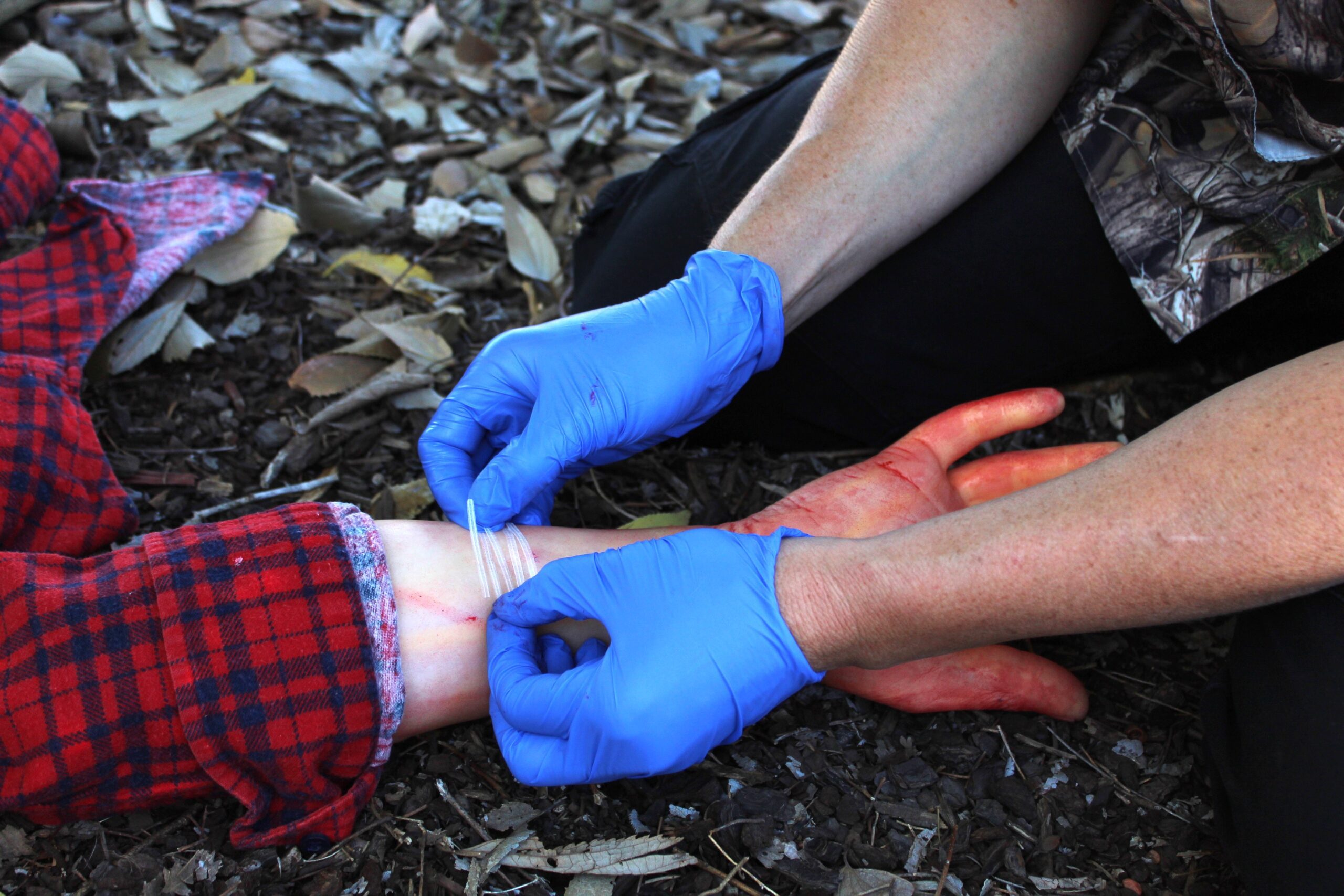
- Small lacerations (less than 1cm wide) can be cleaned and closed with wound closure strips such as Steri-Strips. Pinch the wound edges together and apply strips horizontally along the wound. Cover with a non-stick dressing and bandage securely. Monitor for infection.
- Lacerations wider than 1cm require medical attention. Pack the wound with damp gauze to keep the edges separated and allow healing from the inside out. Cover with a dry non-adhesive dressing, bandage and evacuate for further assessment.


Puncture wounds
Puncture wounds occur when a sharp, thin object penetrates the skin and underlying tissue but exits the wound. Although they may look small and often bleed minimally, punctures can damage deeper tissue and are difficult to clean, making infection a real risk.
Do not perform HPI on puncture wounds; trapped fluid can worsen infection. Instead, clean around the surface with moist gauze and cover with a clean dressing. Never attempt to close a puncture wound and always monitor for infection. Evacuation is recommended, particularly if:
- The puncture is from an animal
- The object was contaminated (eg, broadhead, skinning knife)
- Signs of infection appear
- Particles or fragments remain in the wound
- The wound is near a joint or delicate area.
Attention to prevention
Even the smallest wounds in the bush can become infected. Exercise care when handling sharp objects and treat every cut or puncture diligently. Remember to ‘keep it clean’in the outdoors!
Christie recommends attending first aid training by a reputable provider. This information is general advice. Always operate within your level of training.
Got a question? Reach out to Christie Pisani at [email protected]
Share this article
Related
Articles


What to carry hunting: Essential gear for safety and success

Related
Recipes
Sorry, no related items found.