

Building better hunting habits
Simple things are easily taken for granted. Many tasks are performed without conscious effort, such as opening doors, finding a light switch at night or driving a car. We get away with it using muscle memory developed by repeating common tasks so often we barely think about it.
On the drive into the usual property focused on carbon credits, cattle were observed feeding. A small herd had been introduced to supplement income. One of the calves seemed to have rather short legs. Perhaps it was standing in longer grass or in a shallow depression? The 10x25mm Leupold compact binoculars revealed a boar. A big one! Focus of the trip changed instantly. Guns and ammunition were in their cases with the keys close to hand. My thoughts must have been read as he disappeared into the landscape. However, his image remained to become the target of the hunting effort, more easily thought than accomplished.
Inspection of tracks revealed damage to one of his right rear toes, possibly wear from hard mulga ground or a bullet. Over 11 days that sign was usually found on the south side of one of three channels leading to the black soil flood plains along the river. Further to the west the ground was hard, stony country that didn’t reveal much sign. Close to the river, sign showing the same damage was found along the banks. His preferred home range covered the hard mulga country for shelter and the flood plain for feeding. Animals are like people and prefer to take easy options, so the channel provided the best route for moving around his area.
Gathering titbits of information meant ignoring other pigs. With almost a month on the property, the landscape could be kept undisturbed and still leave enough hunting time at the end of the trip. During this reconnaissance a simple, basic lesson was reinforced that applies to all game hunting. Indigenous hunters advise to ‘walk little and look much’. Often while scouting and inspecting spoor, it was surprising how many times the hunter and the hunted were at the same place at the same time, with neither aware of the other. Only movement, stepping around a bush or snapping a twig underfoot revealed pigs departing the scene.
A useful strategy had been to move slowly through likely country, stopping occasionally to observe the surroundings and even sit on a convenient log for a few minutes, scanning and listening. Game has often emerged from cover, or a grunt has been heard from pigs moving contentedly while foraging. Human vision is pretty good, with both eyes set up for judging distance. Our hearing is also reasonable but not as effective as most animals. Their vision is different to ours in showing detail or colour but eyes on either side of the head deliver a wide field of view, efficient at detecting movement. In addition, their sense of smell is far better than ours. Hunting becomes a challenge between senses and skills of the hunter against those of the prey.
The channels should have been easy hunting, however nature intervened. Tall weeds that sprouted in the previous season had dried out. Moving through them left hundreds of small, thin needle-sharp seeds or spiky seed balls sticking into clothing. The discomfort caused was bad enough but the impact on hunting was worse. It was impossible to move without crushing them underfoot with a grating snap or dragging them against clothing. Sitting and waiting along a channel proved more effective and delivered another lesson. Barely a minute after settling onto a dead branch, a rustle was heard to the left. A medium-sized pig was only a few metres away on the other side of a channel, nosing the ground and easing its way between the reeds. The lesson was noted while the rifle stayed silent.
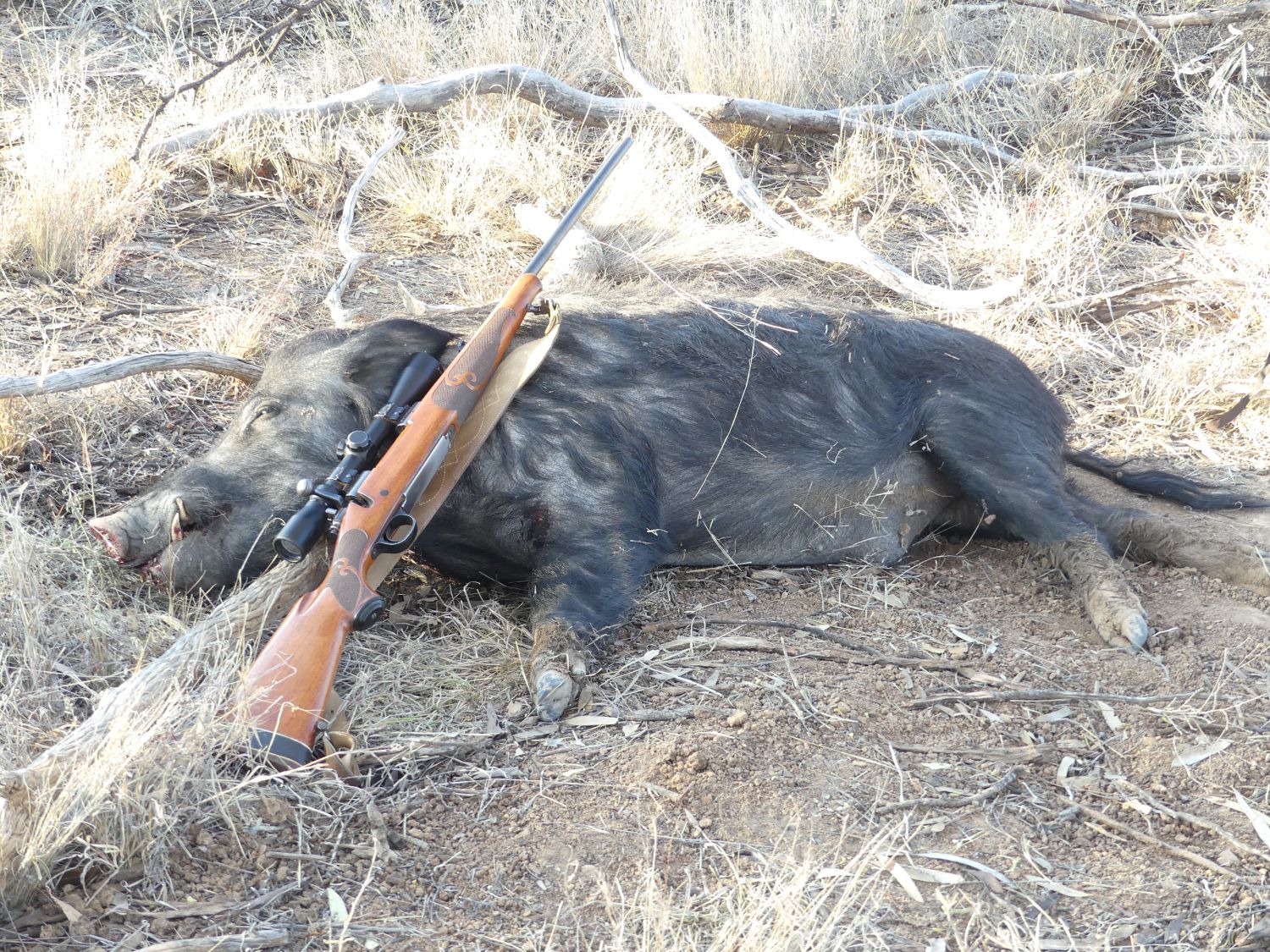
In 37C of heat, a channel was stalked against a faint breeze. A log spied on top of the channel with good sight lines north and south looked ideal to sit and wait a bit. While just settling onto the log, a savage grunt shattered the quiet. From behind an overhanging leafy coolabah branch, a pig emerged, charging up the bank away from a pool of cool water. It was a thumper! Barely seated on the log, the Winchester Model 70 Featherweight was swung up, safety flicked off and cross-hairs settled onto the target. The sight picture looked good, and the rifle fired without conscious thought. Under the worst circumstances muscle memory had kicked in to deliver a perfect instinctive hit into the vital area.

Muscle memory is a form of procedural memory consolidating specific motor tasks through repetition. When a movement is repeated over time the brain creates a long-term muscle memory, eventually allowing it to be performed without conscious effort. This process decreases the need for attention and maximises efficiency within the motor and memory systems. Think of riding a bike or handling a favourite hunting rifle. It will slide into the shoulder, hands finding the correct position while the finger settles on the trigger as the eye focuses on the sights. It’s all one natural, smoothly flowing motion without conscious thought. Muscle memory is found in many everyday activities that become automatic and improve with practice.
Developing any new skill to embed ‘muscle memory’ does not work the way one would expect. When you set a challenge aside for a while and come back, proficiency has increased. It is the breaks between repetitions where the learning action is. By monitoring how neural activity in the brain changes while learning new skills, researchers found that mental ‘instant replay’ after each performance is critical to mastering the skill. The importance of this was missed by scientists for a surprising reason. The ‘mental instant replay’ flashes through the brain 20 times faster than the original experience.
By measuring how much performance improved during training sessions, it was found that skill increased in incremental steps, each repetition getting a bit better than the previous one. Speed and accuracy did not increase during each practice session. Instead, it improved after each rest period. Improvement resulted from whatever the brain was doing during those rest periods. The fact that mastery of any task is improved by providing rest intervals between sessions, as opposed to slogging away with practice sessions one after another, is now well established, as well as the importance of sleep to allow the brain to process new learning.

Two examples spring immediately to mind in recent times. Readers may remember watching an American federal agent draw a handgun in the aftermath of Trump’s first assassination attempt. Seconds of useless fumbling trying to re-holster it ended by keeping it in hand and waving it around in front of an anxious crowd. Another bright idea to make a US vice-president nominee more attractive to male voters resulted in a video of him pheasant hunting. It succeeded in showing him fumble around trying to load a Berretta A400 semi-auto shotgun, designed to be especially easy to handle. At best, both videos were embarrassing. At worst, they illustrated poor training and a lack of muscle memory potentially dangerous to anyone around or to themselves.
While inspecting the fallen pig, a problem emerged. The boar was indeed bigger than usual, 1650mm nose to rump, but both right rear toes showed no damage. He was an exceptional specimen but the wrong one! Another five days of searching, reading sign and covering ground followed. A trail camera was set up over that boar just in case, and the target pig couldn’t resist. His image was captured and served to keep motivating the hunter.


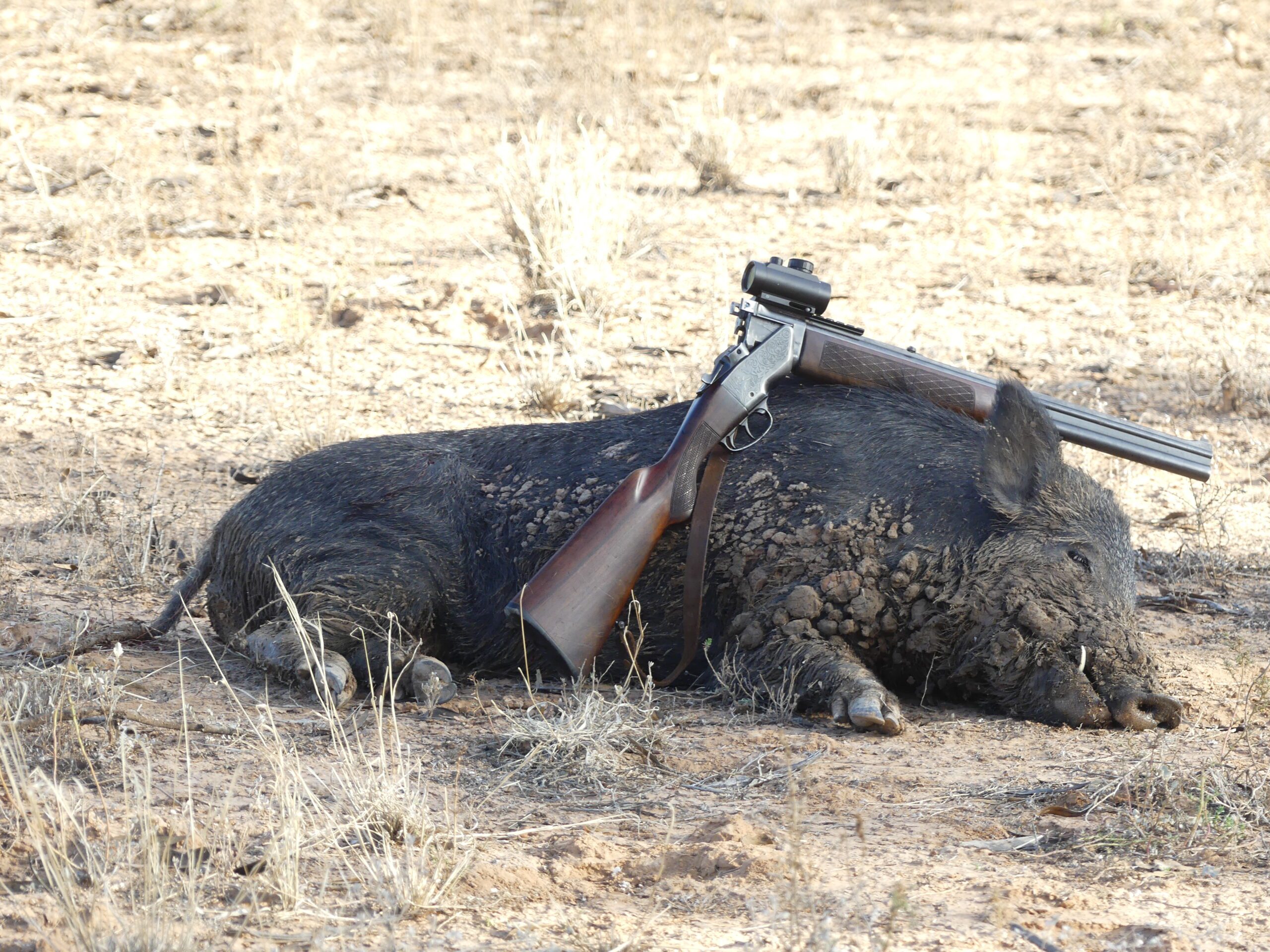
As an aside to pig hunting, cat traps are set up to cull as many of these destructive ferals as possible. To finish them off in the trap, a Brno combination in 7×57 and 12-gauge is used with a .22 rimfire insert for the shotgun barrel. The 8″ length of the insert provides excellent accuracy, however for long shots it needs to be re-zeroed. For finishing trapped feral cats at close range it works just fine. The Brno was used over many years for hunting but has been replaced by the Winchester Featherweight. The Brno still has a role as it is set up for close-quarter hunting using a red dot sight and a 175gr rifle load at 2400ft/sec. The shotgun can be loaded with the full range of 12-gauge ammunition, including solid slugs. Formidable indeed!

On another hot day when cat traps were being checked, inspection with binoculars showed that the flap was closed on one set up near a bore-fed tank. Given the heat, the vehicle was parked in shade and the Brno extracted to finish the job, loaded with a 7×57 round as well as a .22. Approaching the trap revealed a cat curled up awaiting its fate. A deep, thundering grunt grabbed my attention. Among the trees ahead, a large shadow started to move. The Brno was swung up in a familiar movement embedded by previous hunts. The stock felt good as the fore-end came up to meet the other hand. Hunters and competition shooters are prepared to pay small fortunes to acquire a custom firearm designed to fit them perfectly. Quality shotguns are noted for the emphasis placed on fitting the purchaser. The Brno didn’t fit this price range; however, the Czechs are respected for the quality of their work.
Instinct took over and muscle memory became crucial. As a south paw, the gun swung up to my left shoulder and my trigger finger had to first find the Garand-type safety at the front of the trigger guard, flick it forward and then find the correct trigger. The front trigger fires the rifle barrel, and the rear fires the shotgun barrel first followed by the rifle barrel. It’s a neat system and equivalent to a poor-man’s double rifle. If my finger settled on the wrong trigger, the first bullet fired would be a sub-subsonic .22 rimfire, followed a fraction of a second later and probably too late, by the 7mm.
While no longer used as a main hunting rifle, the Brno feels good when in hand. Muscle memory from past years of hunting hadn’t been lost. The 175gr soft point dropped the pig in a cloud of red dust. Inspecting him revealed a boar, a real big one, 1800mm nose to rump, an outlier on the distribution curve of feral pig size in Australia. A right rear toe showed the damage tracked over many days. This was the boar observed on arrival and was dropped at the least expected time. Such is hunting.

Released from the challenge of hunting one pig on 100,000 acres, more were culled, along with a wild dog, a rabbit to slow cook and a fox. Foxes hadn’t been seen for years but favourable conditions allowed them to breed and move up-river. Hunting varies between extremes, from the shot taken using a rest with time to judge range, to the snap shot taken in a second. In the latter situation, muscle memory becomes crucial.
This hunt reinforced the habit of practising firearm handling with deactivated cartridges. Loading with eyes shut, swinging the gun up into the shoulder, opening both eyes to check the sight picture and then unloading with eyes closed develops familiarity with the firearm to maximise safety. It can be done in the privacy of one’s home between hunting trips to embed muscle memory.
Every hunting trip is different as the landscape responds to environmental change. Time is needed to understand the effect on animal behaviour. The challenge is minimised by practising with a favourite firearm, so it becomes an unconscious extension of one’s body. Animals are experts at instinctive response, so to challenge them in the wild, better hunting is achieved by embedding muscle memory into every aspect of our endeavour.
Share this article
Related
Articles


Weipa hunt draws record field
Related
Recipes